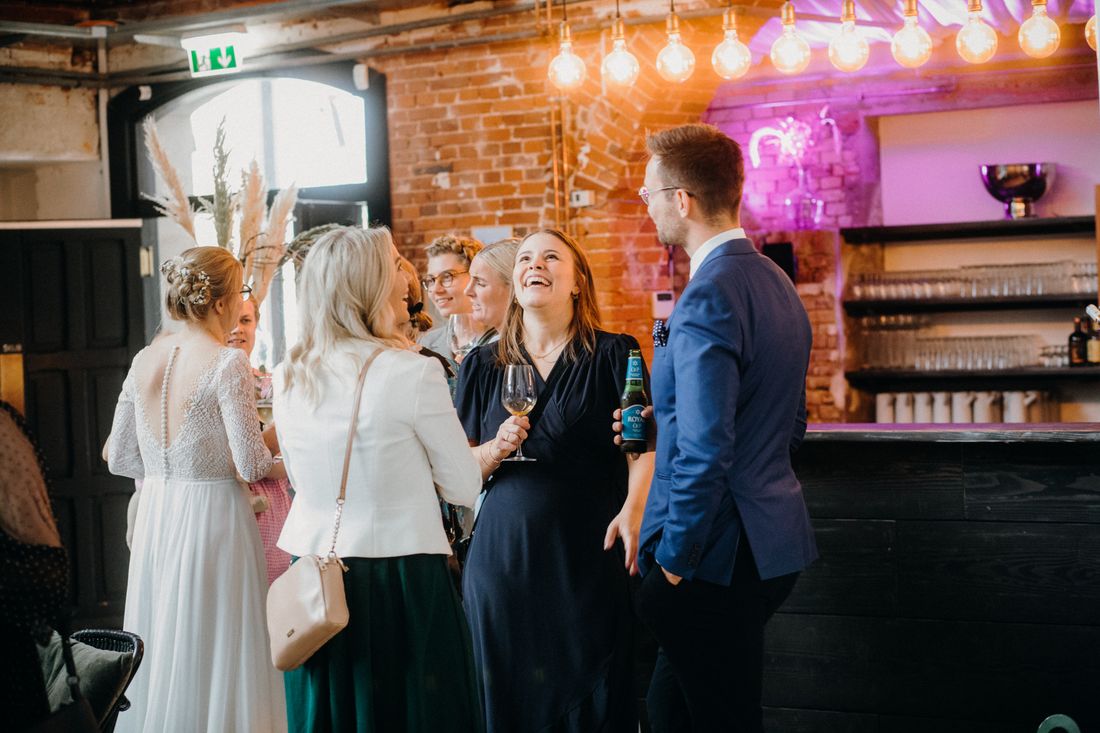
Photo: Core Visuals NYC
Ask me for the shot list on a networking event and I'll tell you there isn't one. No keynote to time, no award to catch mid-handshake, no run of show to check against. The entire program is people standing around talking, which sounds easy to shoot until you're the one standing in the room with a camera and nothing scheduled to point it at.
A networking event has no program, so there's no shot list to fall back on. The photographer has to hunt for one specific thing instead: proof the room was worth walking into. That single goal is what decides lens choice, working distance, timing, and how the photos get used afterward, usually to sell next year's version of the same event.
Table of Contents
- Why a networking event gives you no shot list to fall back on
- What the photographer is actually hunting for in that room
- Why the lens and distance change for a room of small conversations
- How a photographer reads a room with no fixed focal point
- Catching a real conversation instead of a staged handshake
- Why the small details end up mattering more than the wide shot
- Showing a room felt full and worth attending, without inventing numbers
- How networking photos get used again, usually a year later
Why a networking event gives you no shot list to fall back on
A conference has a keynote to time and an award to catch mid-handshake. A networking event has neither. The entire program is people standing in small groups talking, so there’s no sequence of scheduled moments to plan around, only a room that has to be worked continuously, start to finish.
That absence changes the job more than it sounds like it would. On a program with a stage, a photographer can stand in one spot, know roughly when the next moment is coming, and wait for it. A mixer offers no such warning. Conversations start and end on their own schedule, in five or six pockets of the room at once, and none of them announces itself as the one worth catching. The photographer isn't executing a plan anymore. They're scanning constantly, reading body language for the moment a conversation tips from polite into real, and moving before it closes. It's closer to street photography than event photography, run inside one room, for two or three hours, without a single cue from a stage to tell you where to look next.
What the photographer is actually hunting for in that room
With no program to document, the real assignment becomes finding proof the room was worth attending, genuine engagement between people who clearly don't already know each other, not a wide shot of a crowd or a posed handshake for the sponsor banner. That's the single filter everything else in the shoot gets run through.
It sounds like a small distinction, but it changes what counts as a keeper. A wide shot of forty people holding drinks proves attendance, not connection. It could be any room, any event, any year. What actually earns a spot in the final set is two strangers leaning in, one gesturing mid-sentence, the other genuinely reacting instead of waiting for their turn to talk. That's the frame that tells a future attendee this event is worth their evening. In practice, that means walking past a lot of technically fine photos (sharp, well-lit, nobody blinking) because they don't carry that specific signal. The bar isn't image quality. It's whether the photo proves something actually happened between two people in that room.
Why the lens and distance change for a room of small conversations
Shooting conversation instead of a stage means working closer with a shorter lens, because the photographer moves through the crowd itself rather than shooting over it from a fixed riser. A long lens built for a keynote from the back of a ballroom is the wrong tool when the subject is three feet away.
On a stage program, distance is a given. The photographer is often locked to a specific position and a longer lens does the work of getting close without physically being close. A mixer removes that fixed position entirely. Getting a real conversation means standing near enough to read it, which is a different discipline: moving quietly, angling in from the side rather than head-on, and framing fast before a subject clocks the camera and the moment goes stiff. It also means shooting handheld almost the entire night, adjusting for whatever light exists in that pocket of the room, because there's no stage lighting to rely on and no time to set anything up between one conversation and the next.
How a photographer reads a room with no fixed focal point
Without a stage to anchor the room, the photographer has to build a mental map of where energy is actually building (near the bar, by the entrance where new arrivals keep starting conversations, in whichever corner the loudest laugh just came from) and move through that map all night instead of holding one position.
Most mixers have a rhythm even without a program: a slow start while people find their first conversation, a middle stretch where the room is at its fullest and loudest, and a late thinning-out where the remaining groups tend to be the most engaged, because the small talk has already burned off. Reading that rhythm matters more than any single technical choice, since it tells the photographer when to hang back near the entrance for arrivals and introductions, and when to move deeper into the room for the conversations that have had time to get real. Standing still in one good spot might produce a handful of strong frames. Circulating with a sense of where the room's energy actually is produces a set that reads as a full night, not one lucky corner of it.
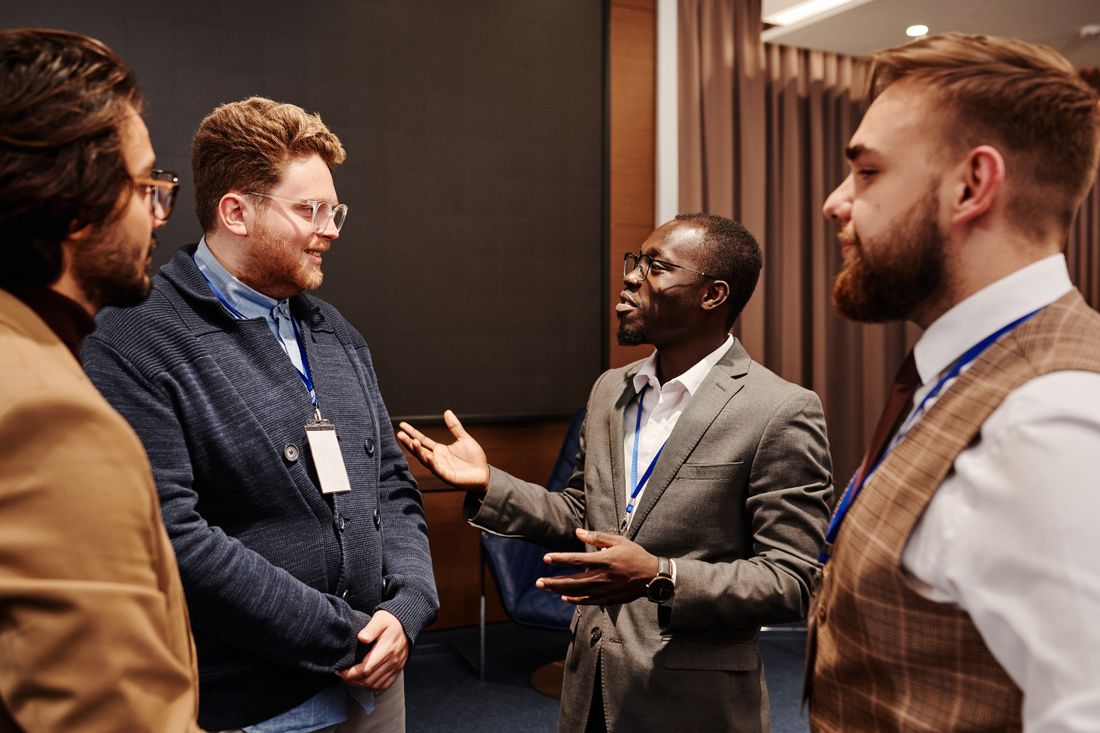
Photo by Henri Mathieu-Saint-Laurent via Pexels.
Catching a real conversation instead of a staged handshake
A staged handshake (two people who stop talking and turn toward the camera on cue) reads as staged instantly, because the body language doesn’t match a real conversation. A genuine exchange looks looser: weight shifted to one side, a drink held off to the angle, attention on the other person, not the lens.
The fix isn't asking people to pose better. It's staying close enough, and patient enough, to catch the conversation that was already happening before the camera showed up, and getting out again before anyone adjusts for it. In practice that means not announcing the shot (no "can I get one of you two") and instead working from a slight angle where a subject's peripheral vision doesn't register the camera as an event. The moment someone notices they're being photographed, their posture changes, even if only slightly, and that shift is exactly what separates a candid frame from a staged one. The best networking photos are almost always the ones the subject didn't know were being taken until afterward.
Why the small details end up mattering more than the wide shot
A name tag being written, a business card changing hands, someone laughing at something just said, these small, specific details do more to prove a networking event worked than any wide shot of the room, because they show the actual mechanism of networking happening instead of just implying a crowd was present.
A wide shot tells a viewer how many people showed up. It doesn't tell them anything happened between those people, which is the entire point of a networking event in the first place. A close frame of two hands exchanging a card, or someone pulling out a phone to save a contact, does that work instead. It's specific enough that a viewer can't mistake it for stock photography or a generic crowd shot from a different event entirely. These moments are also the ones a client actually wants a year later, when they're building a case for the event's value: not "a lot of people came," but "people connected here," shown rather than claimed. Hunting for those small exchanges throughout the night matters as much as covering the room broadly.
Showing a room felt full and worth attending, without inventing numbers
A photo set can make a room feel full and energized through framing and density alone (several overlapping conversations visible in one frame, groups at different depths, drinks and gesture and motion throughout) without the photographer or the final set claiming any specific attendance figure, which isn't something a camera can verify anyway.
This matters because the temptation, especially when a client wants proof the event was well attended, is to reach for language the photos can't actually back up. A photographer's job is to make the room look and feel the way it felt to be in it (busy, warm, worth staying at) through honest composition, not to manufacture a sense of scale that wasn't there. Framing a shot so three or four conversation clusters are visible at once does that job well. So does catching the room from a slightly raised angle near the entrance, where depth naturally reads as fullness. The goal is an accurate impression of a good night, built from real frames, not a number nobody actually counted.
How networking photos get used again, usually a year later
The photos from this year’s mixer typically resurface when a client promotes next year’s version of the same event (a landing page, an email to last year’s list, a sponsor deck), so the frames that matter most aren’t the ones documenting the night, they’re the ones that make someone who wasn’t there want to attend next time.
That later use case is exactly why the hunt for real conversation matters more than broad coverage. A recruiting page or event invite built around a genuine, specific moment (real engagement, real reaction) does more persuasive work than a technically clean wide shot of a full room, because it answers the question a prospective attendee is actually asking: will something worth my evening happen here. Knowing that reuse is coming shapes the shoot itself, even in the moment. It's part of why a photographer keeps working the room past the point of having "enough" safe shots. The frame that sells next year's event might come from the last twenty minutes, not the first hour.
Frequently Asked Questions
How is shooting a networking event different from shooting a conference with a stage?
A conference has a schedule (a keynote, a panel, an award) so the photographer can plan around known moments. A networking event has no program at all; the entire night is unscheduled conversation happening in several pockets of the room at once. That means constant movement and reading body language instead of holding one position and waiting for a cued moment, closer to candid street photography than typical stage-focused event coverage.
Does the photographer pose people or stage handshakes at these events?
Not for a networking event specifically. A staged handshake reads as staged the moment a subject turns toward the camera, since the body language stops matching a real conversation. The stronger approach is staying close enough to catch conversations already in progress and moving on before anyone notices the camera, which produces images that hold up when they're reused for future promotion rather than looking like a posed moment.
What lens and shooting distance work best in a room full of small conversations?
Shorter, faster lenses and closer working distances than a stage program calls for, since there's no fixed photographer position to shoot from and no stage lighting to rely on. The photographer has to move through the room itself, angling in from the side rather than head-on, shooting handheld the entire night, and adjusting for whatever ambient light exists in each pocket of the space rather than one consistent lighting setup.
Should the photographer work the whole room or stay near the bar or entrance?
Both, at different points in the night. Most mixers move from a slow arrival period, through a fuller and louder middle stretch, into a late thinning-out where remaining conversations tend to be the most genuine. Staying near the entrance early catches arrivals and introductions; moving deeper into the room later catches conversations that have had time to get real, rather than staying fixed in one spot for the whole event.
How do networking event photos actually get used after the event is over?
Most commonly they resurface when a client promotes the next version of the same event (on a landing page, in an invite email, in a sponsor deck), which is why frames showing genuine engagement matter more long-term than broad crowd shots. A photo that makes someone who wasn't there want to attend next time does real work; a technically clean wide shot of a full room mostly just confirms people showed up.
Related Reading
Trying to lock down coverage for an event that's still taking shape?
Give us the rough schedule and we'll tell you whether hourly or a package actually saves you money.
See Event Coverage Packages