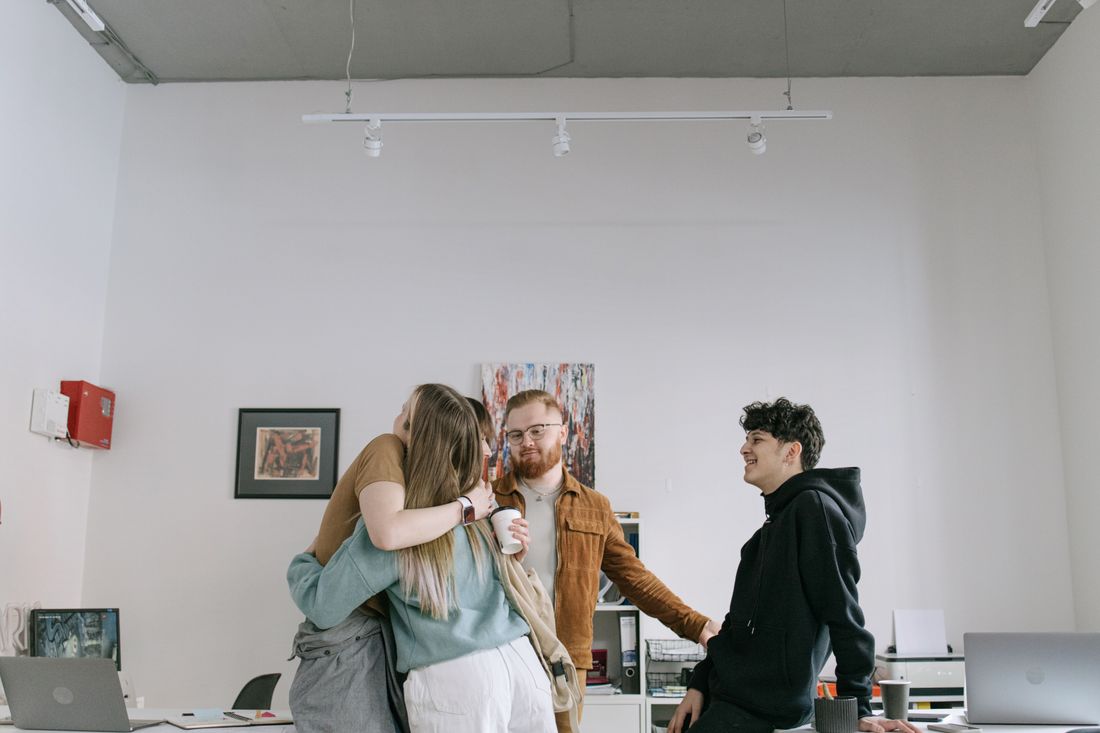
Every event we cover for a company that's been remote for years turns different once we ask one question: has this specific team ever actually been in the same room? A first in-person all-company event isn't a bigger version of the monthly town hall. It's the first time this group becomes real to each other, and that changes what's worth pointing a camera at.
A company's first in-person all-company event after years of remote work needs different coverage than a routine town hall or annual offsite, because the priority isn't the agenda, it's a workforce meeting in person for the first time. Shot lists should center introductions, candid recognition moments, and informal breaks over stage shots and posed groups.
Table of Contents
- Why This First Gathering Isn't Just Another Town Hall
- What Changes When Coworkers Meet Face-to-Face for the First Time
- Building the Shot List Around Introductions, Not Just Sessions
- Candid Connection Over Posed Groups
- The Interstitial Moments: Hallways, Meals, and Breaks
- Documenting Leadership Without Making It a Corporate Video
- What the Footage Gets Used For After the Event
- Planning Coverage Timeline and Crew Size for a First-Ever Gathering
Why This First Gathering Isn't Just Another Town Hall
A company's first in-person all-company event after years of remote work carries different stakes than a routine annual town hall, because it's the first time a workforce that formed entirely on video calls actually stands in the same room. Coverage needs to plan for that fact before it plans for the agenda.
A recurring town hall documents continuity: the same faces, a familiar format, an update on numbers everyone already half expects. This isn't that. Many people on the invite list have never seen a coworker's actual height, actual laugh, or actual handshake. The room itself is the news, not just whatever gets said from the stage.
That distinction should shape the shot list from the first planning call. A photographer walking in expecting a standard corporate event will default to stage shots and slide grabs. A photographer who understands this is a one-time milestone will prioritize something else entirely: the moment two people who've only ever seen each other in a grid of video tiles actually shake hands.
What Changes When Coworkers Meet Face-to-Face for the First Time
What changes is the emotional register of the room. People who have worked together for months or years on video calls are meeting for the first time, and that first meeting carries a mix of nerves, curiosity, and genuine excitement that a routine internal event never produces.
Someone who has only known a colleague as a name on Slack and a small rectangle on a video call is about to find out how tall they are, what their actual voice sounds like without a laptop speaker flattening it, whether the dry humor in their messages matches their in-person delivery. Those small discoveries happen constantly throughout the day, usually quietly, usually between two people rather than on a stage.
We treat those private discoveries as the real content of the day. A wide shot of the general session tells people the event happened. A candid frame of someone's face mid-recognition, the exact second a name becomes a person, tells them what it felt like.
Building the Shot List Around Introductions, Not Just Sessions
The shot list for a first in-person gathering should be built around introductions first and agenda sessions second, because the sessions are the part everyone already expects to see documented. The introductions are the part that will never happen again in quite this way.
Most event shot lists start with the obvious structural beats: opening remarks, breakout sessions, the closing toast. Those still matter here, but they shouldn't anchor the list. Anchor it instead around the specific pairs and small groups most likely to be meeting for the first time.
Ahead of the event, we ask organizers a simple question: which teams have been fully remote and never shared a room? Which new hires have only met their manager on a screen? Those answers point coverage toward the introductions that are actually going to happen, rather than hoping to catch them by accident once the day starts. We turn that list into a working sheet the day-of crew actually carries, not something that lives only in a planning email and gets forgotten once the doors open.
Candid Connection Over Posed Groups
Candid coverage matters more at a first-ever gathering than at a routine one, because the genuine reactions on this specific day, the double-take, the relieved laugh, the surprised hug, can't be recreated with a posed group photo later.
A posed team photo still belongs in the deliverable set. It's useful for a careers page, an internal newsletter, a slide in next year's kickoff deck. But it isn't where the emotional weight of the day lives, and treating it as the priority shot means missing everything that actually made this event different from a normal one.
We work the room the way we'd work a wedding reception rather than a conference: staying mobile, watching body language for the moment before a reunion actually happens, positioning early rather than reacting late. A recurring internal event can be shot on a predictable rhythm. This one can't, because nobody, including us, knows exactly which introductions are about to happen or when. That unpredictability is a feature of the day, not a scheduling problem to solve, and the coverage plan should treat it that way.
Photo by RDNE Stock project via Pexels.
The Interstitial Moments: Hallways, Meals, and Breaks
The interstitial moments, hallway conversations, shared meals, and breaks between sessions, matter as much as the formal agenda at a first in-person gathering, because that's where most of the actual meeting happens between people who have never shared a room before.
Formal sessions put people in rows, facing a stage, not facing each other. The bonding a company hopes this event will produce happens in the gaps: a coffee line conversation, two people from different departments ending up at the same lunch table, someone lingering after a breakout because the conversation wasn't done.
Those moments are easy to under-resource because they look less urgent on a schedule than the keynote. We plan explicit coverage windows for them anyway, treating breaks and meals as scheduled shooting blocks rather than downtime between the parts that matter. That means having a photographer stationed near the coffee line at the exact moment the first break lets out, not walking over once the hallway has already thinned.
Documenting Leadership Without Making It a Corporate Video
Leadership still needs to be documented at a first in-person gathering, but the coverage should show them mingling and listening as much as presenting, because a room meeting its leaders in person for the first time cares more about approachability than polish.
A CEO or founder who has only existed as a face on a company-wide call is, for many employees, meeting a stranger too. How that person moves through the room, whether they seek out individual conversations or stay near the stage, says more to the room than another slide of quarterly goals.
We prioritize frames of leadership actually talking with individual employees over frames of leadership at a podium. A single candid photo of a founder crouched down mid-conversation with a new hire tends to do more for how the company is remembered than a dozen well-lit stage shots. It also tends to be the frame leadership itself asks for again a year later, once the polished keynote shots have blurred together.
What the Footage Gets Used For After the Event
Footage from a company's first in-person gathering usually gets reused for longer than a standard internal event's coverage, because it becomes a reference point, the day the team actually met, cited in recruiting materials, onboarding decks, and the next kickoff for a long time afterward.
A routine town hall's photos rarely outlive the quarter they were taken in. A first-ever gathering's photos tend to have a longer shelf life, because they document something that won't repeat: the specific day a remote-first company became a company that had actually met.
We deliver this kind of event with that longer horizon in mind: organized folders by moment type rather than one long dump, a short highlight edit that can go straight into a recruiting page or an all-hands recap without anyone having to re-cut it, and a few portrait-style frames of leadership that will still look current a year later. A company that's planning to grow past this first gathering usually treats it as the opening entry in an archive, not a one-off.
Planning Coverage Timeline and Crew Size for a First-Ever Gathering
A first in-person all-company event usually needs more coverage time and a slightly larger crew than a routine annual event of the same size, because so much of what's worth capturing happens in unplanned moments across the entire day rather than during a few scheduled sessions.
A predictable internal event can often be covered by one photographer working a known rundown. A first-ever gathering benefits from arriving earlier, staying through the informal wind-down, and, depending on headcount, pairing a photographer with a second shooter so simultaneous introductions in different corners of the venue don't have to compete for the same lens.
We scope crew size and hours around headcount and venue layout rather than defaulting to a standard package, because a 40-person team meeting for the first time in one room needs different coverage than a 400-person team spread across a full conference floor doing the same thing. That conversation happens before any package gets locked in, not after, since it's the venue map and headcount that actually determine how many hands are needed on the day.
Frequently Asked Questions
How is a first in-person all-company event different from a regular town hall for photo and video coverage?
A regular town hall documents continuity for people who already know each other; a first in-person gathering documents a workforce meeting in person for the first time. Coverage should prioritize introductions, candid recognition moments, and hallway conversations over stage shots and slide grabs, since the event itself, not just what gets announced from the podium, is the actual story worth capturing. The shot list should reflect that from the first planning call, not get adjusted mid-event.
Should a first in-person company event still include a posed group photo?
Yes, a posed team photo still belongs in the deliverable set, useful for a careers page or a future kickoff deck. But it shouldn't be the priority shot. The event's real value is in candid, unscripted moments, coworkers recognizing each other in person for the first time, which a posed photo can't recreate once the day is over. Both should be planned for, in that order of priority.
How much coverage time does a first in-person gathering need compared to a routine internal event?
More than a routine annual event of the same size, since so much worth capturing happens in unplanned hallway and meal moments rather than a few scheduled sessions. Arriving early and staying through the informal wind-down matters more here than at a predictable town hall, and larger headcounts often benefit from a second shooter to cover simultaneous introductions across the venue at once.
Should leadership be photographed differently at a first in-person all-company event?
Leadership should still be documented, but coverage should favor them mingling and listening over podium shots. For many employees this is also the first time meeting a founder or executive in person, and a candid frame of a leader in genuine conversation with an individual employee tends to say more about the company than another well-lit stage photo ever will.
What happens to photos and video from a company's first in-person gathering after the event?
This kind of footage typically has a longer shelf life than a routine internal event's coverage, since it documents something that won't repeat: the day a remote-first team actually met. Companies commonly reuse it in recruiting materials, onboarding decks, and the following year's kickoff, which is why organizing files by moment rather than one dump matters more here than usual.
Related Reading
Not sure if hourly or a package makes more sense for your event?
Tell us the expected length, and we'll run the actual numbers before you book.
See Event Coverage Packages