Photo: Core Visuals NYC
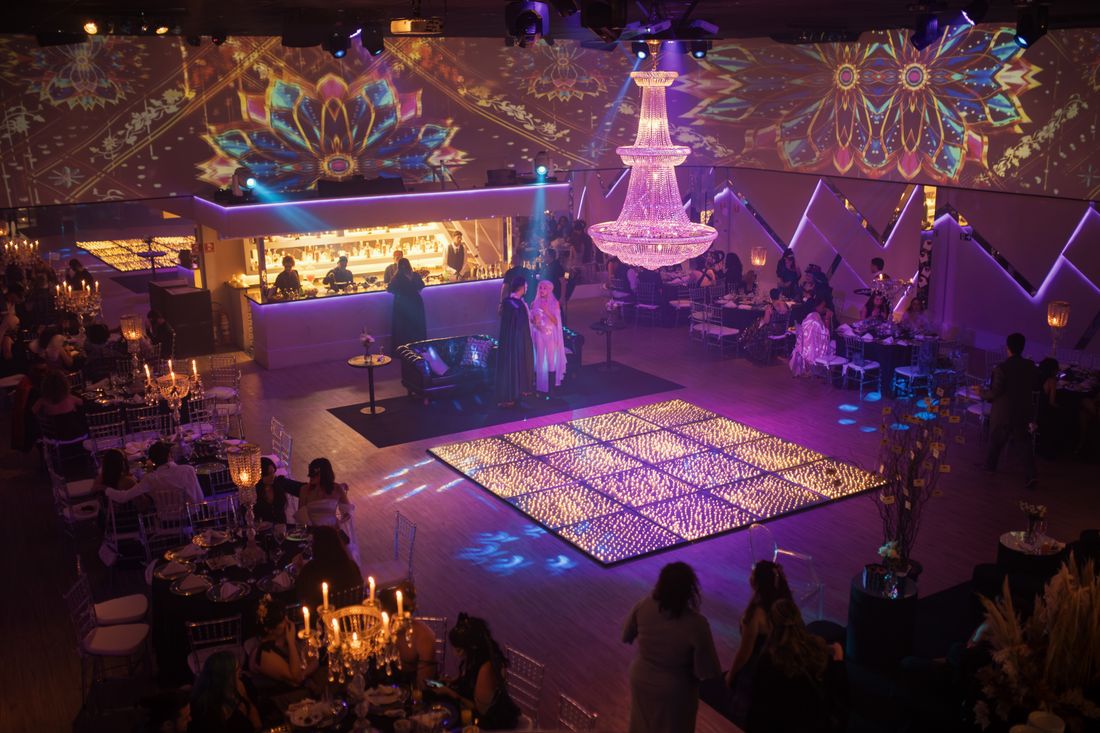
Dark doesn't have to mean grainy. That's the part clients usually don't believe until they see it, because their own experience is a rooftop lounge or a dim restaurant private room turning every phone photo into a smear of noise and motion blur. The room isn't the problem. What's pointed at it is.
Grainy event photos come from a camera being forced to boost its sensor's sensitivity (ISO) to register an image in low light, which amplifies noise along with the picture. Blurry ones come from a shutter speed too slow to freeze motion. Both are solvable with the right lens, exposure choices, and flash technique, not luck or a better phone.
Table of Contents
- Why dim venues make phone and point-and-shoot photos look grainy
- What a fast lens actually buys you in a dark room
- How much ISO a current full-frame camera can actually hold
- The exposure tradeoff between aperture, shutter speed, and ISO
- Bounce flash vs. direct flash, and what to do when neither ceiling bounces
- Mixed and coloured stage lighting, and why skin tones shift
- Why some low-light photos are blurry, not just grainy
- What editing can fix afterward, and where the real limit sits
- Questions worth asking a photographer before you book a dark venue
Why dim venues make phone and point-and-shoot photos look grainy
A photo turns grainy in a dark room because the camera boosts ISO, its sensor's sensitivity, to register an image from very little light, amplifying noise along with the picture. Phones push ISO hardest, since their sensors are tiny, which is why a rooftop shot often looks worse from a phone than a dedicated camera in the same room.
Phones try to hide this with computational tricks, stacking several frames together and smoothing out noise algorithmically, and in decent light that works well enough. In a genuinely dim venue those same tricks tend to smear detail instead of sharpening it, so a face can look almost painted rather than photographed. A larger camera sensor gathers more light per pixel to begin with, so it doesn't need to push ISO nearly as hard to reach the same brightness. That difference in sensor size is doing more work than most people assume when they compare a phone shot to a professional one from the same dark room.
What a fast lens actually buys you in a dark room
A fast lens has a wide maximum aperture, something like f/1.4 or f/1.8, instead of the f/3.5 to f/5.6 range typical of a basic zoom, which lets in several times more light at the same shutter speed and ISO. In practice that's the single biggest lever a photographer has in a dim venue, often bigger than the camera body itself.
Event work leans on fast primes specifically because that extra light-gathering ability means less need to crank ISO, which keeps noise down without slowing the shutter enough to invite motion blur. The tradeoff is a much shallower depth of field. At f/1.4 the zone that's actually in focus can be inches deep, so a subject leaning forward mid-sentence can drift out of focus fast. That's a discipline problem, not an equipment problem: it takes a photographer used to focusing fast and re-focusing constantly through a conversation, not just someone who bought the lens. Owning a fast lens and knowing when its narrow focus zone will work against a moving subject are two different skills, and the second is the harder one to shop for.
How much ISO a current full-frame camera can actually hold
This is the question most people frame wrong. It isn't "can the camera go dark enough," it's "how far can ISO climb before the noise becomes the photo instead of a texture in it." Current full-frame bodies hold detail cleanly well past the range a phone sensor can survive, and modern noise-reduction software has pushed that ceiling higher still without softening the image the way older tools did.
Where that ceiling actually sits depends on the sensor, the lens in front of it, and how much detail the final use needs. A file bound for a web gallery tolerates more noise than one that's getting printed large. What matters for a client booking a dim venue isn't a specific number, it's whether the photographer treats a high ISO as a controlled, expected tool for that room rather than a last resort they're embarrassed to reach for. A photographer who hesitates to raise ISO when the room actually calls for it usually hands back photos that are underexposed instead of merely grainy, and underexposed is much harder to recover than grain.
The exposure tradeoff between aperture, shutter speed, and ISO
Every exposure in a dark room is a three-way tradeoff: a wider aperture lets in more light but narrows focus, a slower shutter lets in more light but risks blur, and a higher ISO brightens the image but adds noise. Push one dial too hard to protect the others and the photo breaks in a different, specific way.
In practice, a photographer working a dim venue typically opens the aperture as wide as the lens and the moment allow, then holds shutter speed at whatever's fast enough to freeze the kind of motion actually happening, a toast is slower than a dance floor, and lets ISO absorb whatever light is still missing after those two decisions. That order matters. Someone who defaults to raising ISO first, before maxing out aperture and shutter room, ends up with more noise than the venue actually required. It's a judgment call made shot to shot, not a fixed setting dialed in once at the door.
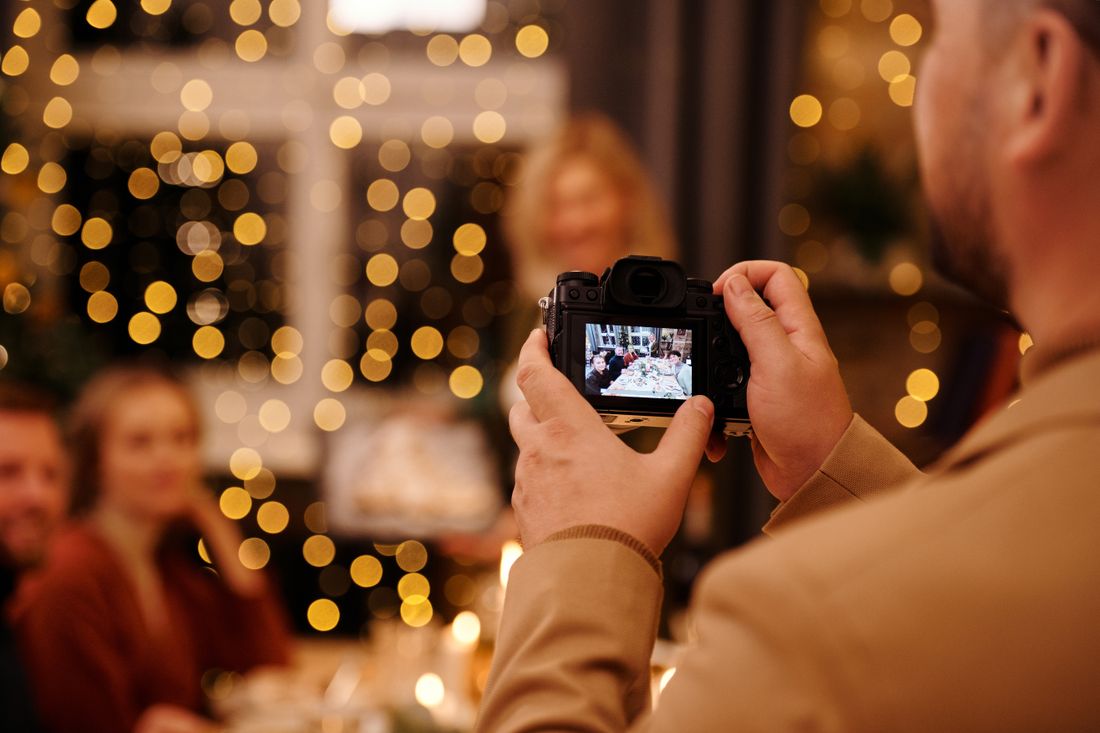
Photo: Core Visuals NYC
Bounce flash vs. direct flash, and what to do when neither ceiling bounces
Direct, on-camera flash blasts light straight at a subject, flattening faces and throwing a hard shadow behind them. It's the harsh, washed-out look most people associate with flash and want to avoid at a nice venue. Bounce flash redirects that light off a ceiling or wall first, reaching the subject softened and from a more natural angle.
Bounce only works with something light-colored and reasonably close overhead to bounce off, which rules out a lot of the venues that make NYC event spaces distinctive: a black-ceilinged loft, an industrial space with exposed rigging, a gallery with a soaring dark ceiling, or a rooftop with open sky above the group. In those rooms the light simply has nothing to reflect off, so bounce flash either does nothing or throws an ugly hot spot straight down. The better call there is usually no flash at all: lean on a fast lens and a higher ISO instead, and accept a slightly grainier frame in exchange for keeping the venue's actual light and color intact. Reading which of those two situations a given room falls into is itself part of the job, and it should happen on a walk-through before guests arrive, not mid-event.
Mixed and coloured stage lighting, and why skin tones shift
Most dim NYC venues mix light sources with different color temperatures in the same frame: warm string lights, cool overhead fixtures, and colored stage or bar lighting that can swing the whole room blue, magenta, or amber depending on the cue. A camera has to make a single judgment call about which of those sources the photo should read as true to, and it can only pick one.
Get that call wrong and skin tones shift orange or blue in a way that looks like an editing mistake rather than the room's actual character. Colored stage light is the hardest version of this problem, since it isn't really wrong, it's the room's intended look, and flattening it out entirely can make a photo feel less true to the night than leaving some of the cast in. In practice this is less about one correct setting and more about walking the room before the event starts, noting what's lighting it and from where, so exposure and white balance decisions during the event are informed instead of improvised on the fly.
Why some low-light photos are blurry, not just grainy
Grain and blur come from different failures and get fixed differently. Grain is a noise problem from too little light reaching the sensor. Blur is a timing problem, the shutter stayed open longer than the motion in front of it allowed, so a hand mid-gesture or a body mid-turn smears across the frame instead of freezing.
A dance floor or a toast with raised glasses needs a meaningfully faster shutter than a seated conversation, which means the exposure has to lean harder on aperture and ISO to compensate, since shutter speed isn't the dial available to give in that moment. This is where relying on a phone or an inexperienced shooter shows up most clearly: a slow shutter can still produce a bright, clean-looking photo on the camera's small screen, and only later, viewed full-size, does the blur become obvious. Reading how fast the actual motion in the room is, moment to moment, and adjusting shutter speed for it is a big part of what separates usable low-light coverage from unusable.
What editing can fix afterward, and where the real limit sits
Noise reduction in editing can meaningfully clean up a grainy but sharp, well-composed photo. Modern software is genuinely good at separating noise from detail. What editing generally can't fix is motion blur, a badly blown-out highlight, or a shot that was out of focus to begin with. Software can soften those problems slightly but not undo them.
The real limit isn't a camera spec, it's what happened in the room during the fraction of a second the shutter was open. A photographer who nails focus and shutter speed hands off files that editing can polish into something clean and true to the night. A photographer who leans on fixing it in post as a plan going in is describing a workaround for a problem editing was never built to solve. The gap between those two outcomes is decided during the event, not afterward at a desk, which is worth knowing before booking so expectations match what a dim-venue shoot can actually deliver.
Questions worth asking a photographer before you book a dark venue
Before booking a rooftop lounge, black-ceiling loft, gallery, or club-style space, it's worth asking a photographer directly how they handle low light rather than assuming every event photographer is equally comfortable in a dim room. A few specific questions do more than a general "do you shoot in low light" ever will.
Worth asking: what aperture their main lenses shoot at, since anything at or wider than f/2.8 signals real low-light capability. Whether they plan to use flash in this specific venue, and if so, bounce or direct, a photographer who's actually thought about the room will have an answer, not a shrug. How they handle a dance floor or a toast versus a seated conversation, since that reveals whether they think about shutter speed at all. And whether they've shot a comparably dim space before, since that kind of hands-on experience is what turns exposure decisions from guesswork into instinct once the room's actual light is in front of them.
Frequently Asked Questions
Why do my phone photos from a dark venue look so much noisier than a professional's?
Phones push ISO harder than dedicated cameras because their sensors are much smaller and gather less light per pixel, so they need a bigger sensitivity boost to reach a usable brightness in a dim room. That boost is what creates visible noise. A larger camera sensor paired with a wide-aperture lens needs far less ISO to hit the same exposure, which is the main reason the same dark room looks cleaner through a dedicated camera.
Does a photographer need special equipment to shoot a rooftop lounge or gallery at night?
The main requirement is fast, wide-aperture lenses, typically f/1.4 to f/2.8, since that's what lets a camera gather enough light without pushing ISO into heavy noise or slowing the shutter into blur territory. A capable flash for occasional bounce use helps in some rooms. It's less about a long gear list and more about a photographer who's comfortable making exposure judgment calls quickly in changing light.
Our venue has black ceilings and nothing to bounce flash off. What happens then?
Bounce flash needs something light-colored and close overhead to work, so a black-ceiling loft or a soaring gallery ceiling takes that option off the table. In that case a photographer typically skips flash entirely and leans on a fast lens and a somewhat higher ISO instead, trading a small amount of extra grain for keeping the room's actual light and color intact rather than fighting it.
Will using flash ruin the mood of a dim, atmospheric venue?
Direct, on-camera flash can, since it flattens the room's actual lighting and throws hard shadows that erase the atmosphere a client often booked the venue for. Bounce flash off a ceiling or wall is softer and less disruptive, but only works in venues with something light-colored nearby to bounce off. In open, dark-ceilinged, or cavernous spaces, many photographers skip flash entirely and lean on a fast lens and higher ISO instead.
Can grainy or blurry low-light event photos be fixed afterward in editing?
Grain from high ISO can usually be cleaned up well with modern noise-reduction tools, since software is genuinely effective at separating noise from real detail. Motion blur, badly blown highlights, and out-of-focus shots are much harder to fix and often can't be fully recovered. That's why getting exposure and shutter speed right during the event matters more than counting on an edit to rescue it later.
Related Reading
Trying to lock down coverage for an event that's still taking shape?
Give us the rough schedule and we'll tell you whether hourly or a package actually saves you money.
See Event Coverage Packages