Photo: Core Visuals NYC
Trade show booth photography is the ask I hear most from first-time exhibitors: a photographer on the floor for the hours the booth is staffed, delivering proof the space and the travel budget actually worked. It used to be a scoped-down slice of our general event coverage. It's now its own fixed product, built around trade show hours and trade show turnaround, because exhibitors need files back while the show is still running, not a week later.
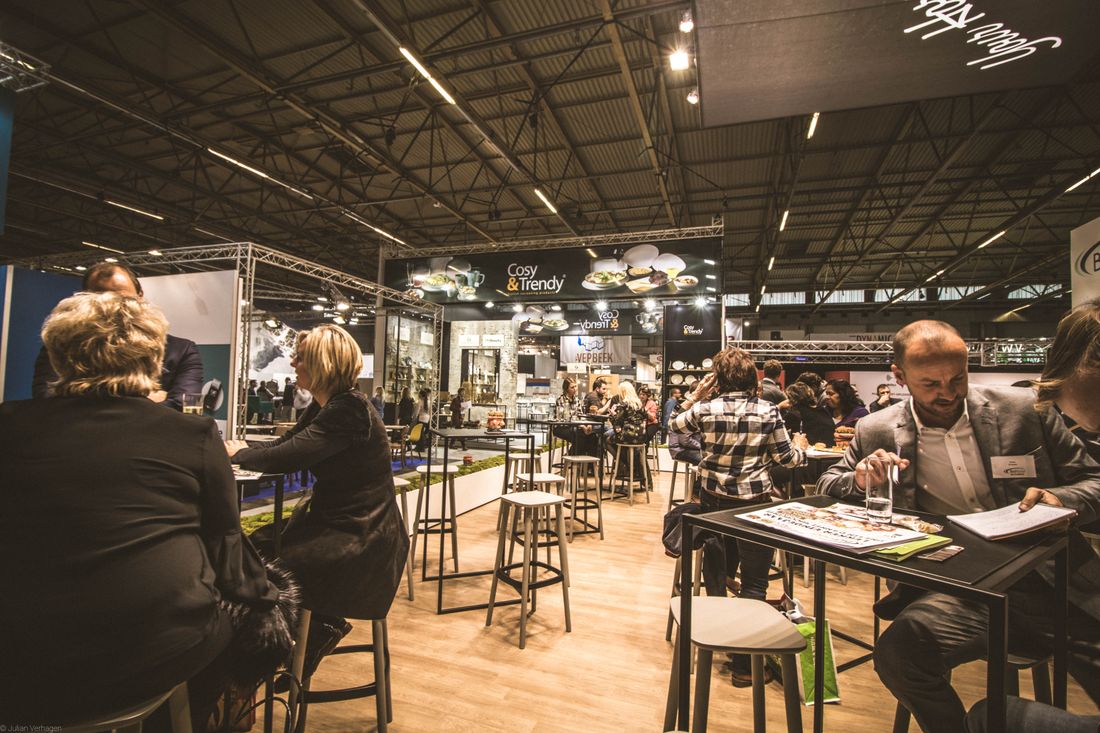
Trade show booth photography documents the booth itself, empty and clean before the floor fills, plus staff engaging real visitors, product and demo detail, and signage sharp enough to prove the booth ran. Photographers covering a trade show booth now book it as a fixed package with same-day or next-day delivery, not a scaled-down version of a full event shoot.
Table of Contents
What trade show booth photography covers
Trade show booth photography covers four things: the booth design itself, staff actually talking to visitors, product or demo close-ups, and enough of the signage and any badges in frame to prove which show this was and that your team was on the floor for it. That last part matters more than exhibitors expect. A gallery with no legible signage is hard to use in a sponsorship renewal deck or an internal report, no matter how good the individual photos are.
A trade show booth booking now includes a short vertical video clip in every package, not just stills. That's a change from a couple years ago, when a photo-only shoot meant carving a narrower scope out of our standard event coverage. The dedicated trade show product bundles a few vertical clips in with the photos because most exhibitors want something to post to social before the show floor even closes for the day, and it doesn't add meaningfully to the shoot time.
Get the clean booth shot before the floor fills
The cleanest shot of the booth's actual design, signage, layout, and lighting, happens right when the floor opens, before visitor traffic and neighboring booth activity start cluttering the sightlines. This is often the shot used in a post-show recap, next year's sponsorship pitch, or an internal report on what the booth investment looked like, so it needs the signage legible, not just present in the frame somewhere.
Waiting until the floor is busy to get this shot usually means settling for a compromised version, with visitors or a neighboring booth's signage crowding the frame. Ten minutes right at floor-open, before you're pulled into greeting the first visitors, is the planning step that makes the difference in the final gallery.
A common miss: bringing the photographer in after the floor is already busy, then finding there's no clean shot of the booth itself in the final gallery, only versions crowded with foot traffic and other exhibitors' signage.
Staff and visitor interaction, not staged smiles
Once the floor is open, the priority shifts to genuine staff-visitor interaction: someone explaining the product, a demo drawing a small crowd, a real conversation at the booth table. These shots work best unposed. Visitors don't know they're part of the coverage, and staff are focused on the conversation rather than the camera, which reads as far more credible than a lineup of people smiling at the lens.
A photographer covering a trade show booth needs to stay unobtrusive for this part, shooting from a slight distance with a longer lens instead of stepping into the conversation, so visitors never feel like they're being photographed for marketing material mid-pitch. That distance is part of what keeps the resulting images honest instead of stiff. It's also why we shoot in short, repeated bursts across the day rather than one long block. Booth traffic ebbs and flows on its own schedule, and the strongest interaction shots are rarely the ones you can plan for in advance.

Photo: Core Visuals NYC
Multi-day shows and shift changes
A multi-day trade show often means booth staff rotate across the run of the show, different people working morning versus afternoon shifts, or a different team on day two than day one. Booth photography benefits from capturing that rotation instead of assuming the same faces appear in every shot, since the finished gallery usually gets used to recognize the full team's presence, not just whoever happened to be staffing the booth when the photographer showed up.
Flag the staffing schedule to us ahead of a multi-day show. Knowing the shift changes lets us plan coverage windows around them, so the gallery reflects the actual full team involved rather than one shift standing in for the whole event.
What it costs and how fast files come back
Trade show booth coverage is now two fixed packages, both scoped to up to three hours: Same-Day Social Coverage, shot on iPhone, delivers twenty to thirty edited photos plus the organized raw vertical clips and one twenty to thirty second reel, same day, for nine hundred fifty dollars. Professional Photo + Video, shot on a mirrorless camera, delivers fifty to seventy edited photos, a thirty to forty five second vertical recap, and ten same-day selects, with the full set following within forty eight hours, for one thousand eight hundred fifty dollars.
A booth that needs more than three hours of coverage, or coverage across several show days, gets quoted against the actual schedule rather than a flat per-day multiplier. If you're also running a headshot station in the booth for lead capture, that's priced and booked separately: the trade show tier of that product covers multi-day, multi-station setups for one hundred fifty or more guests, from eight thousand dollars, with delivery rolling across the run of the show instead of all at once.
What the gallery gets used for after the show closes
Beyond the immediate post-show recap, booth photography tends to have a longer shelf life than exhibitors expect going in. A strong booth-design shot becomes reference material for next year's design decisions. A genuine interaction photo becomes a testimonial-adjacent social post. The full gallery becomes evidence for a sponsorship renewal conversation or an internal budget review arguing for returning to the same show.
Treating the shoot as single-use content undersells what a well-executed booth gallery can do over the following year. Send the gallery to whoever owns next year's exhibit budget, not just to marketing for a recap post. That's usually the audience that decides whether the booth comes back at all.
Related Reading
Not sure if hourly or a package makes more sense for your event?
Tell us the expected length, and we'll run the actual numbers before you book.
See Event Coverage Packages