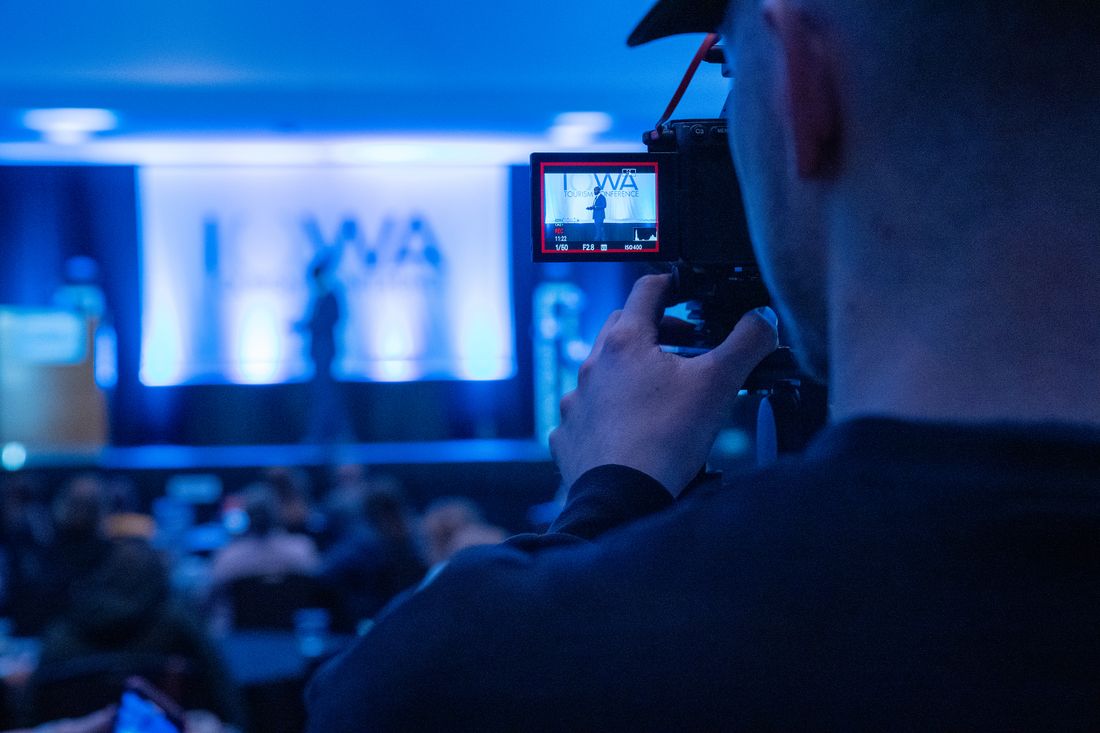
Photo by BEIGE MEDIA via Pexels.
A great talk doesn't sell the next one on its own. The room that heard it remembers for a week, then moves on to the next thing. What keeps working after everyone's gone home is footage, and most of what gets shot at a conference, panel, or podcast never turns into anything an event organizer would actually watch before deciding to book someone. That's the gap a speaker reel closes: real footage from a real appearance, cut down into the two or three minutes that do the convincing a live room already did once.
A speaker reel is a short edit built from real footage of a person speaking (a conference talk, a panel, a podcast appearance), cut down to the minute or two an event organizer needs to judge stage presence. It gets built after the talk, from what was actually captured, not prepared beforehand like a headshot or content kit.
Table of Contents
- What a speaker reel actually is, and what it isn't
- The footage worth collecting while the speaker is actually talking
- Why clean audio decides whether any of this is usable later
- The camera angles that actually cut into something watchable
- Why audience reaction has to be earned, not staged for the camera
- Finding the one soundbite the whole reel gets built around
- What actually convinces an event organizer to book from a reel
- Why a strong reel grows across talks instead of being built once
What a speaker reel actually is, and what it isn't
A speaker reel is a short edit built from footage of someone actually speaking (a real talk, panel, or podcast appearance), cut down to the two or three minutes an event organizer needs to judge whether a person can hold a room. It's proof of performance, not a highlight of applause or a polished studio piece.
That distinction matters because two other things get made around a speaking engagement and neither one is this. A content kit (headshots, a few rehearsed clips, a bio) gets built before a speaker ever steps on stage, prepared in a studio or a quiet room. A full recording of the talk is the opposite problem: forty minutes of unedited video nobody but the speaker's own team will sit through. A reel sits between those two, made after the talk from footage of the real thing, cut down to the length an organizer will actually watch before deciding. Getting that order right is what separates a reel that gets watched from one that gets closed after ten seconds.
The footage worth collecting while the speaker is actually talking
The clips worth keeping from a talk are narrow: clean audio throughout, two or three strong angle changes (a wide shot of the speaker on stage and a tighter shot of their face), a few seconds of the audience reacting, and one clear, complete soundbite where the speaker makes a point in a single unbroken sentence.
Most of that list is achievable with one camera and some planning, which is the point. A speaker reel doesn't require a multi-camera production, it requires someone thinking about the edit before the talk starts. A wide establishing shot sets the scene: the stage, the room, the speaker in context. A tighter shot carries the actual delivery, since that's the frame a viewer reads expression and conviction from. Audience reaction only counts if it's real (a genuine laugh or a room leaning in, not a cutaway hunting for applause). And the soundbite is the one piece nothing else can substitute for: thirty seconds where the speaker says something sharp, in one take, without stumbling over the sentence.
Why clean audio decides whether any of this is usable later
Clean audio is the one requirement that can't be fixed in the edit. A visually rough clip with clear sound is usable, but a beautifully shot clip with room echo, a muffled lav mic, or PA feedback is not. Every other decision about a speaker reel assumes the audio was captured right the first time.
That's why the audio source matters more than the camera used to shoot it. A feed pulled straight from the venue's soundboard, or a lav mic on the speaker themselves, will almost always beat whatever a camera's built-in mic picks up from twenty feet back in a room full of side conversation and HVAC noise. Conference audio systems are usually already recording for the livestream or the AV team's own archive, which means the cleanest source is often sitting on someone else's hard drive rather than a camera at all, worth asking for before the event, not scrambling for after. A reel built on shaky board audio can still be saved with editing. A reel built on audio nobody can understand, no matter how good the visual cut is, gets closed in the first few seconds and never opened again.
The camera angles that actually cut into something watchable
A reel needs at least two distinct angles on the speaker (a wide shot for context and a closer shot for delivery), because a single static angle held for two straight minutes reads as a security-camera recording, not a piece of content built to be watched and shared.
Two cameras running at once is the simple fix (one locked on a wide shot of the stage, a second on a tighter frame of the speaker's face and hands), and cutting between them in the edit as the pacing calls for it, not on any regular rhythm. A single camera can still get there if it's operated, not just mounted: a camera operator who pushes in during a key point and pulls back during a transition gives an editor two effective angles from one physical camera. What doesn't work is a phone propped on a tripod in the back row, capturing the whole talk from one unmoving wide shot. That footage documents that the talk happened. It doesn't give an editor anything to cut, which means the reel ends up either static and flat or impossible to build in the first place.
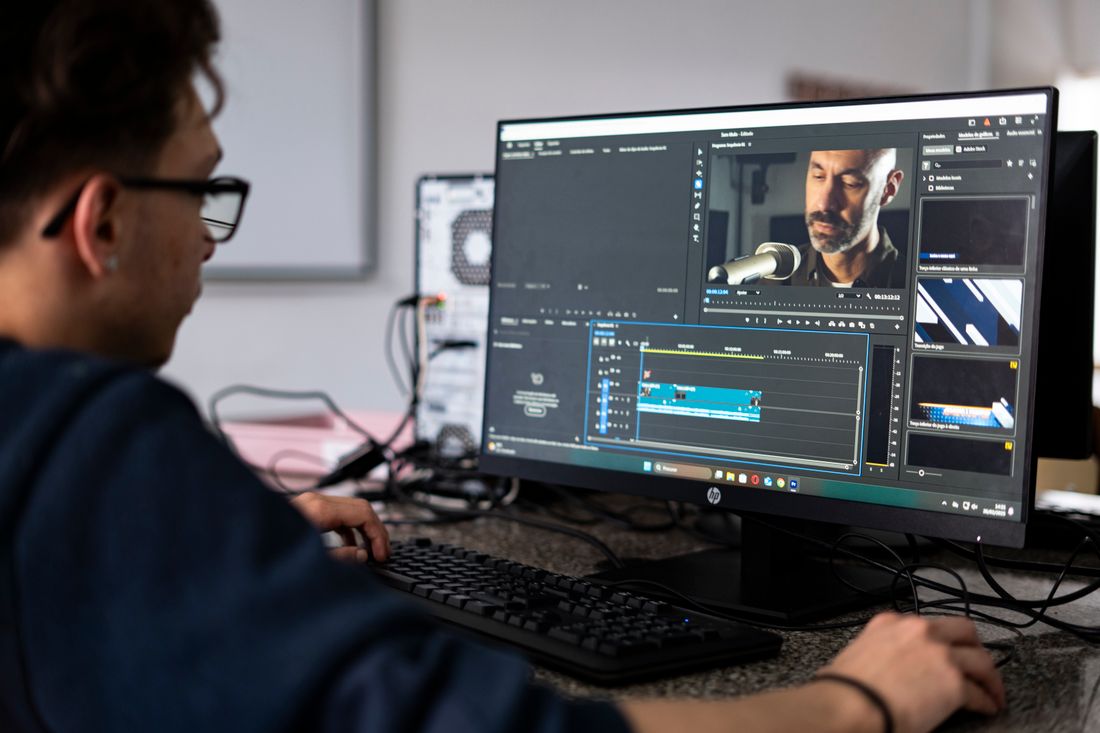
Photo by André Eusébio via Pexels.
Why audience reaction has to be earned, not staged for the camera
Audience reaction footage only works when it's caught in the moment (a real laugh, someone nodding along, a room leaning forward at a turn in the talk), because a directed cutaway or an organizer prompting applause for the camera reads as fake the instant a viewer notices it.
That's a hard thing to plan for, since it means a second camera or a wide shot has to be running on the crowd the entire time, waiting for a moment nobody can schedule. It's also why a single wide shot of the room matters even when the tighter shot on the speaker is the one carrying most of the reel. That wide angle is what catches the room reacting without anyone directing it to. The value of that footage isn't proving a crowd showed up. It's showing that what the speaker said actually landed with real people, which is a different and more persuasive claim. A few seconds of a genuinely engaged audience, cut in at the right point against the speaker's own delivery, does more to convince a future organizer than any wide shot of a full room ever will on its own.
Finding the one soundbite the whole reel gets built around
Every persuasive speaker reel has one clip at its center (a self-contained soundbite, usually ten to thirty seconds, where the speaker makes a complete point in their own words without a stumble or a mid-thought edit), and the rest of the reel gets built to lead into it.
Finding it usually means watching the full talk back at least once with no other goal than marking timestamps where the speaker said something in one clean breath. Live delivery rarely produces many of those. Most of a talk is transition, setup, and connective tissue between the actual points, which is normal and fine for the talk itself but useless for a thirty-second reel. An organizer skimming a reel isn't listening for forty minutes of context. They're listening for the ten seconds that prove this person can say something clearly and with conviction in front of a room. Once that clip is found, the rest of the reel gets built around it: the wide establishing shot up front, a few supporting cuts and reactions in the middle, and the soundbite placed where it lands with the most weight, usually near the end rather than buried in the middle.
What actually convinces an event organizer to book from a reel
An event organizer watching a speaker reel is judging one thing: can this person hold a room for the length of a real session. That means length matters more than polish. Sixty to ninety seconds of real stage presence beats three minutes of an over-produced highlight reel padded with music and slow motion.
Organizers book speakers in bulk, often reviewing a dozen candidates for one slot in a single sitting, and a reel that runs long or opens slow gets closed before it makes its case. The reels that get watched all the way through move fast: a quick establishing shot, then straight into the speaker talking, cut tight enough that there's rarely a dead second on screen. Pacing does more work than production value here. A reel shot on one decent camera with clean audio and a sharp cut beats a glossy, slow-moving edit almost every time, because what's being judged isn't the video's quality. It's the speaker's. The goal isn't to impress an organizer with editing. It's to get out of the way fast enough that they can actually evaluate the person talking.
Why a strong reel grows across talks instead of being built once
A speaker reel doesn't have to come from one talk. Footage from a panel, a podcast appearance, and a conference session can all feed the same reel, and the strongest ones usually do, because they prove the speaker performs consistently rather than having one good day on one stage.
Treating a reel as a living asset rather than a one-time project changes how it gets used. After every engagement worth keeping (a talk that landed well, a panel where a point came across clearly, a podcast clip with real energy), new footage gets reviewed against what's already in the reel, and the strongest material replaces the weakest rather than getting tacked on at the end. That keeps the reel current instead of aging into something built around a single event from years back, which organizers can often spot immediately. It also takes the pressure off any one talk, since the reel is a rolling collection, not a one-shot deliverable that has to land perfectly the first time. A speaker who treats each engagement as a chance to add or replace a clip ends up with a stronger asset than one trying to nail it once and stop.
Frequently Asked Questions
What's the difference between a speaker reel and a full recording of the talk?
A full recording is the entire session, usually thirty to sixty minutes, kept mostly for the speaker's own archive or the event's records. A speaker reel is a short, edited cut (often sixty to ninety seconds) built from the strongest moments of that recording: clean angles, real audience reaction, and one clear soundbite. The recording documents that the talk happened. The reel is built specifically to convince someone who wasn't there to book the speaker next.
How long should a speaker reel be?
Most effective speaker reels run sixty to ninety seconds, occasionally stretching to two minutes if the speaker has strong footage from more than one engagement worth including. That's short enough for an organizer to watch in full during a busy booking review, and long enough to show a real arc (an opening moment, delivery, audience reaction, and a closing soundbite) rather than a single disconnected clip. Longer reels tend to lose organizers before the strongest material even plays.
What footage should a speaker ask an event to capture during their talk?
Ask for a wide shot of the stage, a tighter shot of the speaker's face and hands, and a camera or feed running on the audience throughout, not just during applause. Ask whether the audio is coming off the venue's soundboard or a lav mic rather than a camera's built-in mic, since that decides whether any of the footage is usable later. If the event already records for a livestream, that source is often the cleanest audio available.
Does a speaker reel need footage from multiple events, or is one strong talk enough?
One strong talk can carry a first reel, especially if the wide shot, tight shot, audience reaction, and soundbite all came out clean. But the strongest reels tend to be built across several appearances (a panel, a podcast clip, a conference talk), because that mix proves consistent stage presence rather than one good day. Treating the reel as an ongoing project, updated after each worthwhile engagement, produces a stronger asset than trying to finish it once.
How is a speaker reel different from the content kit a speaker prepares before an event?
A content kit (headshots, a bio, maybe a rehearsed clip or two) gets built before a speaker ever steps on stage, usually in a studio or a quiet room, to prepare them for the engagement. A speaker reel gets built after, from footage of the real talk actually happening in front of a real room. One is preparation; the other is proof. Organizers deciding whether to book someone are looking for the proof, not the preparation.
Related Reading
Planning founder content or a launch and unsure what to actually shoot?
Tell us where the images or video will run, site, LinkedIn, press, or a launch page, and we'll scope it with a fixed price before you book anything.
See Personal Branding & Launches