Photo: Core Visuals NYC
Panels are the part of a conference agenda everyone treats as an afterthought. The keynote gets a full crew, the panel gets a camera in the back of the room. But four people in chairs is actually harder to make watchable than a single speaker on a stage, because the value is in a conversation, not a presentation, and a conversation only reads on video if you can cut between the people having it. Here's the mechanism: how many cameras a panel actually needs, where the cutaways come from, why the house audio feed alone is a real risk, and what a panel realistically turns into once it's edited.
A watchable panel discussion video needs at least two cameras (one wide for context, one closer for reactions), plus cutaways to the audience and moderator, individual lav mics on every panelist, and a room mic as backup. A single locked-off wide covers the audio but gives an editor nothing to cut to.
Table of Contents
- A Locked-Off Wide of Four Chairs Isn't Coverage
- A Panel Is an Editing Problem Before It's a Shooting Problem
- One Camera, Two Cameras, Three Cameras: What Each Actually Buys You
- Where the Cutaways Actually Come From
- The Audio Split: Lavs, the House Feed, and a Room Mic
- Framing the Moderator So the Panel Doesn't Feel Like an Interrogation
- Stage and Seating Choices That Make or Break Coverage
- What Panel Coverage Actually Costs
- What a Panel Shoot Realistically Delivers
A Locked-Off Wide of Four Chairs Isn't Coverage
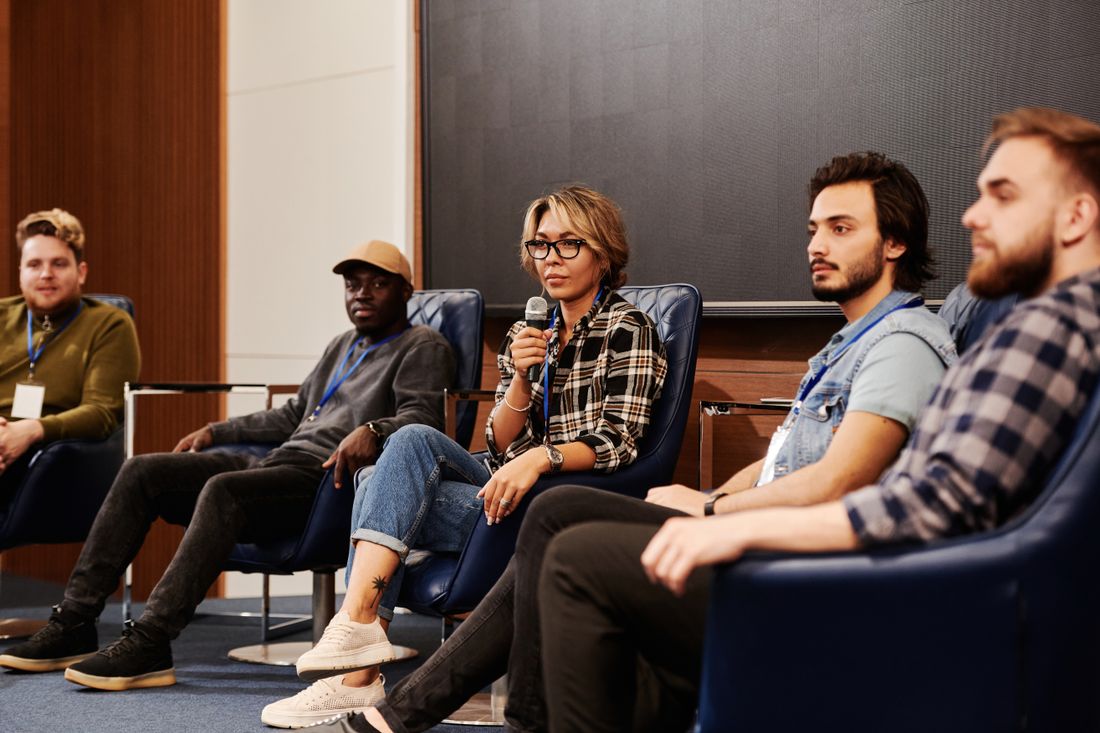
A single static wide of four panelists talking captures every word, but it hands an editor nothing to cut to. No reaction shot, no scale change, no visual break, so the finished video reads like a security camera pointed at a meeting, not something anyone chooses to keep watching.
That's the whole problem in one sentence: a locked-off wide isn't neutral coverage, it's a bet that the conversation alone will hold attention once the framing never moves. Four people trading answers for forty minutes generates plenty of audio and almost no visual information if nothing on screen ever shifts. Viewers don't consciously register "this is one static shot." They just feel their attention drift, usually around the point the panel gets absorbed in its own answers and stops performing for the room. A single camera also removes any margin for error. If a panelist leans out of frame or the moderator turns away, there's no other angle to save the moment in the edit. The fix isn't a better camera or a wider lens. It's more angles, chosen for what an editor will actually need later.
A Panel Is an Editing Problem Before It's a Shooting Problem
Every choice about a panel gets made backwards from what most people assume: the edit determines the shoot, not the other way around. An editor can only cut to footage that was actually captured, so the real planning question isn't "how do we film this." It's "what will this need to look like cut together."
This is the part that gets skipped when a panel is treated as a lower priority than the keynote next to it. Nobody plans a panel's coverage by imagining the finished sequence in advance: a two-shot to open, a cut to the moderator's question, a reaction from the panelist about to answer, a wide to reset the room. They plan it by pointing a camera at the stage and hoping. The problem shows up in the edit bay: an editor staring at forty minutes of one unbroken angle, unable to trim a rambling answer without a visible jump, unable to build rhythm with no second piece of footage to intercut. Coverage decided in advance (camera count, cutaway sources, audio isolation) gives an editor room to shape the conversation instead of laying it end to end.
One Camera, Two Cameras, Three Cameras: What Each Actually Buys You
One camera gets you a record of the panel and nothing to cut with. Two cameras gets you a wide for context and a second angle for reactions or a moderator two-shot, enough for a real edit. Three cameras adds a dedicated moderator or audience angle, which is what separates a good panel video from an adequate one.
The jump from one camera to two is the one that matters most. It's the difference between raw footage and something an editor can actually build. A wide holds the whole panel so the viewer always knows who's in the room and where they're sitting relative to each other. A second camera, usually a tighter shot roaming between speakers, is what supplies reaction cutaways and lets an editor tighten a long answer without a visible jump. A third camera is a refinement, not a requirement; it usually goes on the moderator specifically, since moderator reactions carry a conversation's rhythm, or on the audience when the room itself is part of the story. Beyond three, the value curve flattens fast: more cameras mean more footage to sync and review, not necessarily a more watchable cut.
Where the Cutaways Actually Come From
Cutaways for a panel come from four sources: the audience listening or reacting, the moderator's face while a panelist is answering, close shots of hands and gestures, and wide shots of the room itself. None of these require a dedicated extra camera. They're what the second and third cameras are actually there to catch, alongside the panelists.
Audience reaction shots do the most work per second. A laugh, a nod, someone leaning forward, all confirm to a viewer that the conversation is worth their attention too. Moderator cutaways matter because a moderator's face while listening tells the viewer how to feel about what was just said. Hands and gestures are underused: a close shot of someone counting off points on their fingers reads as engagement without needing a full reaction shot. Room-wide shots are the reset button. They remind the viewer of the setting and give an editor a place to breathe between exchanges. None of this is spontaneous in the edit; it only exists if a camera was actually pointed at the audience or the moderator during the panel, a decision made before the event starts.
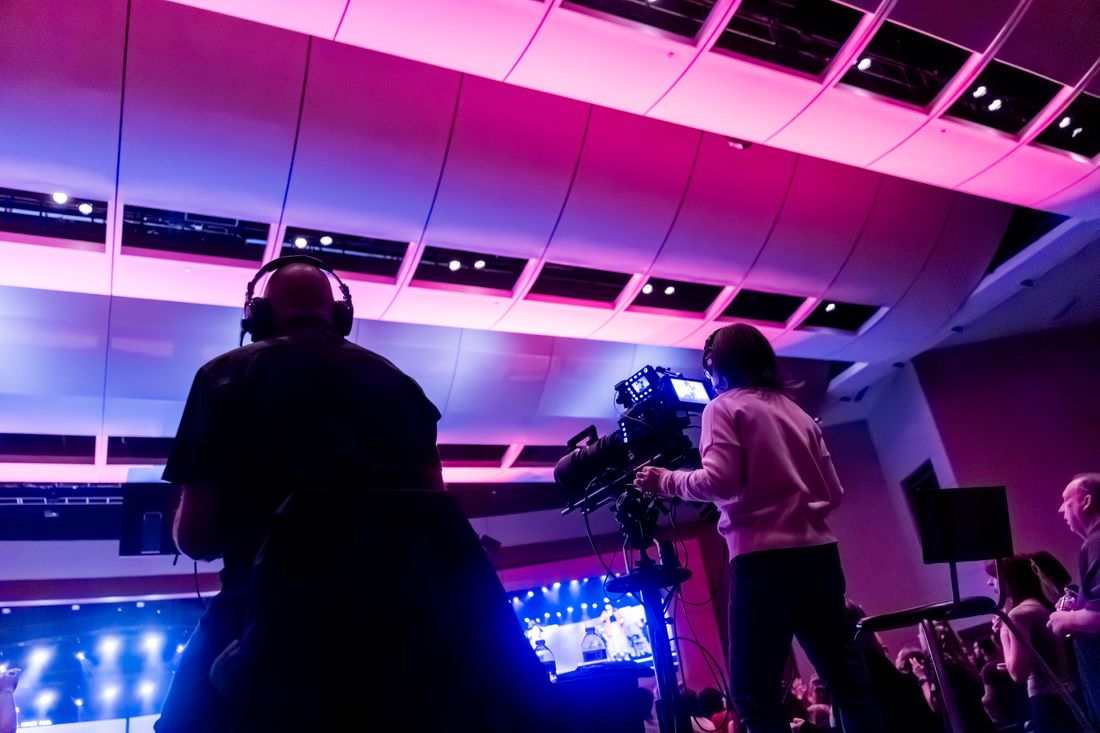
Photo: Core Visuals NYC
The Audio Split: Lavs, the House Feed, and a Room Mic
The safest audio setup for a panel is individual lavalier mics on every speaker, feeding a separate recorder, with the venue's house sound feed pulled as a backup and a room mic capturing ambient audience response. Relying on the house feed alone is a real risk. It's built for the room, not for a clean video mix.
A venue's house feed is designed to make a room sound good in the room. It's often one mix of every microphone blended together, sometimes with the audience mic bleeding in, sometimes dropping out when a panelist leans back from a shared table mic. Individual lavs solve the biggest problem: separated audio per speaker, so a slow talker and a fast talker can each be leveled independently instead of fighting each other in one track. The room mic isn't there for the panelists at all. It's there for audience questions and reaction, which matters more once cutaways to the crowd are in the edit. Losing the house feed is recoverable if lavs were running. Losing the lavs because everyone trusted the house feed is not. That's the version that actually costs a deliverable.
Framing the Moderator So the Panel Doesn't Feel Like an Interrogation
A moderator needs their own dedicated framing, not just inclusion in the panel's wide shot, because they're doing different work than the panelists (asking, listening, redirecting), and a viewer needs to see that work to follow the conversation's shape. Cutting to a moderator mid-question is often more useful than cutting to whoever's about to answer.
Panels go flat visually when the moderator only exists as an offscreen voice or a sliver at the edge of the wide frame. Giving the moderator real coverage, a clean angle that can be cut to on its own, lets the edit show the shape of the conversation: who's steering it, when a question lands, when a redirect is coming. It also solves a practical problem, because a moderator asking a question is naturally the cleanest moment to cut away from a panelist still settling into their answer. Skipping moderator framing tends to happen because moderators get treated as furniture rather than participants, but on video they're closer to a host. A panel with strong moderator coverage feels like a conversation. One without it feels like four people answering questions from off camera.
Stage and Seating Choices That Make or Break Coverage
A straight line of chairs facing the audience is the hardest panel layout to shoot well, because every camera sees the same flat row of profiles. A slight arc, or chairs angled toward each other, gives cameras actual depth and lets panelists see each other, which reads on screen as a real exchange instead of four solo statements.
Seating decided by whoever set up the room, not by whoever's filming it, is the single most common reason panel footage looks worse than it needed to. A dead-straight row means a wide shot reads as a lineup, and a tight shot on any one panelist has nothing behind them but an empty chair or a stranger's shoulder. Angling the chairs even slightly toward the center changes both problems at once. It gives a two-shot an actual relationship to frame, and lets panelists react to each other rather than staring at the crowd. Stage height and lighting matter too: a panel lit only for the room, not for camera, forces a compromise between exposing faces and blowing out the backdrop. None of this requires redesigning the event, just a seating conversation first.
What Panel Coverage Actually Costs
A panel that's the only thing on the schedule that day usually books at the hourly rate: $850 an hour with a two-hour minimum, so even a single one-hour panel still lands at the $1,700 floor. That rate covers the crew and however many cameras the session actually needs, priced by time rather than by how many chairs are on stage.
Once a panel is one segment inside a longer event day, it moves onto the package structure instead. The two-camera setup a panel needs to be watchable is standard on the Premium package, 8+ hours of photo and video together, from $9,500, which also covers the short highlight reel and social clips a panel's strongest moments end up in. A video-only day can still run two cameras under Essential (up to 5 hours, $3,500) or Professional (6-8 hours, $6,000). There's no separate panel line item; it gets scoped inside whichever package or hourly block the panel actually falls into, and event photography and videography in NYC typically starts around $3,500.
What a Panel Shoot Realistically Delivers
A well-covered panel realistically yields one full-length edited recording for archival or registration-gated use, plus a handful of shorter clips built around the strongest individual answers or exchanges, not a single highlight reel that tries to represent the whole forty minutes. Expecting one clip to carry the entire conversation usually means picking the least interesting common denominator.
The full-length edit is the record: cleaned-up audio, cut between the angles that were actually shot, useful for anyone who registered but couldn't attend live or wants the whole exchange later. The real value for marketing usually lives in shorter pulls. Two or three minutes built around one sharp answer, one genuine disagreement, one moment the room reacted to, each able to stand alone without the rest of the panel as context. That second category only exists if the coverage supported it: a moment only becomes a usable clip if there's a clean angle on the person talking and a cutaway that confirms the reaction was real. A panel shot on one locked-off camera still yields a full recording, technically. It rarely yields anything shorter than the whole thing, because there's no footage variety to build a standalone clip from.
Frequently Asked Questions
How many cameras do I actually need for a panel discussion?
Two cameras is the practical minimum for a watchable panel (one wide holding the full group for context, one tighter angle for reactions and cutaways). A single camera records the conversation but gives an editor nothing to cut to, so it usually ends up looking like a static meeting recording. A third camera, often dedicated to the moderator or audience, adds real value once budget allows, but two is where a panel becomes editable.
Why can't the venue's house sound feed just cover the panel's audio?
A house feed is mixed for the room, not for video. It often blends every microphone into one track, lets audience noise bleed in, or drops a panelist when they lean back from a shared mic. Individual lavalier mics on each speaker, recorded separately, let an editor level a slow talker against a fast talker and isolate one voice from crosstalk. The house feed works as a backup, but relying on it alone risks losing usable audio.
What does it cost to add panel coverage to an event?
A standalone panel usually falls under the hourly rate, $850 an hour with a two-hour minimum, so a single panel still books at the $1,700 floor. When a panel is one part of a full event day, it moves onto the package structure instead, and the two-camera video a panel needs is standard on the Premium package, 8+ hours of photo and video together, from $9,500. Event coverage in NYC typically starts around $3,500.
What seating arrangement works best for filming a panel?
A slight arc or angled seating, rather than a dead-straight row facing the audience, gives cameras real depth to work with. Panelists angled a few degrees toward each other can actually see and react to one another, which reads on camera as a genuine exchange instead of four separate statements aimed at the crowd. A straight row forces every shot into the same flat profile and leaves an empty chair behind whoever's framed.
What's the actual deliverable from a filmed panel discussion?
Realistically, a full-length edited recording plus a small set of short clips pulled from the strongest individual moments, not one highlight reel meant to represent the whole conversation. The full edit is the archival record for anyone who missed it live. The short clips, built around a sharp answer or a real reaction, are what get used for marketing afterward, and they only exist if the coverage included enough angles to cut a standalone moment together.
Related Reading
Not sure if hourly or a package makes more sense for your event?
Tell us the expected length, and we'll run the actual numbers before you book.
See Event Coverage Packages