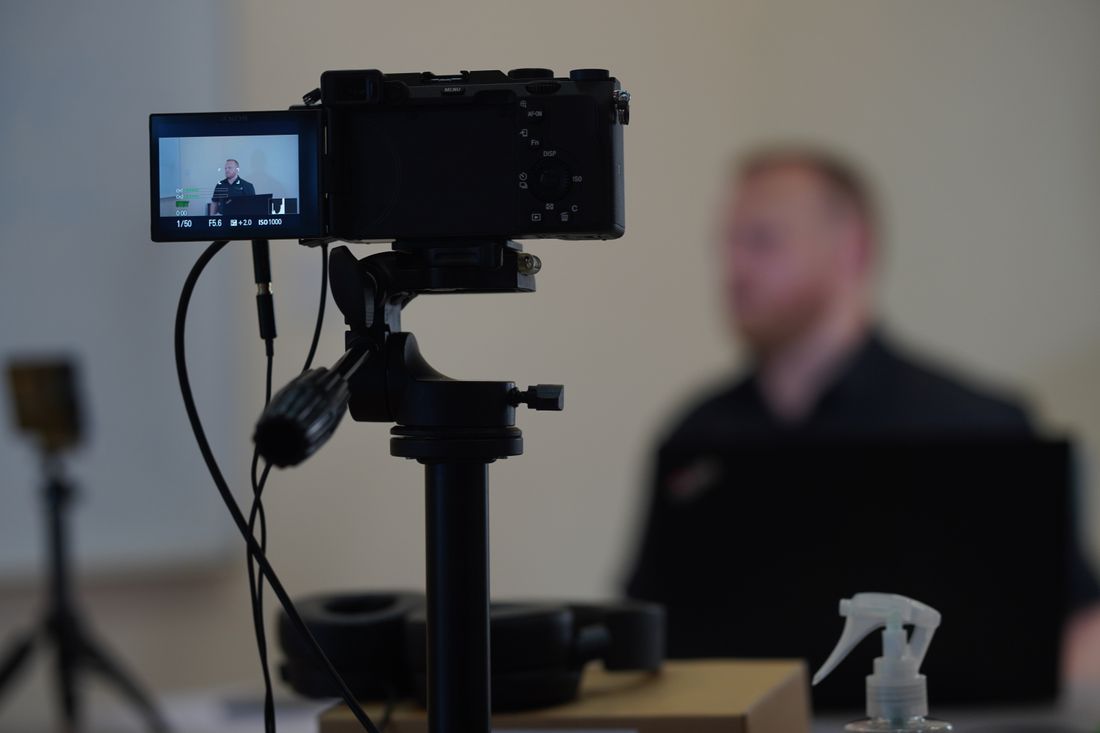
Photo: Core Visuals NYC
Every leader has said something at an all-hands that was better than anything from their last ten LinkedIn posts combined (sharper, funnier, more honest) and then let it disappear into an internal recording nobody outside the company will ever see. The instinct to fix that by re-shooting a polished version usually kills the exact thing that made the moment worth saving in the first place.
An all-hands soundbite survives the move to LinkedIn only when the audio, framing, and background behind the speaker were handled correctly at capture time, before anyone knew a specific moment would be worth clipping. Re-shooting the line later for an external audience removes the unscripted quality that made it worth posting.
Table of Contents
- Why the Internal Take Is the One Worth Posting
- The Audio Has to Be Usable Before Anyone Decides to Repurpose It
- Framing That Survives a Square or Vertical Crop
- What Has to Be Behind the Speaker
- Why Re-Shooting a Clean Version Defeats the Point
- What Genuinely Can't Be Rescued in the Edit
- Consent: An Internal Audience Is Not an External One
- Capturing for Both Audiences Without Staging Either One
Why the Internal Take Is the One Worth Posting
The internal all-hands moment usually outperforms anything scripted for LinkedIn because nobody in the room was performing for an outside audience. The leader was answering a real question, thinking out loud, or reacting honestly in the moment, and that unguarded quality is the entire reason a thirty-second clip pulled from the recording is worth posting at all.
Scripted answers protect a leader from saying something imprecise, but they strip out the specific word choice, the pause before a hard answer, the joke that only lands because nobody planned it. An external audience has gotten good at spotting the gap between a leader talking and a leader being coached through talking points, and an all-hands recording is one of the only places that gap doesn't exist yet.
That's the case for treating the all-hands recording as raw material worth reviewing, not a rough draft to be replaced. The room is honest because nobody in it expected a crop, a caption, or a stranger's feed to be the next stop for what they just said, which is precisely what a re-shoot can't reproduce.
The Audio Has to Be Usable Before Anyone Decides to Repurpose It
Audio decides whether an all-hands moment can become a LinkedIn clip more than any other capture choice. A soundbite has to work for a viewer scrolling with sound off or on, which means a lavalier or a mic close to the speaker, not the room's house PA or a ceiling mic, is what actually makes the moment usable after the fact.
Most all-hands setups are built for the room, not a future export. A ceiling mic or a PA feed captures echo, HVAC hum, and chair shuffle along with the words, and none of that gets clearer by cutting the clip shorter. It usually gets more obvious, since a thirty-second clip has nowhere for a buried voice to hide the way a forty-minute recording does.
LinkedIn lets viewers turn on closed captions for any video shared to the feed, which matters because a large share of that audience is watching muted before they ever turn sound on. See LinkedIn's own guidance on sharing video on LinkedIn. Captions only help if the track underneath them is clean; auto-generated text pulled from a boomy room mic garbles names and numbers as often as it gets them right.
Framing That Survives a Square or Vertical Crop
Framing survives an external crop only when the speaker was never pushed to the edge of the shot in the first place. An all-hands is typically shot wide to cover a stage, a panel, or a room, and a wide shot cropped down to a square or vertical LinkedIn clip either cuts off the speaker's head or leaves them a small figure lost in empty space.
The fix isn't shooting every all-hands like a LinkedIn video from the start. That would defeat the point of capturing something unscripted. It's keeping the speaker roughly centered with real headroom on all sides, so a wide internal frame can be reframed tighter later without losing the top of someone's head or the context that made the moment make sense.
LinkedIn's own posting guidance recommends keeping the edges of a video, top, bottom, and sides, free of text, logos, and other key elements, since interface overlays can cover them. The same margin that protects a video from LinkedIn's own interface is the margin that gives an editor room to crop an all-hands frame down without cutting into the one thing the clip is actually about.
What Has to Be Behind the Speaker
A clean, controllable background behind the speaker is a requirement for external use, not a nice-to-have, because an all-hands is often shot in front of a slide with real numbers, a whiteboard with a roadmap, or a colleague who never agreed to appear in a LinkedIn post. None of that can be blurred out convincingly after the fact without redoing the graphics from scratch.
A slide showing quarterly figures or a competitive comparison is fine for the people in the room, who already have context and access. Cropped into a still frame and posted publicly, the same slide becomes a screenshot anyone can zoom into, save, and forward, well outside how it was ever meant to be seen.
The background problem is easiest to solve before the meeting starts: picking an angle where the screen isn't directly behind the speaker, or setting a second camera on the speaker against a plain wall or window instead of the full room. Fixing it after the all-hands means either giving up the clip or spending real time rebuilding a background that should have been clean at capture.
Why Re-Shooting a Clean Version Defeats the Point
Re-shooting an all-hands moment recreates the words but not the moment, because the leader now knows the take is headed to an external audience. That awareness changes the pacing, the eye line, and the phrasing, even when the goal is to sound exactly as natural as the first time. A re-shoot aimed at sounding unscripted is still, by definition, scripted.
Viewers have gotten reasonably good at sensing the difference, even without being able to name it. A re-shot line often lands a beat too clean, a smile arrives a half-second early, a pause that was genuine the first time gets replaced by a pause that was planned to look genuine. None of that shows up as an obvious flaw; it just reads as slightly off.
This is also where the actual content usually thins out. The unscripted version included a specific word, a real hesitation, or a detail that only came up because someone asked a real question in the room. A re-shoot, aimed at hitting the same beats more cleanly, quietly drops the specifics that made the original worth clipping and replaces them with a smoother version of roughly the same idea.
What Genuinely Can't Be Rescued in the Edit
Some problems at capture time are unrecoverable afterward, no matter how much editing follows. Audio buried under room noise below a usable floor, a shot too wide for a face to read clearly at LinkedIn's small feed size, and a background showing real financial figures or an unconsented colleague all fall into that category. An edit can trim a clip, but it can't add information that was never captured.
A moment where the actual value was a slide, a prop, or a demo that never got turned toward the camera is the same problem in a different shape. If the thing that made the line land was something the audience needed to see and the camera wasn't pointed at it, no amount of cutting brings that context back into the frame.
Knowing which problems are fixable and which aren't is what keeps a repurposing pass honest. A slightly awkward zoom or a stray cough is worth living with. A voice nobody can understand or a slide with numbers that were never meant to leave the room is a reason to let that specific moment stay internal instead of forcing it into a post it can't support.
Consent: An Internal Audience Is Not an External One
Someone who spoke up at an internal all-hands agreed to be heard by their own colleagues, not necessarily by a public LinkedIn audience, recruiters, competitors, or a future employer doing a background check. Treating an all-hands remark as automatically available for external use skips a real step, especially for anyone in the room other than the leader who called the meeting.
This applies with the least ambiguity to the leader, who is generally speaking in an official capacity and should expect internal remarks might travel further. It applies with much more force to an employee who asked a pointed question, made a joke, or reacted visibly on camera, someone who showed up for an internal meeting, not a public appearance.
None of this is legal advice, and a real consent process for turning internal footage external belongs with HR or legal counsel, not a production checklist. What belongs on a production checklist is the habit of asking before a clip featuring anyone other than the person who called the meeting goes anywhere near a public feed, a documented practice, not a formality to skip because the footage already exists.
Capturing for Both Audiences Without Staging Either One
The way to end up with footage that can go external without staging the all-hands for an outside audience is to build the technical floor into every session regardless of whether anything from it will ever leave the building: clean audio near the speaker, a frame with room to crop, and a background that's already appropriate for people who weren't in the room.
This is the practice we bring to internal video work at Core Visuals: treat the capture setup the same way whether or not a moment ends up worth repurposing, because nobody can predict in advance which two minutes of a ninety-minute all-hands will be the two minutes worth pulling. Deciding that after the fact is normal. Fixing bad audio or a blown-out background after the fact usually isn't possible.
None of this requires turning an all-hands into a produced event or asking a leader to perform for a camera that wasn't there before. It just means the same setup a company already uses to record the meeting for its own archive can also be the setup that survives being clipped, captioned, and posted, if the basics were handled before anyone knew a specific line was worth keeping.
Frequently Asked Questions
Can internal all-hands footage go on LinkedIn without re-shooting it?
Yes, when the original capture already has clean audio close to the speaker, a frame with enough headroom to crop, and a background free of confidential slides or unconsented colleagues. If those weren't true when the camera was rolling, cropping the clip afterward tends to make the same problems more visible rather than less, especially at the smaller size a LinkedIn feed actually displays video.
Why does re-shooting a clean version of an all-hands moment often make it worse?
Because the leader now knows the line is headed to an outside audience, and that awareness changes pacing, eye contact, and word choice, even when the goal is sounding natural. Viewers tend to notice the gap between a real moment and a performed one, even without naming it, and a re-shoot built to sound casual usually reads as a performance of casualness instead of the real thing.
What audio setup actually protects an all-hands soundbite for later use?
A lavalier or a microphone positioned close to whoever is actually speaking, kept separate from a venue's house PA or a ceiling mic, which usually captures room echo and audience noise along with the voice. Because many viewers watch LinkedIn video muted before turning sound on, the clip also needs to support captions, and accurate captions depend entirely on a clean audio track captured in the room, not fixed afterward.
Do employees need to consent before their all-hands remarks go external?
Treat it as a real practice question rather than a formality. Someone who spoke up at an internal meeting agreed to be heard by colleagues, not necessarily by a public LinkedIn audience, competitors, or a future employer. This applies most clearly to employees other than the leader who called the meeting. It is a documented-practice observation, not legal advice, and a real consent process belongs with HR or counsel.
What can't be fixed in editing if the original all-hands footage wasn't captured well?
Audio buried under room noise below a usable floor, a shot too wide for a face to read clearly at feed size, and a background revealing real financial figures or an unconsented colleague are typically unrecoverable after the fact. A slide or a demo that was never actually turned toward the camera has the same problem: an edit can trim a clip, but it cannot add back content that was never captured.
Related Reading
Working on founder content or a launch and not sure what to shoot?
Tell us where the content needs to live (site, LinkedIn, press, or a launch page) and we'll come back with the scope and a fixed price before anything gets booked.
See Personal Branding & Launches