Photo: Core Visuals NYC
Every venue walkthrough for a December party ends with the same question: can you actually get good photos in here? The room has string lights, a DJ booth throwing colored washes across the floor, and no house lights once the party gets going. The honest answer isn't yes or no. It's which shots this room can deliver, and which ones it can't, and that split is worth knowing before the event, not during it.
A dark holiday party venue reliably delivers candid mingling shots, toasts, and string-light ambiance photography, because those subjects hold still or move slowly enough for the available light. Crisp, frozen dance-floor action in near-darkness without added light isn't realistic. Motion blur is the tradeoff for shooting a moving subject in a room built for mood lighting, not photography.
Table of Contents
- What's Realistic in a Dark Holiday Party Venue
- Candid Mingling and Toasts: The Shots That Work
- String-Light Ambiance: Turning the Venue Itself Into the Shot
- Dance-Floor Motion: What's Actually Achievable in Near-Darkness
- Colored DJ Lighting and Why It Changes the Approach
- What to Brief Your Photographer On Before the Party
- Setting Expectations With Your Team Before the Event
- When Added Light Changes What's Possible
What's Realistic in a Dark Holiday Party Venue
A dark holiday party venue reliably produces candid mingling shots, toasts, speeches, and moody wide shots of the room's own string lights. What it doesn't reliably produce, without extra equipment, is crisp, frozen action on a dark dance floor, and knowing that split ahead of time changes what a planner asks for.
The difference comes down to how still the subject is, not how skilled the photographer is. A conversation between two people at a cocktail table barely moves; a room full of people dancing under colored lights moves constantly, and cameras need either more light or a faster shutter to freeze that motion, which a dim room usually can't supply on its own.
This post assumes you already know why dim rooms are harder on a camera in the first place. That mechanism is covered elsewhere. What matters here is the practical split: which shots a holiday party venue can honestly deliver, and how to plan coverage around the ones it can't.
Candid Mingling and Toasts: The Shots That Work
Candid mingling and toasts are the most reliable shots in a dark holiday party venue, because the subjects are mostly stationary (standing, talking, raising a glass) which gives a camera enough time to gather light without the image blurring. These are the shots that reliably end up in the recap gallery or the year-end newsletter.
A toast in particular is a strong subject for low light: a person standing still, often lit from one direction by whatever ambient source is nearest, holding a pose for several seconds while they speak. That stillness is exactly what a dim room needs to produce a sharp, usable frame, even without any added lighting equipment.
Mingling shots work the same way. Two colleagues leaning in to talk over the music, a small group laughing near the bar. None of that requires freezing fast motion. It's the category of shot a holiday party venue was basically built to support well, string lights and all, and it's worth planning coverage priorities around.
String-Light Ambiance: Turning the Venue Itself Into the Shot
String lights are one of the few light sources in a dark venue that photograph well on their own terms. They read as warm, atmospheric points of light rather than something a camera has to fight against. A wide shot of a string-lit room is often one of the strongest images from the night.
Unlike overhead fluorescents or a stray phone flash, string lights create a soft, layered glow that a camera can expose for directly, rather than needing to overpower. Photographed well, they turn the venue's own decor into part of the story instead of just a backdrop competing for light with everything else in the room.
These shots work best as wide, atmospheric frames (the room itself, a few blurred figures in the distance, the lights doing the visual work) rather than as the main light source for a sharp portrait. Treated that way, string lights become an asset instead of a lighting problem to work around all night.
Dance-Floor Motion: What's Actually Achievable in Near-Darkness
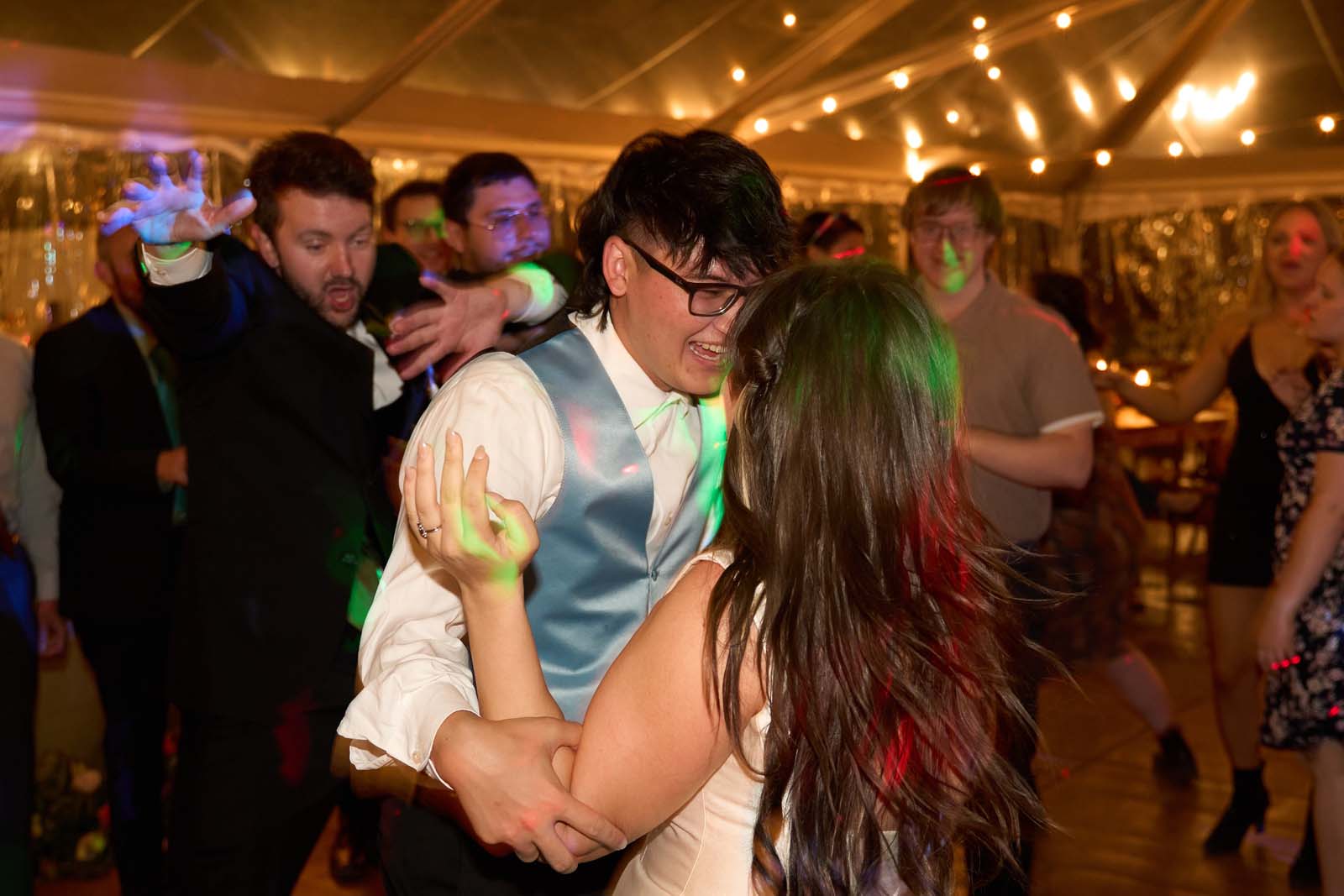
Dance-floor motion in a genuinely dark room, without added light, tends to come back as movement and energy rather than crisp, frozen faces, deliberate blur that reads as motion, not a technical failure, but still not the sharp freeze-frame some planners expect. That expectation gap is the single biggest source of disappointment after a holiday party.
Freezing fast motion requires a fast shutter speed, and a fast shutter speed needs light the room usually isn't providing once the lights go down and the music picks up. Without adding light, a photographer is choosing between a sharp but very dark frame or a brighter frame with visible motion blur on anyone actually dancing.
Some blur can work in the room's favor. It reads as energy, motion, a party actually happening, rather than a stiff posed shot. But it's a different look than the crisp portrait-style dance shots planners sometimes picture, and that's worth knowing going in, not discovering in the final gallery.
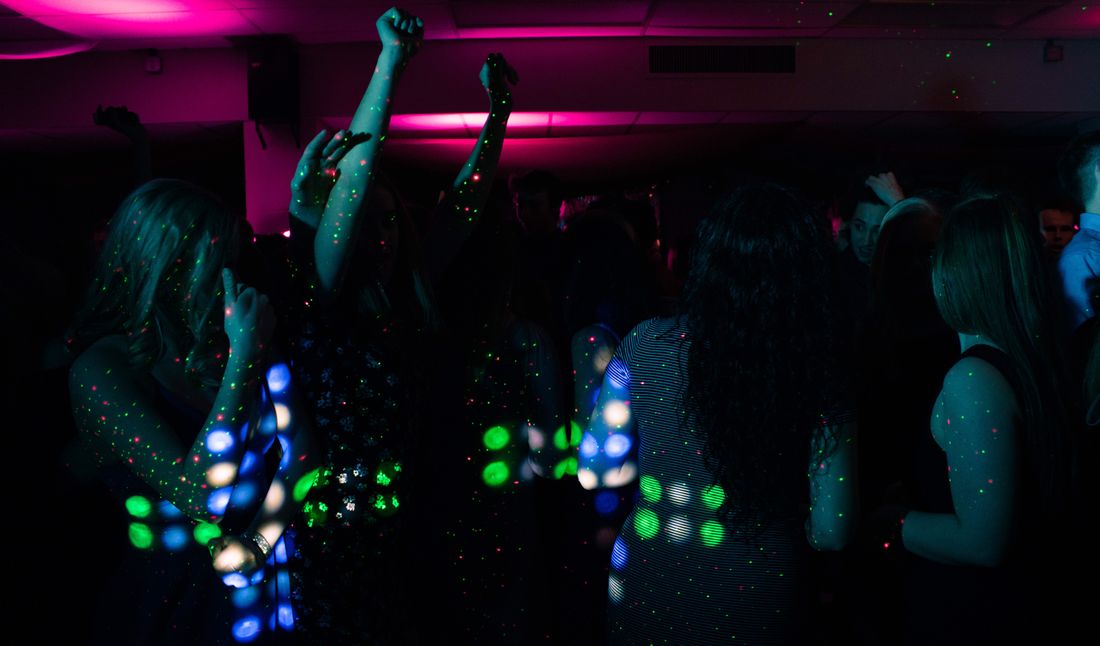
Photo by Trinity Kubassek via Pexels.
Colored DJ Lighting and Why It Changes the Approach
Colored DJ lighting (moving heads, gobos, uplights washing the walls in red or blue) adds color and mood to a photo, but it also shifts a camera's color balance and often moves or pulses in ways a static exposure setting doesn't anticipate. It's a different lighting problem than a simple dim room.
A face lit half in blue and half in warm ambient light can look striking in one frame and oddly two-toned in the next, depending on where the colored wash happens to fall at that exact moment. Photographers working a DJ-lit dance floor are constantly adjusting for lighting that's actively changing, not just low.
The practical upshot: colored lighting photographs best in wider shots that let the color read as atmosphere, rather than tight portraits where an odd color cast on a face becomes the whole point of the frame. Knowing the DJ setup in advance helps a photographer plan around it instead of reacting to it.
What to Brief Your Photographer On Before the Party
Before a holiday party in a dark venue, tell your photographer about the string lights, whether there's a DJ with colored or moving lighting, roughly when the dance floor opens, and whether the venue allows any additional lighting equipment. Each of those details changes what's realistic to plan for on the night itself.
Venue lighting varies more at holiday parties than almost any other corporate event. A law firm's holiday dinner in a private dining room looks nothing like a startup's party in a nightclub space with a full DJ booth. A photographer who knows which one they're walking into can plan coverage priorities accordingly, rather than guessing on arrival and adjusting on the fly.
It's also worth flagging when the formal moments happen (the toast, the awards, the CEO's remarks) since those are the shots most likely to end up in a recap or newsletter, and they deserve priority positioning while the room still has usable ambient light to work with.
Setting Expectations With Your Team Before the Event
Setting expectations before a dark-venue holiday party means telling whoever's requesting the gallery that dance-floor shots will likely show motion and mood rather than crisp, frozen faces, while toasts and mingling shots will come back sharp. That one conversation prevents most of the disappointment that shows up after the fact.
A marketing manager expecting every photo to look like a bright office headshot session will be let down by a moody, string-lit gallery, even if the gallery is genuinely strong. The mismatch usually isn't about photo quality. It's about a mental picture that was never corrected before the event happened.
The fix is simple: describe the venue and the likely look of the gallery to stakeholders in advance, the same way you'd describe the venue's decor or the dress code. A team that expects atmosphere gets atmosphere; a team expecting a bright, still gallery from a dim nightclub space is set up to be disappointed regardless of how the night actually goes.
When Added Light Changes What's Possible
Adding flash or continuous lighting changes what a dark venue can deliver, including sharper dance-floor shots, because it gives the camera a fast burst of light instead of relying entirely on the room's ambient glow. It's the main lever that shifts the realistic-shots list further toward frozen action.
A bounced or off-camera flash can freeze a moment on the dance floor the same room couldn't produce sharply on its own, without turning the shot into a harsh, flat snapshot. The difference is in how the light gets used, not just whether it's there. That's a decision worth discussing with a photographer in advance rather than assuming it's automatic.
Some venues restrict additional lighting equipment, which is another reason to flag the venue and its rules early. Where added light is allowed, it's the clearest way to close the gap between what a dim room produces on its own and what a planner might be picturing for the dance-floor shots specifically.
Frequently Asked Questions
Can a photographer get sharp dance-floor photos in a dark holiday party venue?
Not reliably without added light. A genuinely dark dance floor forces a choice between a sharp but underexposed frame or a brighter frame with visible motion blur on moving dancers. Some blur often reads as energy rather than a technical miss, but it's a different look than a crisp, frozen dance shot. Adding flash or continuous lighting is the main way to close that gap where the venue allows it.
What holiday party shots come out well in a dark venue?
Candid mingling, toasts, speeches, and wide atmospheric shots of string lights all photograph reliably in a dim room, because the subjects hold still long enough for the camera to gather usable light. These are the shots most likely to end up in a recap gallery or company newsletter, and they're worth prioritizing while planning coverage for a dark-venue holiday party rather than assuming every shot type is equally realistic.
Should I tell my photographer about the venue's string lights and DJ lighting in advance?
Yes. String lights, colored DJ washes, and moving lighting each change what a photographer can plan for, and knowing about them ahead of time lets them prepare rather than react on the night. A room with a DJ booth and moving lights is a different job than a quiet private dining room, even if both technically count as a dark venue on paper, so flag the setup early.
Why do dance-floor photos from a holiday party sometimes look blurry?
Blur on a dance floor usually comes from a shutter speed too slow to freeze fast movement in a room that isn't providing enough ambient light to use a faster one. It isn't a mistake so much as the tradeoff of photographing motion in a dim room built for atmosphere, not photography. Added light is the main way to reduce it where the venue allows equipment.
How should I set expectations with my team before a dark-venue holiday party?
Tell whoever's expecting the gallery that toasts and mingling shots will likely come back sharp, while dance-floor shots may show motion and mood rather than frozen faces. That one conversation, held before the event, prevents most of the disappointment that shows up afterward when a genuinely good gallery doesn't match a mental picture nobody corrected in advance, especially for planners picturing a brighter, stiller room than the venue actually is.
Related Reading
Booking a photographer for an event and still weighing hourly versus a package?
Send over the run of show and we'll price both options out before you commit to either.
See Event Coverage Packages