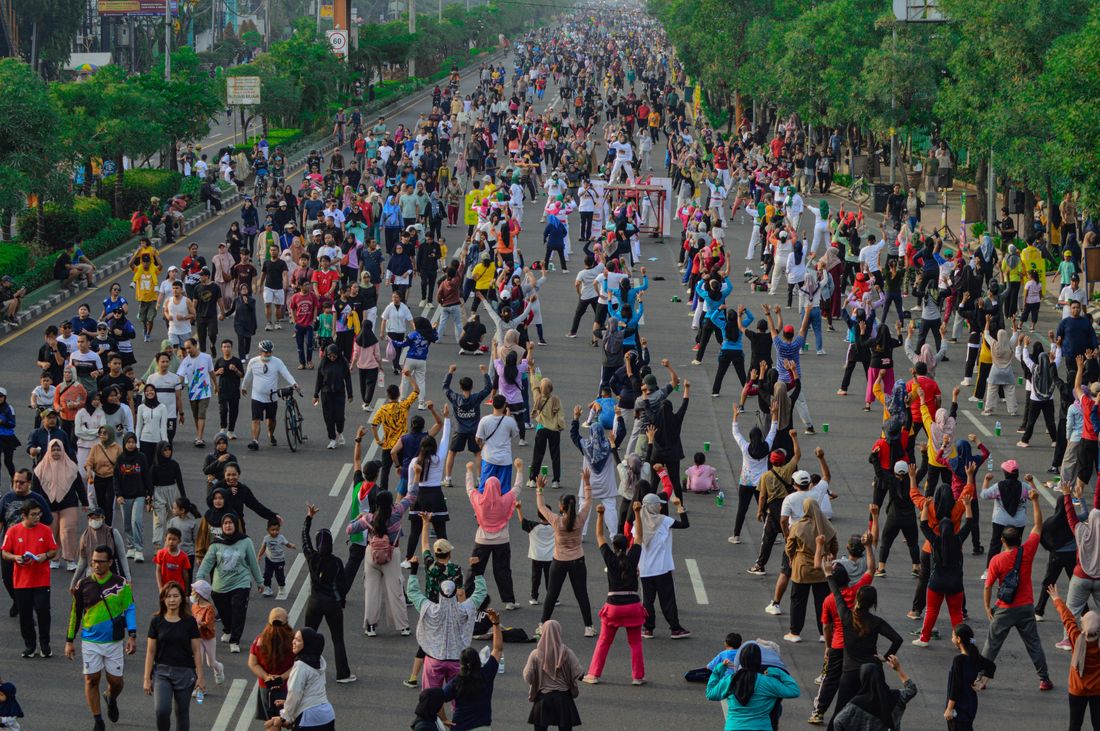
Photo by Anhar Buyung via Pexels.
Here's something a stage-based coverage plan doesn't survive contact with: a charity walk, run, or ride has no stage. It has a start corral that fills and empties inside twenty minutes, a route that can stretch for miles with participants strung out across it all morning, and a finish line that runs on its own clock as the fastest and slowest finishers cross an hour or more apart. Covering it well means throwing out the ballroom playbook and building a plan around the shape of the course instead, from bib-number consent to how many shooters an actual route needs.
Covering an endurance fundraiser, a charity walk, run, or ride, means planning coverage around fixed points on a course, the start corral, the midpoint, and the finish, rather than following one stage the way a gala shoot does. It also means treating bib numbers as identifying information, working sponsor visibility into real moments instead of posed shots, and sizing the shooter count to the course shape, not the headcount.
Table of Contents
- What Actually Changes When the Room Is a Start Line and a Route?
- What Changes About Light and Gear for an Outdoor Endurance Event?
- How Should Bib Numbers and Consent Get Handled Along the Route?
- What Does a Route-Based Shot List Look Like Instead of a Stage-Based One?
- How Does Sponsor Visibility Get Captured Without the Photos Looking Like an Ad?
- What's the Case for Video, Not Just Stills, at a Start or Finish Line?
- How Many Photographers or Videographers Does an Event Like This Actually Need?
- What Does the Resulting Photo and Video Library Get Used for After the Event?
What Actually Changes When the Room Is a Start Line and a Route?
A ballroom event has one stage and one crowd in one room; an endurance fundraiser has thousands of people spread across a start line, a mile-long route, and a finish line, all moving at once. Coverage has to plan for scale and distance instead of a single vantage point, or most of the day goes uncaptured.
At a gala, I can stand near the stage and know the next usable frame is coming, because the run of show tells me where to look. A walk, run, or ride has no equivalent. The start corral fills for twenty minutes and then empties all at once. The route stretches for miles with participants strung out along it for the whole morning, and the finish line runs on its own clock as the fastest and slowest finishers cross an hour or more apart. Planning around one location the way a ballroom shoot does means missing whatever isn't happening in front of the camera at that exact moment. The fix isn't more hustle on the day, it's a different map drawn before the day starts, one built around the shape of the course instead of the shape of a room.
What Changes About Light and Gear for an Outdoor Endurance Event?
Outdoor light at a walk or run is uncontrolled and changes all morning, moving from flat pre-dawn light at the start to hard overhead sun by the time the last wave finishes. Gear has to account for that swing directly: faster shutter speeds for moving subjects, a longer lens for the route, and a plan for both ends of the light curve.
A ballroom's house lighting stays the same from the first toast to the last. A 5K or a charity ride starts in early, flat light, moves through the harsh shadows of midday sun, and can end in a completely different light quality than it began in, all inside a single assignment. That swing changes exposure settings repeatedly through the morning rather than once at setup. Subjects are also moving at running or cycling pace rather than walking to a podium, which pushes shutter speed up across the board. A longer lens earns its place here too, since a photographer working the route often can't get physically close to a runner or rider without stepping into their path, so distance has to be covered by glass instead of proximity.
How Should Bib Numbers and Consent Get Handled Along the Route?
A charity walk or run happens on public streets, which means bystanders and other participants end up in frames a photographer never set out to take, alongside the registered walkers and runners who did sign a waiver. The safe default is to treat bib numbers as identifying information and keep unrelated bystanders out of frames meant for marketing use.
Registered participants typically sign a waiver as part of entry that covers event photography, but that waiver doesn't extend to the person walking their dog past the route or the family watching from a stoop. A shot that's mostly a registered runner with a stranger visible in the background is a different liability question than one with only participants in it. Bib numbers add a second layer, since a number is tied to a name in the event's own registration system, and a clearly readable bib in a marketing image is closer to publishing a name than most people realize. Framing tighter on faces and moments rather than wide crowd shots, and keeping bibs out of focus where possible, keeps the resulting library usable without a legal question attached to it later.
What Does a Route-Based Shot List Look Like Instead of a Stage-Based One?
A route-based shot list assigns coverage to fixed points along the course, the start corral, a midpoint with a natural backdrop, and the finish chute, instead of following one subject the way a stage-based plan follows a speaker. Each point gets its own priorities, because the start, the middle, and the finish are three different emotional moments, not one continuous scene.
A keynote shot list is built around a single person moving through a predictable sequence: walk-on, remarks, exit. A walk or ride shot list works the other way, built around fixed points that thousands of different people pass through once. The start corral wants energy and anticipation, packed bodies, signage, the moment before the horn. A mile marker or a natural landmark along the course wants the grind of the middle, when the crowd has thinned out and the effort shows on faces. The finish chute wants triumph, and it's usually the highest-value real estate on the whole course, since it's where a photographer catches the widest range of finishers, from the competitive front pack to the walkers crossing hours later to a genuine ovation.

Photo by Nguyen Ngoc Tien via Pexels.
How Does Sponsor Visibility Get Captured Without the Photos Looking Like an Ad?
Sponsor visibility matters because sponsorship funding is often what makes the event possible, and organizers need images that show banners, branded tents, and activation booths in a recap deck. The way to capture that without the gallery reading like an advertisement is to let sponsors appear as part of a real scene instead of staging a logo-forward frame.
A banner stretched across the finish line or a sponsor's branded water station is part of the actual event, the same way a step-and-repeat is part of a gala, so it belongs in the coverage. The difference between useful sponsor documentation and an ad-style photo is mostly about what's happening in front of the branding. A runner grabbing water in front of a sponsor tent, caught mid-motion, reads as documentary. A posed shot of the tent alone with nobody using it reads as an ad slide, and organizers rarely want that in a recap gallery anyway. Working sponsor visibility into genuine moments, rather than treating it as its own separate shot category, gives the recap deck what it needs without turning the whole gallery into a wall of logos.
What's the Case for Video, Not Just Stills, at a Start or Finish Line?
Video earns its place at a start and finish line because the sound and motion of a crowd counting down or an announcer calling finishers by name is most of what makes those moments land, and a still photo can't carry that. A short recap edit built from start-horn and finish-chute footage does work stills alone can't.
A still frame of a packed start corral is a good image, but it's missing the horn, the collective cheer, and the wave of motion that actually defines the moment for anyone who was there. The same is true at the finish, where an announcer often calls out names or team affiliations as people cross, adding a layer no photo captures. A short video crew doesn't need to replace stills coverage to add real value here; a handful of clips at the two highest-emotion points on the course, cut into a thirty- to sixty-second recap, gives organizers something stills alone can't: a piece built for social and for next year's fundraising push that plays the actual sound of the day back to people who felt it.
How Many Photographers or Videographers Does an Event Like This Actually Need?
The honest answer scales with the course, not the headcount at the finish line: a single shooter can cover a compact loop course with one central vantage point, but a point-to-point route or a course longer than a couple of miles needs coverage split across at least two fixed points to avoid a long dead stretch with nobody documenting it.
A loop course that starts and finishes in the same place lets one photographer work the start, cut across the interior of the loop, and be back at the finish before the front pack arrives, which is a real logistical advantage smaller walks and rides have. A point-to-point route removes that option entirely, since the start and finish are in two different places and nothing shortcuts the distance between them. In that case, coverage has to be planned as two or more separate assignments from the outset, each with its own shooter, rather than one person trying to be in two places. Deciding this before the event, based on the actual course map rather than a guess, is what keeps the finish chute from being the only real coverage anyone ends up with.
What Does the Resulting Photo and Video Library Get Used for After the Event?
The library from a walk, run, or ride mostly ends up doing next-year fundraising work: a recap email to this year's donors and participants, a highlight reel for next year's registration page, and sponsor-facing proof that the activation was seen and used. Knowing that ahead of time should shape the shot list, not just the delivery folder.
A donor recap email wants a small set of genuinely moving images, finish-line emotion, a close call for a cause someone can name, delivered fast enough to land while the event is still fresh in an inbox. A next-year registration page wants the opposite kind of image: aspirational, energetic shots that make someone who didn't participate this year want to sign up for the next one. A sponsor report wants clear, uncluttered documentation that a banner or activation was actually part of a well-attended event, which is a different image than either of the other two uses. Sorting a gallery into those three buckets at delivery, rather than handing over one undifferentiated folder, is what makes the library actually get used instead of sitting in a drive nobody opens again.
Frequently Asked Questions
How is photographing a charity walk or run different from covering a gala?
A gala happens in one room with a run of show and a single stage to anchor coverage to. A walk or run happens across a start corral, a route that can stretch for miles, and a finish line that operates on its own clock for an hour or more. Coverage has to be planned around fixed points along a course instead of one continuous scene, which is a different production exercise, not a harder version of the same one.
Do bib numbers need to be blurred or kept out of marketing photos?
A bib number ties directly to a name in the event's own registration system, so a clearly readable bib in a public marketing image is closer to publishing that name than it looks. The safer default is framing tighter on faces and moments so bibs land out of focus or out of frame, rather than relying on a registration waiver to cover every image the event ends up publishing later.
Does a charity ride or run need video, or are stills enough?
Stills carry most of a walk or run gallery, but a short video, even just a start-horn clip and a handful of finish-chute moments, captures the crowd's sound and motion in a way no still photograph can. A thirty- to sixty-second recap edited from those two points gives organizers a piece built for social and for next year's fundraising push that a photo set alone can't fully provide.
How should sponsor banners and activation tents be photographed at a fundraising event?
Sponsor visibility matters for the recap deck, but a posed shot of an empty tent reads like an ad slide. The better approach documents sponsors inside real moments, a runner grabbing water at a branded station, mid-motion, rather than as a separate logo-forward shot category. That keeps the sponsor report useful without turning the whole gallery into a wall of branding nobody wants to look at.
How many photographers does a 5K or charity ride actually need?
It depends on the course shape more than the headcount. A loop course that starts and finishes in the same place can often work with one shooter moving between the start, the interior, and the finish. A point-to-point route removes that shortcut entirely and needs coverage split across at least two fixed points from the start, decided from the actual course map rather than guessed on the day.
Related Reading
Not sure if hourly or a package makes more sense for your event?
Tell us the expected length, and we'll run the actual numbers before you book.
See Event Coverage Packages