Every event photography quote gets negotiated on hours. Almost none get negotiated on headcount, even though headcount is the variable that actually decides what gets covered. A four-hour shoot with one photographer and a four-hour shoot with two aren't the same job at a different price. They're two different coverage plans wearing the same duration.
The photographer or videographer count on an event decides what can be covered at the same time; the hours booked decide only how long that crew works. One shooter handles a single-room, sequential program well. Adding a body buys coverage of a second room, a second angle, or a separate assignment, not more time from the same one person.
Table of Contents
- Headcount vs. Hours: The Variable Buyers Get Wrong
- What One Shooter Actually Covers
- The Simultaneity Problem No Single Shooter Can Solve
- The Second Body: A Parallel Room, or a Locked-Off Camera Plus a Roamer
- The Third Body: A Portrait Station or a Second Angle on the Keynote
- Where the Returns Flatten
- How Crew Count Shows Up in a Quote
- How to Size the Crew for Your Actual Event
Headcount vs. Hours: The Variable Buyers Get Wrong
Hours are elastic. Book more time and the schedule stretches to fit. Crew size is not elastic the same way: it sets how many places a shoot can physically be at once. Buyers who negotiate hours down but never touch headcount are often solving the wrong constraint, because time was rarely the actual bottleneck.
In practice, most planning conversations start with a duration question: four hours or six, half day or full day. That's the easy number to reason about, because everyone has booked a block of time before. Crew count gets treated as an afterthought, something to add if the budget allows, rather than a decision tied to what the event actually needs covered.
The two variables solve different problems. Hours buy duration, how long coverage runs. Crew buys simultaneity, how many things can be covered at the same moment. A longer booking with one shooter still means one person in one place at any given time. That's the distinction worth sitting with before either number gets negotiated.
What One Shooter Actually Covers
One experienced shooter covers a linear event well: a single room, a program that moves through arrivals, remarks, and networking in sequence, with nothing important happening anywhere else at the same time. Most corporate events are exactly this shape, which is why a single operator is the default on our own event packages, not an exception.
A single shooter also means one point of view carried through the whole event, which has a real upside (consistent framing, consistent color, and one person who understands the room by the second hour instead of two people comparing notes). For a reception, a small panel, or a straightforward all-hands, that consistency often matters more than extra coverage would.
The limiting factor isn't skill. A good photographer or videographer working alone can move fast, anticipate a moment, and still catch it. What one person cannot do is be in the ballroom for a keynote and in the sponsor lounge for the same fifteen minutes. That's not a pacing problem time can fix. It's a physical one.
The Simultaneity Problem No Single Shooter Can Solve
No amount of booked time fixes two things happening at once in two rooms. A shooter given eight hours instead of four still can't split into two people during the ten minutes a keynote and a breakout session overlap. That overlap is a headcount problem, and buyers who respond to it by extending hours are solving for the wrong variable entirely.
This is where the hours-vs-headcount confusion actually costs someone something. A planner worried about gaps in coverage sometimes books extra time on either end of the event, assuming more hours means less gets missed. It helps with setup and teardown. It does nothing for the fifteen minutes when the CEO is on stage and the donor reception starts in the next room.
Sequential problems get solved with time. A long day, a multi-segment program, remarks that run late (hours absorb that). Simultaneous problems get solved with people. Once two things that matter are happening at once, the only fix is a second body in the second room, not a longer booking for the first one.
The Second Body: A Parallel Room, or a Locked-Off Camera Plus a Roamer
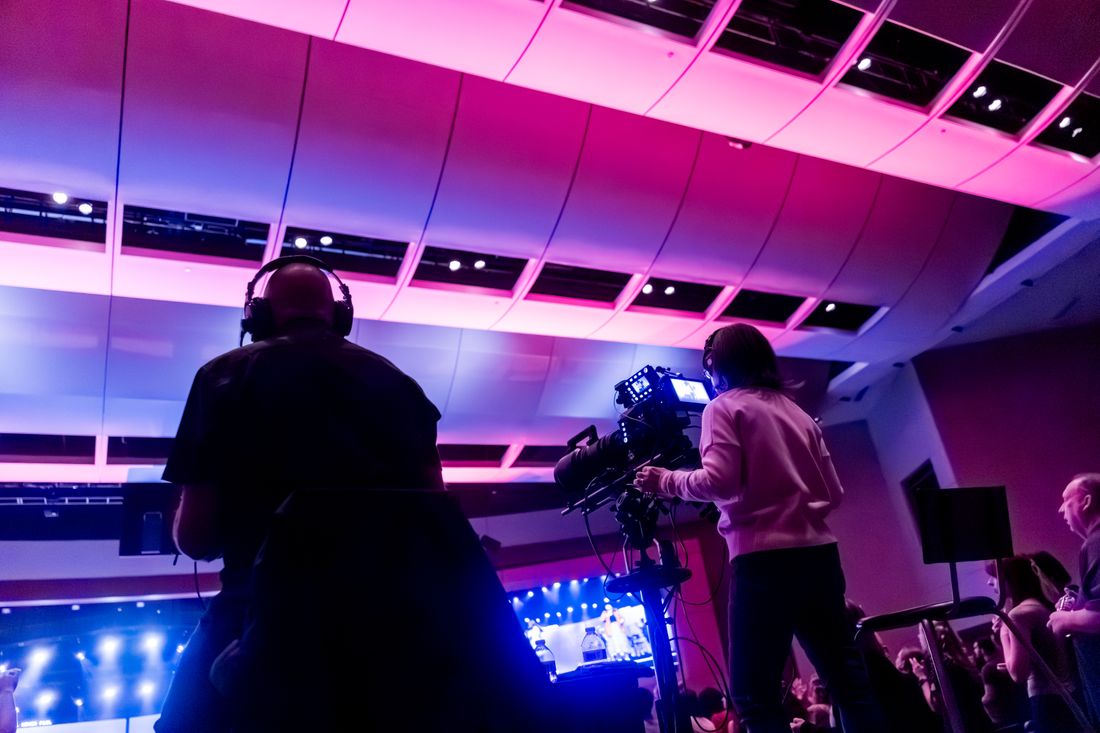
A second person on a shoot buys one of two things: coverage of a parallel room happening at the same time, or a split inside a single room where one operator holds a locked-off wide angle on the stage while the other moves through the crowd for reactions and detail. Which one you need depends on where the event's real risk sits.
For a program spread across a main room and a breakout, the parallel-room case is straightforward. One shooter per room for the window they overlap. For a single stage event, the locked-off-plus-roamer split is often the better use of a second body, especially for video, where a static wide shot protects the keynote itself while a second camera builds the reaction shots and cutaways an editor actually needs.
What a second shooter changes about a single-room shoot specifically (assignment, redundancy, how the footage gets combined) is its own topic. The headcount point here is narrower: a second body is the first place simultaneity actually gets solved, and it's usually solved with exactly one more person, not three.
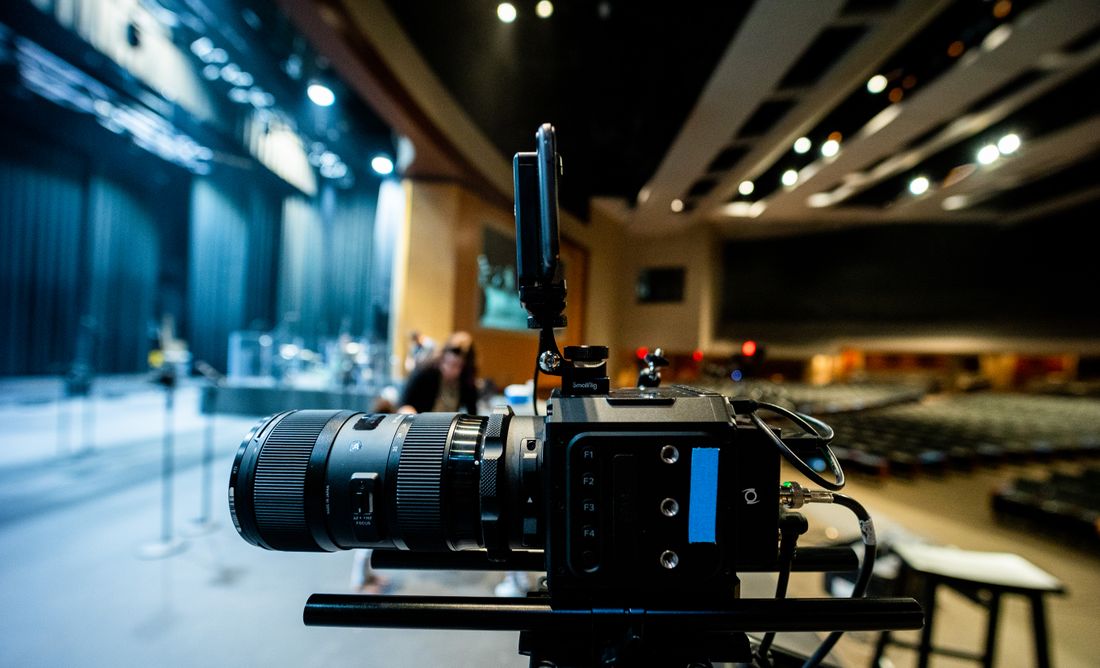
Photo by Caleb Oquendo via Pexels.
The Third Body: A Portrait Station or a Second Angle on the Keynote
A third person on an event usually buys one of two specific things: a staffed portrait station running the whole time as its own self-contained assignment, or a third camera angle on a single high-value moment like a keynote, where two matching wide-and-tight shots aren't enough to cut a clean video. Past that, a third body is rarely about general coverage anymore.
A portrait station is the cleanest example, because it doesn't compete with event coverage at all. It's a separate job happening in a separate corner, staffed by someone who never touches the main gallery. We price that as its own add-on with its own day rate, not as a percentage tacked onto event coverage, because it genuinely is a different service running in parallel.
A third camera on a keynote is narrower still: useful when the moment is a one-time, high-stakes event (a CEO transition, a major product reveal) worth the redundancy. For most programs, a third body is solving a problem that two bodies, assigned well, already covered.
Where the Returns Flatten
Returns on crew size flatten once every simultaneous need in the run of show has a body assigned to it. Beyond that point, an additional shooter mostly produces near-duplicate frames of ground someone else already has covered, not new coverage, the same flattening that shows up when a second shooter gets added to an event with nothing actually happening at once.
The honest test is counting overlaps in the actual schedule, not guessing at a headcount that feels safe. A run of show with one stage, one program, and no breakout has zero simultaneous moments to cover, regardless of guest count or event length. A run of show with a main stage, two breakouts, and a sponsor activation running concurrently has three or four, and headcount should roughly track that number, not attendee count.
Bigger events don't automatically need bigger crews. A five-hundred-person single-track conference still has one thing happening at a time. A hundred-person event with three concurrent sessions has more simultaneity than the larger single-track show, and the crew size should reflect the schedule's shape, not the room's.
How Crew Count Shows Up in a Quote
Crew count tends to move a quote in steps, not as a smooth per-hour add-on the way extra time does. Going from one operator to combined photo-and-video coverage with a second camera is usually a jump to a different package tier rather than a line item stacked onto the existing one, because the added body changes the whole production, not just the invoice.
Our own event packages make this visible. The single-operator tiers cover photo or video, one person, start to finish. Moving to combined photo-and-video coverage (two-camera video plus a separate photo track) is a distinct package built around that added crew and the editing it requires, not the same package with a surcharge attached. A dedicated portrait station works the same way: its own day rate, booked as its own add-on, not a percentage on top of coverage.
That structure is worth understanding before requesting a quote. Ask what the base crew size actually is for a package before assuming "full day" or "premium" automatically means more than one person is showing up.
How to Size the Crew for Your Actual Event
Size crew by counting real overlaps in the run of show, not by guessing at a number that feels proportional to the budget or the guest list. Walk the schedule and mark every window where two things that matter happen at once (a stage program and a breakout, a keynote and a portrait line), and that count is close to the crew size actually needed.
Start with the program, not the venue. A big room with one thing happening at a time still needs one shooter. A modest space running two tracks needs two. Then check format: if photo and video are both required through the same overlapping window, that split often needs its own body too, even inside a single room, since one person can't shoot stills and hold a stable video frame at the same time.
When in doubt, describe the actual schedule to whoever is quoting the job rather than asking for "extra coverage" in the abstract. A specific run of show gets a specific crew recommendation. A vague request usually gets a padded one.
Frequently Asked Questions
How many photographers do I need for a corporate event?
Count the simultaneous moments in your actual run of show, not your guest list or the size of the room. A single-track program in one room, however large the audience, still needs only one photographer. Add one body for each additional room or moment running at the same time (a breakout during the keynote, a portrait station during networking). Most single-room corporate events, even large ones, are well covered by one experienced shooter working alone.
Does adding a second shooter mean twice as many photos?
No. A second shooter exists to catch what a single camera would physically miss (a parallel room, a second angle on a stage moment), not to double the size of the gallery. Expect a fuller, more complete set of usable images, because more of the actual event gets documented, but the real value is coverage you'd have lost entirely, not extra volume of moments already being shot from one angle.
How does event video crew size affect the cost differently than hours?
Hours tend to price close to linearly. Book more time, pay a roughly proportionate add. Crew size usually moves in steps instead: going from one operator to a combined photo-and-video team with a second camera is typically a jump to a different package tier built around that added crew, not a small surcharge stacked onto the existing one. A dedicated portrait station works the same way, priced as its own separate line item with its own rate.
When does a third photographer or videographer actually make sense?
Usually only when a third genuinely simultaneous need exists (a staffed portrait station running for the full event as its own separate assignment, or a one-time, high-stakes moment like a CEO keynote or product reveal worth a third camera angle for the edit). Outside those specific cases, a third body mostly re-covers ground that two well-assigned people already have, which adds real cost without adding real coverage.
Can one photographer or videographer cover both photo and video at a corporate event?
For a narrow moment, sometimes. A quick portrait or a short interview can work with one operator switching formats. For full simultaneous coverage across a program, it's a harder ask: a photographer is chasing expressions and moving through the room, while a video operator needs a stable, continuous angle and clean audio at the same time. Asking one person to do both usually means one format ends up shortchanged.
Related Reading
Trying to lock down coverage for an event that's still taking shape?
Give us the rough schedule and we'll tell you whether hourly or a package actually saves you money.
See Event Coverage Packages