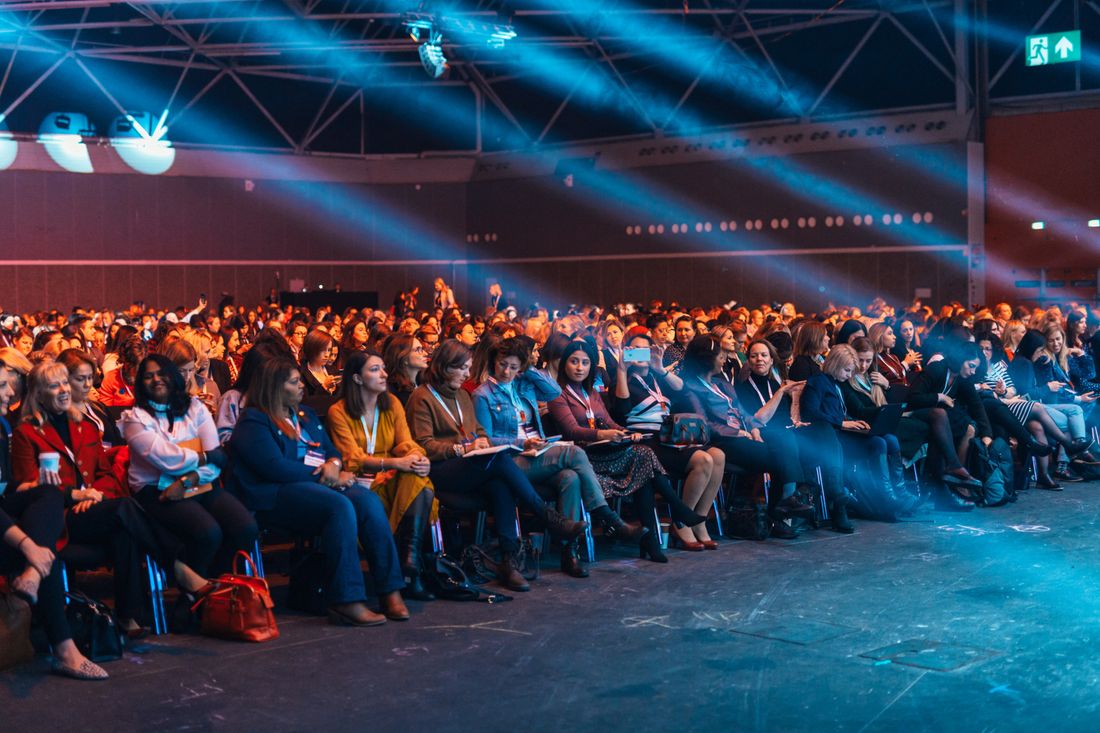
Photo by Loveleen Cherub via Pexels.
A trade association running its own annual conference isn't putting on a public event for outside press. The people in the seats are the members who pay dues every year, and the whole week is a live argument for why that membership is worth renewing. That changes what's worth documenting. A generic "cover the conference" brief chases keynote moments and clean wide shots. An association's own annual meeting needs proof that members showed up, stayed engaged, and got something real out of being there, because that proof is what next year's renewal and recruitment materials get built from.
A trade association's own annual conference needs coverage built around member engagement, not press-facing polish, because the audience is the dues-paying membership and the real metric is renewal, not headline pickup. Committee sessions, chapter tables, leadership continuity, and advocacy work matter more here than a generic keynote shot list would suggest.
Table of Contents
- What Makes a Trade Association's Own Annual Conference a Different Coverage Job
- The Leadership Transition Is the Moment With No Retake
- Committee Meetings and Chapter Tables Carry the Real Engagement Story
- The Exhibit Hall Needs Traffic Proof, Not a Tidy Wide Shot
- Awards and Member Recognition Need the Same No-Retake Planning as the Leadership Moment
- Advocacy and Policy Sessions Need Documentation, Not a Glamour Shot
- Building the Shot List Around Renewal and Recruitment, Not a Highlight Reel
- Turning One Annual Conference Into a Year of Association Content
What Makes a Trade Association's Own Annual Conference a Different Coverage Job
A trade association's annual conference is built for its own dues-paying members, not for outside press or the general public, and that single fact changes what a camera should prioritize all week. The association itself is effectively the brand being proven, and member engagement — not headline pickup — is the metric the deliverables need to support.
A generic conference brief defaults to keynote coverage and tidy wide shots of a stage, because that's what a public-facing event usually needs for press pickup. A trade association's own meeting runs on a different logic: committee sessions, chapter tables, a leadership transition on stage, members actually talking to each other in a hallway. None of that reads as newsworthy to an outsider, and none of it needs to. It reads as proof to a member deciding whether renewing dues next year is worth it, which is the only audience this event is really performing for. Confusing the two jobs is an easy mistake to make, since both events look similar from behind a camera — a stage, a podium, rows of chairs.
The Leadership Transition Is the Moment With No Retake
A gavel passing from the outgoing president to the incoming one, or a new slate of officers being installed on stage, is usually the single highest-stakes moment of a trade association's annual meeting. It happens once, fast, and it becomes the image the association uses to represent continuity for the entire coming year.
That makes advance planning worth more than any lighting setup. Knowing the run of show, where the outgoing and incoming leaders will stand, and whether there's a physical object changing hands — a gavel, a chain of office, a plaque — means the shot exists when it happens instead of being missed while a camera is still finding focus. A second angle from the audience side catches something the stage shot can't: the room's reaction, longtime members watching one of their own step into the role. That reaction shot often ends up doing more work in the annual report than the handshake photo itself. There's no re-staging a gavel pass after the fact.
Committee Meetings and Chapter Tables Carry the Real Engagement Story
The sessions that matter most for proving member engagement are rarely the ones with the biggest room. A packed committee meeting or a busy chapter table in a hallway is often better proof that the association's structure actually works than a well-attended keynote is, because it shows members participating, not just watching.
That reprioritizes where time goes during the day. A committee session with visible discussion — members leaning across a table, papers and laptops out, real back-and-forth — is worth documenting even if the topic is narrow and procedural. A chapter table with a small crowd trading business cards or comparing notes on local programming tells a membership-growth story a keynote photo can't. Reading which rooms have genuine participation, rather than defaulting to whichever room is biggest, is what turns a day of general coverage into material the association can actually use to show its structure at work. A brief scan of the agenda before the day starts, flagging which sessions historically draw a crowd, is usually enough to plan around without needing to guess in the moment.
The Exhibit Hall Needs Traffic Proof, Not a Tidy Wide Shot
A sponsor or exhibitor floor at a trade association's conference renews its sponsorships based on evidence that members actually stopped and engaged, not on a clean, empty wide shot of the booths. A photo of real conversation at a table does more for next year's sponsorship pitch than a symmetrical establishing shot ever will.
One wide shot early in the day is still worth taking, mainly to show the hall's layout and scale. Everything after that should chase evidence of traffic: a member leaning over a table to ask a question, a small line waiting for a demo, a sponsor rep mid-conversation with someone taking notes. Sponsors are essentially renewing a membership of their own each year, and a photo set that shows genuine interest is a stronger argument for that renewal than a caption claiming the floor was busy. Timing helps too — traffic usually peaks right after a session lets out, when members walk the floor between sessions. Knowing that rhythm ahead of time means the crew is positioned for it instead of catching the tail end of a crowd that's already thinning out.

Photo by Liliana Drew via Pexels.
Awards and Member Recognition Need the Same No-Retake Planning as the Leadership Moment
Scholarship presentations, lifetime achievement awards, and member-of-the-year recognitions run on the same fast, unrepeatable rhythm as a leadership transition: a name is called, someone walks up, there's a handshake or a plaque, and the program moves on. Missing that sequence means missing the photo the whole segment existed to produce, and there usually isn't time built into the program to redo it.
Knowing the order of recipients and where they'll be called from ahead of time is what makes the difference between catching the moment and catching the aftermath. These images get reused longer than almost anything else from the event — next year's call for nominations, a recipient's own LinkedIn post, a spot in the association's newsletter announcing the winner. A wide shot of the room applauding, taken from the audience side rather than the stage, usually captures the warmth of the moment better than a tight shot on the recipient alone. Getting a name list and a rough order from the association's staff beforehand, even an informal one, removes most of the guesswork once the program is actually moving.
Advocacy and Policy Sessions Need Documentation, Not a Glamour Shot
Many trade associations exist partly to represent their industry's interests, and an annual conference often includes a policy briefing, a legislative update, or an advocacy-day recap. These sessions rarely produce a dramatic image, but documenting that the work happened matters to members who fund that advocacy through their dues.
The coverage goal here is straightforward: a clear, well-lit shot of the speaker and the room, a wide shot showing attendance, maybe a moment of members taking notes or raising a hand with a question. This is a case where restraint matters more than creativity — the photos exist to show members that this part of their membership is real and active, not to make a policy briefing look more dramatic than it was. (Any specific legislative or regulatory content in the room stays the association's own material to characterize; a crew's job is documenting that the session happened, not interpreting what was said.) A well-lit, clearly attributed photo of the session is what supports that record later, whether it's used internally or shared with members who couldn't attend.
Building the Shot List Around Renewal and Recruitment, Not a Highlight Reel
The shot list for a trade association's annual conference works best when it's built backward from where the images actually get used: next year's registration email, a membership renewal appeal, the annual report, a chapter's own recruiting page. Each of those needs something specific, not a generic highlight reel of the event.
A renewal appeal wants images that show belonging — members talking, a full room, a recognizable face from a local chapter. A recruitment page for prospective members wants a sense of what showing up would actually feel like: engaged sessions, a lively exhibit floor, a leadership team that looks approachable. Agreeing on these reuse cases with the association's staff before the event, rather than guessing afterward, is what turns a single day of photos into a set that actually gets used across a full year of member communications instead of sitting in a shared drive. A short conversation with staff a week or two out, walking through which channels the photos will feed, costs almost nothing and saves a reshoot later.
Turning One Annual Conference Into a Year of Association Content
A single well-planned shoot at the annual conference can supply a trade association's content needs for the full year until the next one: renewal emails, chapter newsletters, social posts recognizing award winners, recruitment materials for prospective members. Treating the event as a year's content bank, not a one-day deliverable, is what makes the planning effort worth it.
That framing changes how the day gets worked. Instead of chasing a general highlight reel, the goal becomes a sorted set of assets: leadership transition for the annual report, committee and chapter engagement for renewal messaging, exhibit floor traffic for the sponsorship deck, awards for recognition posts and next year's call for nominations. Handing the association's staff a labeled, sorted set at delivery — rather than one long folder — is a small step that saves them real time and makes it far more likely the content gets used across the channels it was actually shot for, rather than filed away and forgotten until the next conference rolls around.
Frequently Asked Questions
What's actually different about photographing a trade association's own annual conference?
The audience is the association's own dues-paying membership, not outside press or the general public, and the real metric is renewal and engagement, not headline pickup. That shifts priority toward committee sessions, chapter tables, leadership continuity, and advocacy work — the things that prove the membership is worth renewing — rather than the keynote-heavy shot list a generic public conference would call for. The stage looks the same either way; the priorities behind the camera differ.
What's the single highest-priority moment at an association's annual meeting?
A leadership transition — an outgoing president handing off to an incoming one, or a new slate of officers being installed — usually carries the most weight. It happens once, fast, with no retake, and becomes the image the association uses to represent continuity for the year ahead. Knowing the run of show and stage positions in advance matters more than any lighting setup for that specific sequence.
Do committee meetings and chapter tables really need coverage over the main keynote?
They deserve real priority, not automatic top billing. A packed committee session or a busy chapter table often proves member engagement better than a well-attended keynote does, since it shows people participating rather than just watching. Reading which rooms have genuine discussion, instead of defaulting to whichever room is biggest, produces material that better represents the association's structure at work — and a quick look at the agenda ahead of time usually shows which sessions are worth planning around.
Why photograph exhibit hall conversations instead of a clean, empty booth shot?
Sponsors renew based on evidence that members actually engaged, and a tidy empty booth photo proves nothing about that. Real conversation — a member leaning over a table, a short line waiting for a demo — is the evidence a sponsorship renewal pitch actually needs. One wide establishing shot early in the day is useful; everything after that should chase traffic, ideally timed around when a session just let out.
How does conference coverage actually help with membership renewal?
Building the shot list backward from where images get used — a renewal appeal, the annual report, a chapter recruiting page — means the day produces material that supports those specific channels instead of a generic highlight reel. A renewal appeal needs images that show belonging; a recruitment page needs a sense of what attending would actually feel like. Agreeing on that with association staff before the event is what makes it usable all year.
Related Reading
Not sure if hourly or a package makes more sense for your event?
Tell us the expected length, and we'll run the actual numbers before you book.
See Event Coverage Packages