Photo: Core Visuals NYC
A client who is genuinely great at their job usually can't read a script out loud and sound like a person. Hand someone three sentences of marketing copy and ask them to say it to a camera, and you get a performance (stiff, over-enunciated, eyes flicking to the page just off-lens). It isn't a talent problem. It's a format problem.
A scripted testimonial fails twice: the client can't deliver written lines like a natural speaker, and the audience can hear the read the second it starts. The fix isn't a tighter script. It's dropping the script entirely, running the segment as a real interview, and building the finished testimonial out of the answers afterward, in the edit.
Table of Contents
- Why a written script gives you the worst possible read
- Run it as an interview, write the script in the edit
- Ask about the before, the decision, and the change
- What the pre-interview conversation is actually for
- The setup that makes people forget the camera
- Get every answer as a complete sentence, not a fragment
- Record more than you need, and shoot the b-roll to cut it
- The approval loop that kills more testimonials than a bad performance
Why a written script gives you the worst possible read
A written script gives a non-actor the worst possible read: stiff pacing, over-enunciation, and eyes that drift toward the page. The fix is to never write the client's lines at all. Get the same content through a spoken answer to a real question instead.
People who aren't performers read written language differently than they speak it. Give someone a sentence like "the turnaround time made a real difference for our team" and they'll say it like they're reading a sentence, because they are. The rhythm is wrong, the emphasis lands on the wrong words, and there's no way to hide the fact that a camera is pointed at someone reciting something. Viewers pick up on this instantly, even if they can't name what's off. A script also strips out the specific detail that makes a testimonial worth watching in the first place. Nobody writes "we were three weeks behind on the launch and didn't know it yet" into marketing copy, but that's the sentence someone says out loud when you ask the right question. The words a person chooses on their own, mid-thought, carry a texture that a script can't fake.
Run it as an interview, write the script in the edit
Running a testimonial as an interview means the client never sees a script and never has to perform. They simply answer real questions in their own words, out of order, and the finished piece gets assembled afterward from whichever answers actually work, cut together in the edit.
This flips the entire production. Instead of handing someone lines and asking for a performance, I ask questions and record the conversation. Nobody has to remember anything, hit a mark, or worry about sounding polished in the moment, because the polish happens later, not on camera. The interview format also produces more usable material than a scripted read ever could. A five-minute conversation might yield four or five moments strong enough to cut together, where a scripted thirty-second read either works or it doesn't. There's no partial credit with a script; a flubbed line means starting over. An interview absorbs stumbles, false starts, and the client thinking out loud, because none of that has to survive the edit. The final testimonial is built like any other piece of video (from the best material available) instead of one unbroken take that has to be perfect.
Ask about the before, the decision, and the change
Good testimonial questions ask about a specific before state, a specific decision the client made, and a concrete change that followed, never a broad "how was your experience," which reliably produces vague adjectives like great or smooth instead of anything a viewer can actually picture or choose to believe.
"How was your experience working with us" invites "great" or "really smooth," words that could describe anything and convince nobody. Better questions have a shape: what was happening before you started looking for this, what made you pick this option over the others, and what's different now that's specific enough to notice. "What was the office move like before you had updated photos" gets a real answer about outdated headshots on a careers page. "What made you choose to shoot this in-house instead of hiring an agency" surfaces an actual reason, not a compliment. The goal isn't flattery. It's specificity a stranger can evaluate. A viewer doesn't trust "they were great to work with." A viewer trusts a detail that sounds like it came from an actual situation, because it did. Questions built around before, decision, and change are the mechanism that gets you there.
What the pre-interview conversation is actually for
The pre-interview conversation happens before the camera is on, and its only job is to surface the client's real answers once, in a low-stakes setting, so they aren't discovering what they actually think for the first time on camera, where that discovery reads on screen as hesitation and awkward pauses.
I'll spend ten or fifteen minutes talking through the same ground the interview will cover, not rehearsing lines, just talking. What was going on before, what changed, what would you tell someone considering the same thing. People often give their best, most specific answer in this off-camera conversation, then flatten it once the camera starts, because now they're aware they're being recorded. Having heard the real answer once means I can nudge them back toward it: "that's the thing you just told me, say that." It also means I'm not fishing for a good answer live, on the client's time, with a camera running and everyone watching the clock. The pre-interview isn't about locking language. It's about finding out what's actually there to say before asking someone to say it in front of a lens.

Photo by Vitaly Gariev via Pexels.
The setup that makes people forget the camera
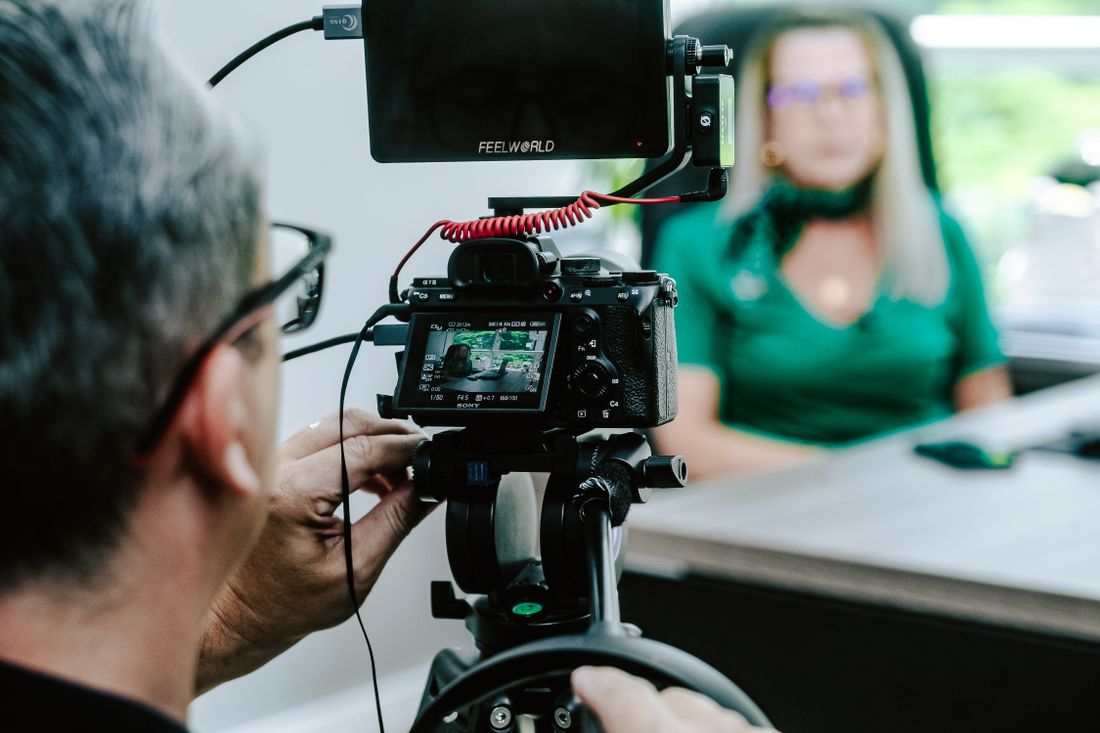
The setup that makes people forget the camera is a small crew, an eyeline aimed at a person instead of a lens, no teleprompter, and a room the client already feels at ease in, usually their own office rather than a neutral studio.
A single camera operator and maybe one more person changes the dynamic entirely compared to a full crew standing around a monitor. I sit near the lens, not behind it, so the client is talking to a person, not addressing a black circle. No teleprompter. Reading off a screen produces the same flat delivery a memorized script does, just with better eye contact. Room choice matters more than people expect: a client's own office, with their own chair and their own window light, removes an entire layer of self-consciousness that a rented studio with three softboxes never lets go of. None of this is about tricking anyone into forgetting a camera exists. It's about removing every extra cue that reminds them a performance is expected, so what's left is closer to how they'd actually talk.
Get every answer as a complete sentence, not a fragment
Recording so the edit works without the original question audible means asking questions specifically built to require a complete-sentence answer, so the client's response makes full sense entirely on its own, with no context missing, once the interviewer's question is trimmed out of the final cut.
If I ask "did the new site help with hiring" and someone answers "yeah, a lot," that clip is unusable. It only means something next to a question nobody will hear in the final cut. So I ask "what changed about hiring after the new site went up" instead, which pulls a full sentence out of most people without prompting: "hiring got easier once the site actually looked like the company we are." That sentence stands alone. Sometimes a client still answers in fragments, and the fix isn't editing around it. It's asking the same question again, differently: "say that back to me as a full sentence, like you're telling a friend." People do this naturally once they understand what's being asked. The questions disappear in the final cut entirely; the answers are the only thing that survives, so every answer has to work without them.
Record more than you need, and shoot the b-roll to cut it
Plan to record roughly ten to twenty minutes of conversation for a testimonial that finishes at ninety seconds to two minutes, and shoot b-roll of the client's actual work environment so the cut has somewhere to go besides a straight jump cut.
That ratio isn't wasted footage. It's the range needed to get past the first few answers, which tend to be the most rehearsed-sounding even without a script, and into the material that's actually usable. B-roll is what makes the difference between a testimonial that looks edited and one that looks stitched together: shots of the person at their desk, walking through the space, holding whatever the product or work actually is, cut in over the audio so two different sentences from two different minutes of the interview can sit next to each other without an obvious jump in the person's face and posture. Without b-roll, every cut is visible. With it, the cuts disappear into the footage, and the piece can be shaped around the best answers instead of the order they happened to come out.
The approval loop that kills more testimonials than a bad performance
The approval loop with a client's marketing or legal team is the step most likely to kill a finished testimonial, because a cut edited for pacing and honesty gets reviewed by people optimizing for something else entirely, risk and message control.
A testimonial edited well sounds like a person talking, which sometimes means it includes a mild criticism on the way to the compliment, or a sentence that's true but not exactly how the company would phrase it in a press release. That's usually what makes it work. It's also exactly what a legal or brand reviewer flags first. The way through this isn't avoiding review (a signed release is standard practice, and internal sign-off is normal). It's setting the expectation early that the value of the piece is the fact that it doesn't sound like copy. If every honest, specific line gets smoothed into something safer, the finished video drifts back toward the scripted read it was built to avoid, just with better production value attached to it.
Frequently Asked Questions
How long should a testimonial interview take to record?
Plan for ten to twenty minutes of recorded conversation to get a testimonial that runs ninety seconds to two minutes in the final cut. The first few answers tend to sound the most rehearsed, even without a script in front of anyone, so extra time is what gets you past those early moments into material that's actually usable, specific, comfortable, and worth building the finished edit around.
Should I give the client questions in advance?
A general sense of topics is fine to share ahead of time, but avoid sending exact wording or sample answers. If someone drafts a response in advance and memorizes it, it comes out sounding read rather than spoken, which recreates the exact problem a written script causes. A short pre-interview conversation, covering the same ground loosely, gets you further than sending questions ahead of time ever will.
What if the client is genuinely nervous on camera?
Nervousness usually comes from feeling like a performance is expected of them. A small crew, a conversational eyeline aimed at a person rather than a lens, no teleprompter, and a familiar room (their own office instead of a rented studio) remove most of that pressure. The pre-interview conversation helps too, since by the time the camera is actually on, they've already said the real answer once, out loud, without the stakes.
Do I need a signed release from the client?
Yes. A signed release is standard practice before any testimonial is used publicly, and it's worth handling before the interview even happens, not after the edit is finished. That's a documentation step to work through directly with the client or whoever manages approvals on their end. This isn't legal advice, so confirm what your specific situation requires with whoever handles agreements and consent for your company.
Why does b-roll matter so much for a testimonial video?
B-roll lets the edit combine two different answers from two different points in the conversation without creating an obvious jump cut across the person's face and posture. Without it, every edit is visible and the piece stays locked into whatever order the client happened to speak. With it, the cut can follow the strongest, most specific answers instead of chronology, which is usually what makes the finished testimonial worth watching.
Related Reading
Trying to get the whole team photographed without six separate sessions?
Tell us the group size and the format you need, and we'll come back with one fixed price that already has the volume discount worked in.
See Headshots & Brand Videos