Most corporate event coverage is built to sell a feeling (the energy of a launch, the warmth of a gala, the momentum of a conference keynote). An investor day is a different brief entirely. The audience isn't there to be entertained. They're there to evaluate numbers, and the coverage plan needs to support that goal rather than compete with it.
An investor day or earnings event needs slide-legible video, clean isolated audio, and a set of usable executive stills and b-roll more than it needs a polished highlight reel. The production priority shifts from storytelling to documentation. Every number visible, every word audible, in a form that holds up if someone reviews it weeks later rather than watching it live.
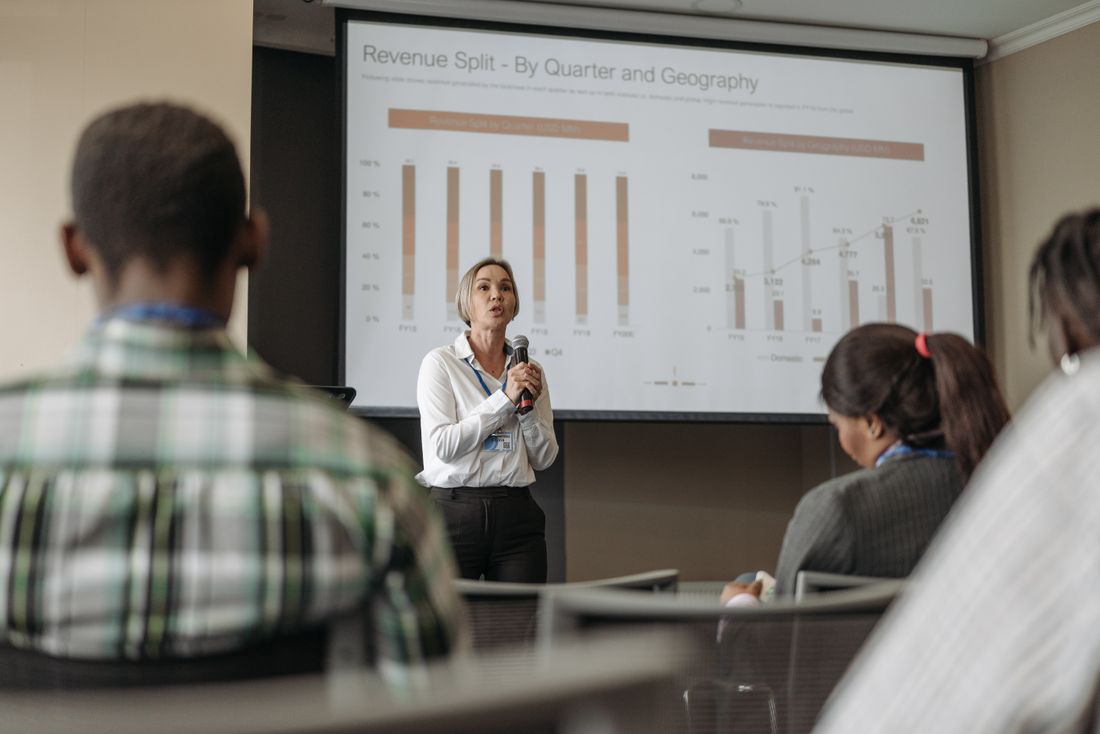
Photo by Pavel Danilyuk via Pexels.
Table of Contents
Documentation, not a story
A launch event or a gala gets edited into a narrative (a beginning, a highlight, a close). An investor day gets treated more like a record: a complete, accurate capture of what was presented and said, available for people who need to reference it after the fact, whether that's a portion of the leadership team who couldn't attend or a compliance or communications function reviewing what was disclosed.
This changes what "good coverage" means. A gala video that skips a slow ten minutes to keep the energy up is doing its job well. An investor day recording that skips ten minutes has created a gap in the record. The editing instinct has to shift from trimming for pace to preserving completeness.
Why every number on screen has to be legible
Slides at an investor day usually carry the actual content of the presentation (revenue figures, growth charts, forward guidance), which means a wide shot that merely includes the screen in frame isn't sufficient the way it might be at a general conference. A dedicated slide capture or screen feed, clearly legible even at a small playback size, is closer to a requirement than a nice-to-have here.
The production mechanics resemble what we'd set up for any conference keynote with dense on-screen content, but the margin for error is smaller. A blurry chart at a marketing conference is a minor miss. A blurry chart at an earnings presentation, where the specific figures are the point of the slide, undermines the reason the recording exists.

Photo by Kampus Production via Pexels.
Worth confirming in advance: whether the company can provide a direct feed from the presentation laptop or AV system, rather than relying on a camera pointed at a projector screen. A direct feed produces a cleaner, more legible slide capture than any camera angle can, and it's usually simple to arrange if raised ahead of the event rather than on the day.
Audio that holds up under later scrutiny
Investor day content often gets referenced, quoted, or transcribed well after the event itself, sometimes by people who weren't in the room and are relying entirely on the recording. Audio that sounds fine live in a large conference room can still be muddy enough on playback that a specific number or phrase becomes hard to make out, a bigger problem here than at an event where the recording is mostly a keepsake.
As with any large-venue keynote, a direct feed from the room's soundboard produces cleaner audio than an on-camera or boom microphone picking up echo off hard surfaces. For investor days specifically, we treat confirming that audio path as a non-negotiable planning step rather than a nice-to-have, given how much weight the audio carries after the fact.
Executive stills and b-roll that get reused
Alongside the full-session recording, an investor day is a good opportunity to capture a set of clean executive stills and general b-roll (leadership at the podium, the room during key moments, wide shots of the venue) that end up reused across annual reports, press materials, and future presentations long after the event itself is over. This part of the shoot looks more like a standard corporate coverage assignment than the documentation-focused video work.
Because these assets tend to have a longer shelf life than a single event's highlight reel, it's worth flagging any specific reuse needs (a particular executive who needs an updated portrait, a slide that will likely get reused in future materials) before the event, so the shot list accounts for it.
A short list of these b-roll and portrait priorities, shared with us ahead of time, means the photographer isn't guessing between the documentation work and the reusable-asset work while the session is actually happening. Both jobs can run in parallel with one coordinated crew, but only if the priorities are clear going in.
What we don't do
Our role at an investor day or earnings event is entirely production: filming and photographing the event accurately, legibly, and completely. We don't advise on what should be presented, how figures should be framed, or any disclosure or compliance question. Those decisions stay with the company and its own legal, financial, and communications advisors. If a production choice (camera framing, slide capture, delivery timing) intersects with a compliance concern, that's the company's call to make, not ours.
This kind of coverage generally fits our standard event tiers: the Essential package covers up to 5 hours at $3,500, and the Professional tier covers 6-8 hours at $6,000. Multi-session investor days with breakout presentations or a fuller agenda typically move into the Professional tier or a custom multi-day quote.
Internal-only versus publicly shared recordings
Not every investor day recording is meant for the same audience. Some companies keep the full session internal (for the board, for employees who couldn't attend, for the record) while releasing only a trimmed, reviewed portion publicly, if anything at all. Others intend the whole session to be publicly available shortly after it wraps. Knowing which case applies before the event changes how the footage should be handled afterward: an internal-only recording can move faster through a lighter review, while a publicly released version usually needs sign-off from legal, investor relations, or communications before it goes anywhere.
This distinction is worth settling during planning rather than during the edit, since it affects turnaround expectations as much as the review process. A recording destined for a public release typically takes longer to finalize than one that only needs to reach an internal distribution list, and setting that expectation early avoids a mismatch between when the video is ready and when the company actually needs it.
Planning an investor day or earnings presentation?
Tell us your agenda and AV setup, and we'll build a documentation plan that holds up after the room empties out.
See Event Coverage PackagesFrequently Asked Questions
What deliverables does an investor day actually need?
An investor day typically needs a clean full-session recording with legible slides, isolated clean audio suitable for later reference or transcription, and a set of executive stills and b-roll for later use in reports or communications. A flashy highlight reel is usually less useful here than accurate, complete documentation.
Is investor day video coverage different from a general corporate event?
Yes. A general corporate event usually wants energy and highlights. An investor day wants accuracy and completeness, every slide legible, every number correct on screen, audio clean enough to be quoted or transcribed later. The production priorities shift from storytelling to documentation.
Do you offer financial or investment advice as part of investor day coverage?
No. Our role is entirely production, filming and photographing the event accurately and legibly. We don't advise on what should be presented, how numbers should be framed, or any financial or disclosure matter. Those decisions stay with the company and its own advisors.
Why does audio matter more at an investor day than a typical event?
Investor day content often gets referenced, quoted, or transcribed after the fact, sometimes by people who weren't in the room. Audio that's merely acceptable in the moment can become a real problem later if a specific number or phrase is inaudible when someone goes back to check it.
How is investor day coverage priced?
It fits our standard event coverage tiers. The Essential package covers up to 5 hours at $3,500, and the Professional tier covers 6-8 hours at $6,000. Multi-session investor days with breakout presentations or a longer agenda typically move into the Professional tier or a custom multi-day quote.