
Photo: Core Visuals NYC
A client advisory board meeting is a working session with a company's most senior clients, not a stage for a highlight reel. The coverage has to know the difference before the camera ever comes up.
Client advisory board meeting photography is a restrained, documentary style built for a room of senior clients who came to work, not to be marketed. The output is governance and relationship material (an internal record of who was there and how the meeting ran) not social or website content, and the shoot is planned around staying nearly invisible in the room.
Table of Contents
- What Makes a Client Advisory Board Meeting Different to Cover
- Who's Actually in the Room, and Why It Matters for Coverage
- The Deliverable Is Governance Material, Not Marketing Collateral
- How a Photographer Works a Room That Wasn't Built for a Camera
- What Actually Gets Photographed in That Kind of Session
- What Stays Out of the Set, on Purpose
- How Usage and Delivery Differ From a Typical Corporate Shoot
- What to Sort Out Before Booking the Shoot
What Makes a Client Advisory Board Meeting Different to Cover
A client advisory board meeting is a working session where a company's most senior clients or partners sit down to give real feedback on strategy, product, or direction. Nobody in that room came to be photographed. They came to work, and the coverage has to respect that from the first frame.
That distinction changes almost every decision after it. A sales kickoff or a product launch wants energy: wide shots, applause, people caught mid-reaction. A client advisory board wants the opposite, a record that looks like the room actually behaved, not like an event was staged inside it. The output isn't meant to sell anything. It's meant to document a relationship between a company and the clients it trusts enough to ask directly for feedback.
In practice, that means the photographer's presence has to be nearly invisible. No flash, no directing people to look up, no requesting a quick group shot mid-agenda. The people in the room are often the same clients an account team will be emailing the next morning, and the images have to read as respectful of that, not as content production.
Who's Actually in the Room, and Why It Matters for Coverage
A client advisory board is usually eight to twenty senior people (clients, key partners, sometimes a mix of both) invited because their opinion carries weight, not because they're easy to photograph. Most have sat in dozens of corporate rooms before and can tell instantly when a shoot is working the room instead of documenting it.
That audience sets the tone before the camera does. These aren't employees who can be pulled aside to pose between sessions, and they aren't conference attendees who expect a photo moment on the way in. Many are attending as a favor to the relationship, carving real time out of a real schedule to give input a company asked for. Treating them like content subjects undercuts the reason they showed up.
The coverage has to earn trust the same way the meeting itself does: by staying out of the way. That usually means fewer total images than a typical corporate event, shot from further back, with almost no direct engagement between the photographer and the guests. The goal is a record the people in the room wouldn't mind seeing themselves in, not a highlight reel built for someone else's feed.
The Deliverable Is Governance Material, Not Marketing Collateral
The photos from a client advisory board meeting are internal-facing by default: they go into a board recap, an account team's relationship file, or a leadership debrief, not a homepage or a social feed. That's the single biggest thing that separates this shoot from almost everything else on a corporate calendar.
Framing it that way changes the brief before a single photo is taken. Instead of "get us usable social content," the request is closer to "document that this meeting happened, who was in the room, and what the working environment looked like." Those are different jobs. One optimizes for a scroll-stopping frame. The other optimizes for an accurate, professional record that a chief of staff or an account lead can drop into a summary without a second thought.
We treat the brief accordingly: fewer directed moments, more documentary framing, and a delivered set built to be useful in a recap deck rather than eye-catching on social. If a client ever does want to reuse an image externally later, that's a separate conversation and a separate release, not the assumption going in.
How a Photographer Works a Room That Wasn't Built for a Camera
A restrained shoot means working from the edges: a single shooter, a quiet presence, and a position near the back or side of the room rather than in front of the table. No posed reaction shots, no walking the room mid-discussion to get a closer angle, and no interrupting a speaker to reset a composition.
The technical choices follow the same logic. Available light over flash whenever the room allows it, a longer lens instead of getting physically closer, and shutter timing built around natural pauses (a break, an entrance, a moment when the group is already looking at a screen) rather than manufactured ones. A useful test for every frame is whether it could have existed without a photographer in the room at all.
That restraint is also why one shooter is usually enough for this kind of session. A second photographer doubles the visible presence in a room that's explicitly trying to minimize it, and a group this size rarely needs more coverage than one person moving carefully can provide. The smaller the footprint, the more the meeting stays the meeting.
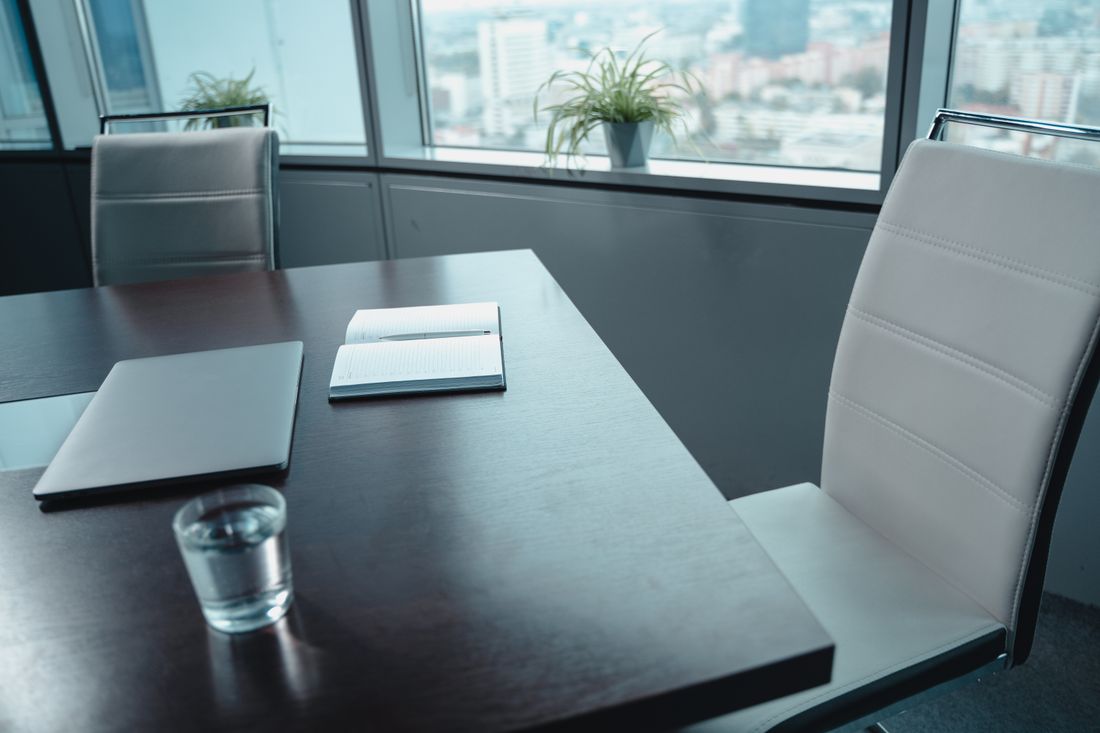
Photo by Tima Miroshnichenko via Pexels.
What Actually Gets Photographed in That Kind of Session
The frames that matter are the working ones: the group at the table mid-discussion, a presenter at a screen, a small breakout huddled over a printed deck, arrival and settling-in before the agenda starts. If there's a meal or a reception attached, that's covered too, but as a supporting beat, not the centerpiece.
What's deliberately thin is anything that reads as a posed group photo in the boardroom-portrait sense. That belongs to a different kind of shoot, like a formal board-of-directors portrait sitting, and mixing the two registers in one set makes both look staged. A client advisory board's value is that it looks like real work happened, so the images have to hold that line even when it would be simpler to ask everyone to look up for one clean shot.
Detail frames earn their place too (a name card, a working document on the table, the room itself before people arrive). They round out a recap deck without needing a single identifiable face in them, which is often the safest and most useful image in the whole set.
What Stays Out of the Set, on Purpose
Nothing in this set should read like a testimonial, an endorsement, or a marketing quote with a face attached to it. No image should suggest a client is publicly vouching for the company just because they showed up to a meeting. That's a use case for a different kind of shoot, with a different consent conversation attached.
Candid moments that look flattering out of context also get cut, even when they're technically good photographs. A senior client laughing mid-sentence can read as genuine warmth in the room or as a stock-photo endorsement, depending entirely on how it's captioned and where it's used later, and a photographer can't control that after delivery. The safer discipline is not producing the ambiguous frame in the first place.
The same goes for anything that implies more access than actually happened: no shots angled to suggest a one-on-one conversation between people who spoke for thirty seconds, no framing that exaggerates the size or energy of the room. The set should be honest about what the meeting was, not built to look bigger than it was.
How Usage and Delivery Differ From a Typical Corporate Shoot
The delivered set for a client advisory board meeting is usually smaller and more curated than an event gallery (a tighter edit, culled hard for anything that could read wrong out of context). Usage is typically restricted to internal purposes: leadership decks, account team files, and the meeting's own recap, not the company website or paid social.
That's a real difference in scope, and it's worth setting at the quote stage rather than discovering it after delivery. A company that wants both an internal governance record and a handful of externally safe images should say so up front, because those are two different shot lists and two different consent standards, not one gallery split after the fact.
If a client photographed in the room later wants an image for their own use (a headshot pulled from the set, for instance) that's a separate request that goes through its own release, not an assumption baked into the original booking. Discretion here isn't a constraint on the work; it's the actual point of the assignment.
What to Sort Out Before Booking the Shoot
Confirm the agenda before the shoot, not after. A client advisory board runs on a tight schedule set by senior people's calendars, and a photographer improvising around a moved break or a session that ran long is how a room notices the camera. Getting the run of show in advance is what lets the coverage stay invisible once the meeting starts.
Settle scope early too: one shooter is standard for this size of room, timing usually covers the working sessions plus arrival and any meal, and any request for a formal group portrait should be scheduled as its own short moment rather than squeezed into the working agenda. Confidentiality expectations tied to the meeting's content are the client's own arrangement with their guests. We follow whatever discretion terms the room already operates under rather than setting new ones ourselves.
Book earlier than a typical internal event. These meetings are usually locked onto a small group of executives' calendars months out, and matching a photographer's availability to that window is easier the sooner it's confirmed.
Frequently Asked Questions
Do the clients in the room need to be told they'll be photographed?
Yes. The company hosting the meeting should let attendees know a photographer will be present, the same way a well-run meeting notice covers who else is in the room. That's a hosting and consent decision that belongs to the company running the advisory board, not to the photographer. In practice, most hosts add a brief line to the meeting invite or opening remarks, which is enough to remove any surprise once the session starts.
Can these photos be used on our website or social media?
Not by default. The set is built as an internal governance and relationship record, and using an image externally means treating it as a separate request with its own release from anyone identifiable in it. If a company knows in advance it wants a handful of externally safe images too, that should be part of the original brief so the shot list and consent approach can account for both uses from the start.
How many photos do we actually get back?
Expect a smaller, tightly curated set rather than a large event gallery. This kind of meeting produces fewer usable frames because so much of the room is deliberately left undocumented on purpose. The final selects are culled hard for anything that could read wrong out of context, prioritizing a clean, professional record over sheer volume. The exact count depends on the agenda's length and how many distinct working sessions it includes.
Do we need more than one photographer for a room this size?
Usually not. A client advisory board is a small, controlled room, and a single photographer working quietly from the edges is standard practice. Adding a second shooter doubles the visible presence in a space that's specifically trying to minimize it, without adding much coverage a careful single shooter can't already provide. Multiple photographers make more sense for a larger event with concurrent sessions, not a working meeting like this one.
What happens if a session runs long or the agenda changes at the last minute?
The photographer should get the run of show in advance and build in flexibility around real meeting time rather than a fixed clock, since these agendas often shift around senior attendees' schedules. Confirming timing the day before, and checking in briefly with a meeting organizer on-site, is usually enough to adjust coverage without disrupting the room. That's why we ask for the agenda ahead of the shoot instead of assuming a rigid schedule holds.
Related Reading
Not sure if hourly or a package makes more sense for your event?
Tell us the expected length, and we'll run the actual numbers before you book.
See Event Coverage Packages