Photo by Martin Lopez via Pexels.
Ask a university communications office what they got from last year's research symposium and the answer is usually a folder of photos nobody uses: a wide shot of a half-full lecture hall, taken from the back row, showing rows of the backs of people's heads. It photographs badly because it was never actually documenting anything. The research happened in the poster session, in the small conversations at each board, and that's the part almost nobody plans the coverage around.
A research symposium photographs badly by default because the standard coverage — a wide shot of a lecture hall — proves nothing: the room looks empty regardless of real turnout, no face is identifiable, and nothing explains the research. The actual story is the poster session: presenters mid-explanation, small clusters engaging, legible titles, and the department's own faculty in frame.
Table of Contents
- Why the Lecture-Hall Wide Shot Doesn't Prove Anything
- What a Poster Session Actually Needs From a Photographer
- Legible Signage and Poster Titles Are Part of the Shot
- Getting Faculty Into the Recap, Not Just the Room
- What the University Comms Office Needs From the Same Day
- What the Department Needs, and Why It's Different From Comms
- What the Grant Report Needs From the Same Coverage
- Confirming Which Posters Can Be Photographed Before the Day Starts
Why the Lecture-Hall Wide Shot Doesn't Prove Anything
A wide shot from the back of a lecture hall is the default way a symposium gets photographed, and it's the least useful image the day produces. A half-full room reads as poorly attended even when turnout is normal, no single face is identifiable at that distance, and nothing in the frame explains what any of the research actually was.
That's not a lighting problem or a lens problem. It's a framing choice that treats attendance as the story, when attendance is rarely the point of an academic symposium. The room could be packed and the photo would still say nothing about what got presented, argued, or discovered that day — a full room and an empty room look almost the same from the back row.
We treat the wide shot as an establishing frame at most: one image, early, that shows scale and setting, never the coverage itself. The real story of a symposium happens afterward, in the poster session — in the small clusters standing in front of a board and the hallway conversations that follow. That's where a coverage plan should spend most of its frames, not the seats.
What a Poster Session Actually Needs From a Photographer
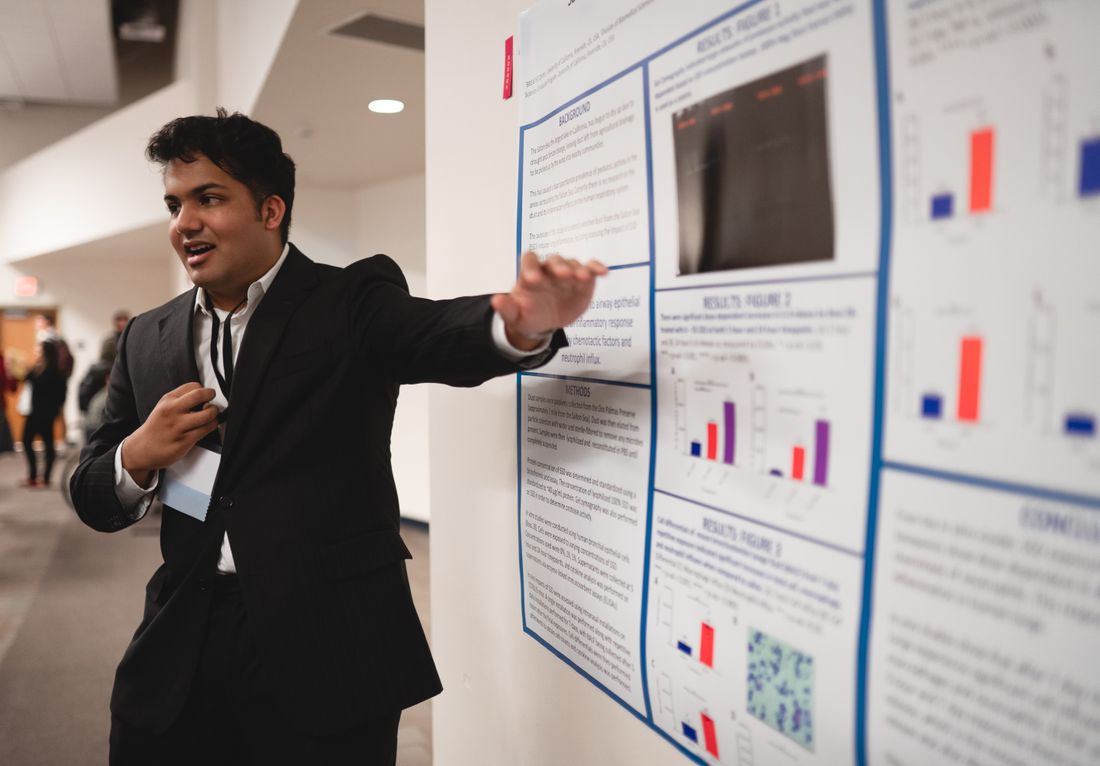
A poster session needs coverage built around individual conversations, not the room as a whole. That means presenters mid-explanation with a hand raised toward their own data, small clusters of two or three people actually leaning in, and enough of the poster in frame to prove what was being discussed — shot close, from an angle, moving constantly.
The room itself works against a static approach. A poster session is dozens of small, simultaneous conversations happening at once in a space that's usually too bright, too crowded near the popular boards, and too empty near the ones nobody's found yet. Standing in one spot and shooting wide captures none of that texture — it just captures a hallway with paper on the walls.
In practice, that means covering it the way a wedding photographer covers a cocktail hour: moving board to board, watching for the moment a presenter's hand goes up or a listener leans in, and getting close enough that the exchange reads as a real conversation instead of two people standing near each other. The energy of the session is in those individual exchanges, not the floor plan.
Legible Signage and Poster Titles Are Part of the Shot
A poster session photo without a readable title or department name attached is a wasted frame, because nobody looking at it later can tell what they're looking at. Getting a poster's title, author line, or session signage legible in at least a few frames is what lets a comms office or a department actually caption the photo months later.
This is easy to lose sight of mid-session, because the interesting part of the frame is usually the person, not the board behind them. But a tight shot on a presenter's face with the poster reduced to an unreadable blur behind them is a photo that needs a caption written from memory instead of read off the image — and memory fades faster than anyone expects once a shoot is two weeks old.
The fix is simple and worth planning for deliberately: alongside the close, expressive frames, grab a handful where the poster title and author names are actually sharp and readable, even if the framing is less dynamic. Those are the working files a comms team reaches for first, because they don't require anyone to remember which poster was which.
Getting Faculty Into the Recap, Not Just the Room
A department's recap needs its own faculty visibly present in the coverage, not just the students and postdocs presenting posters. A symposium is departmental proof of activity, and the person who runs the department usually isn't the one standing at a poster board — they're circulating, greeting visiting speakers, and easy for a moving photographer to miss entirely.
This usually isn't anyone's fault. Faculty tend to move through a poster session differently than presenters do — briefer stops, more handshakes, less time in front of any one board — which makes them genuinely harder to catch in a natural, unposed frame than someone standing still explaining their own research for twenty minutes straight.
Knowing this ahead of time changes how the day gets covered. It's worth asking the organizer beforehand which faculty matter most for the recap — the chair, the dean if one's attending, the grant's principal investigator — and treating those few names as a checklist to actively watch for, the same way a wedding shoot tracks down specific family members instead of hoping they wander into frame.
Photo by Pavel Danilyuk via Pexels.
What the University Comms Office Needs From the Same Day
A university comms office mainly needs versatile, brand-safe images: clean crops with room for text overlay, a mix of wide and tight shots, and photos that read well small on a homepage tile or a social post months after the event. They're building a library for ongoing use, not a one-time recap.
That means comms usually cares less about which specific poster is in frame and more about variety — different buildings, different times of day if the symposium runs multiple sessions, a range of people so the same three faces don't appear in every photo the office publishes for the next year. A single great shot used once is worth less to comms than a dozen solid, flexible ones.
It also means avoiding anything that ages badly fast: a screen showing a specific date, a shirt with a graphic that reads as dated in two years, anything that pins the photo too precisely to this one day. Comms offices reuse images longer than anyone expects going in, so a photo that still looks current in three years is worth more than one that only works this month.
What the Department Needs, and Why It's Different From Comms
A department wants proof of its own people and its own research, specifically — named presenters next to their actual posters, faculty greeting the specific visiting speakers they invited, the lab group photographed together. Where comms wants flexible and generic, a department wants precise and attributable, because the audience is internal: colleagues, the provost, next year's applicants.
This shows up in how the photos actually get used afterward. A department newsletter or an annual report names people directly under their photo, so a shot needs to be tied to a specific presenter and poster, not just a mood of "the symposium happened." A caption that says "graduate students present research" is far less useful to a department than one naming who and what.
It also means the department's shot list looks different from a generic one — specific presenters flagged in advance, specific faculty who need to be caught greeting specific guests, maybe a lab group pulled aside for two minutes for a photo that wouldn't happen naturally in the flow of the session. Worth confirming that list before the day starts, not during it.
What the Grant Report Needs From the Same Coverage
A grant report needs documentation that a funded activity actually took place, tied to the specific project it funded: the presenter next to the poster that names the grant, the room with attendance visible, sometimes a wide shot the department would otherwise skip entirely. It's the one audience where the "boring" establishing photo genuinely earns its place.
This is the audience most likely to get overlooked, because it's rarely the loudest voice in the room on shoot day. Nobody from the funding agency is standing there directing the coverage — the requirement lives in a report template that gets filled out weeks later, after the shoot is long done and the photos are already delivered and archived.
The practical fix is asking early, before the shoot, whether any grant reporting requirement exists and what it specifically calls for — a certain kind of image, a minimum attendance count, a specific poster photographed clearly. That's a five-minute question in the planning email. Discovering the requirement after delivery, when nobody thought to shoot for it, is a much longer conversation.
Confirming Which Posters Can Be Photographed Before the Day Starts
Not every poster at a symposium is fair game for a camera. Some carry unpublished, pre-print, or embargoed data a researcher can't have circulating yet, and a poster board isn't a reliable signal either way — nothing on it announces this one's still under review. Confirming with the organizer which posters can be photographed is documented practice, not an afterthought.
We treat this as a standard pre-shoot question, the same way a location or a schedule gets confirmed in advance, not a legal judgment call made in the room. The organizer or department contact is the one who actually knows which projects are sensitive, which presenters have asked to opt out, and which posters are fine to shoot freely — that's their call, not a photographer's guess based on how a board looks.
In practice this is a short conversation before the day starts: ask whether there's a list of posters or presenters who've opted out, and default to skipping anyone not explicitly cleared if the organizer hasn't reviewed the full roster. It costs five minutes of planning and avoids a much longer conversation later about a photo that shouldn't have been taken.
Frequently Asked Questions
What's the biggest mistake in photographing a research symposium?
Treating the lecture-hall audience shot as the coverage. It photographs badly by default — a half-full room reads as poorly attended even at normal turnout, no face is identifiable from the back, and it explains nothing about the actual research. The real content of a symposium is the poster session afterward: presenters mid-explanation, small clusters engaging, legible titles. That's where the coverage plan should spend most of its frames.
How should a poster session be covered differently from a keynote?
A keynote is one subject and one angle for a fixed period. A poster session is dozens of small, simultaneous conversations spread across a room, so it needs constant movement board to board, watching for a presenter's hand going up or a listener leaning in, and close framing that reads as a real exchange. Treat it more like covering a cocktail hour than a stage presentation.
Why does the department want different photos than the university's comms office?
Comms wants flexible, brand-safe images it can reuse for years — variety, clean crops, nothing that dates fast or ties too tightly to one exact day. A department wants precise, attributable proof: named presenters next to their specific posters, faculty greeting the specific guests they invited. One audience is building a general library; the other needs photos tied to specific people and specific research. Both are legitimate needs from the same shoot — just different jobs.
Should every poster at a symposium be photographed?
Not automatically. Some posters carry unpublished, pre-print, or embargoed research a presenter can't have circulating publicly yet, and nothing printed on the board reliably signals that either way. Confirming with the event organizer beforehand which posters and presenters are cleared to photograph is documented practice, not an extra step — a short planning question handled before the day starts, not a judgment call a photographer should be making alone in the room.
Does a grant report need different photos than the department's own recap?
Often, yes. A grant report typically needs documentation tying the funded activity to a specific project — a presenter beside the poster naming the grant, visible attendance in the room, sometimes the plain establishing wide shot a department would otherwise skip entirely. It's worth asking before the shoot whether any grant reporting requirement exists and what it specifically calls for, since that requirement rarely comes up naturally during the day itself and is easy to miss.
Related Reading
Not sure if hourly or a package makes more sense for your event?
Tell us the expected length, and we'll run the actual numbers before you book.
See Event Coverage Packages