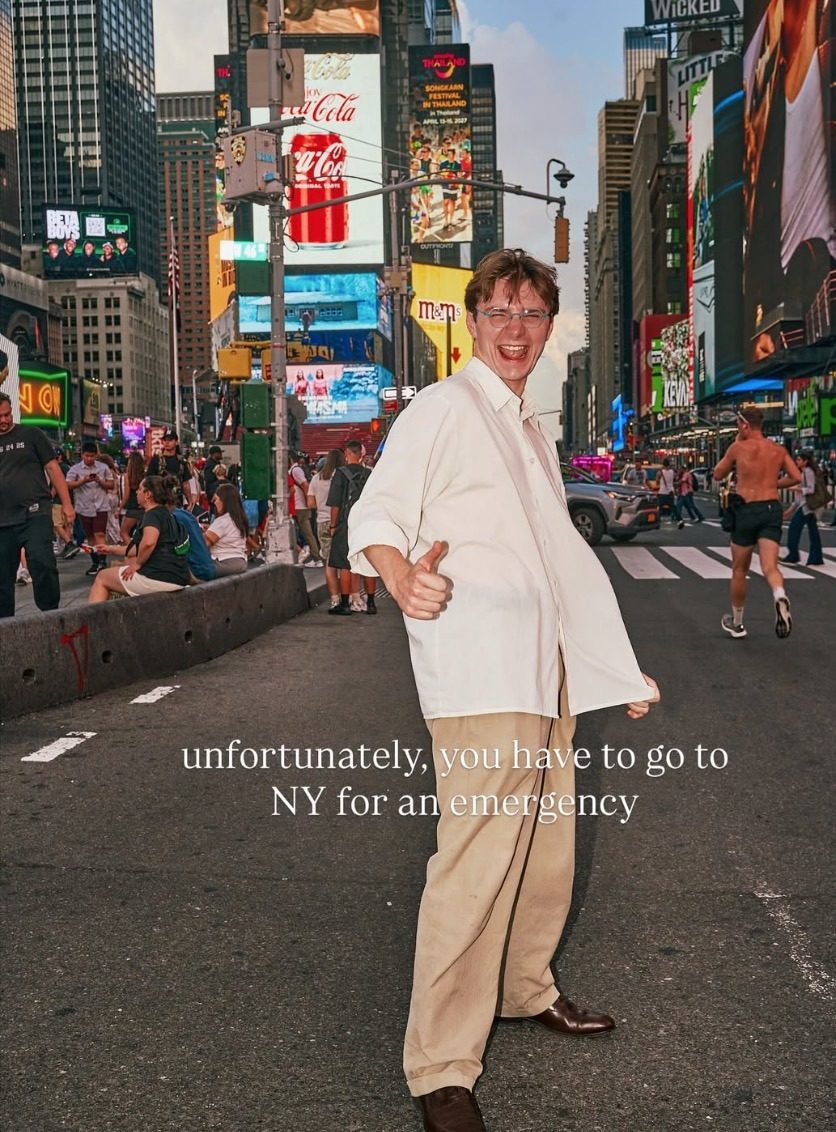
Ian in the middle of a Times Square crosswalk, as published on @ian.nyc.guide. The text on the image is his.
Ian Sowden crossed a hundred thousand followers this summer, and we went out to make photos for it.
Ian runs @ian.nyc.guide, which means his whole job is showing people a version of New York they can actually walk into. He asked for something to mark the milestone. I said yes before he finished the sentence, partly because he's a friend and partly because a shoot with a real reason behind it is rare enough to be a pleasure.
The locations were never in question. Times Square. The Intrepid. The places his channel is built on, the ones people fly across an ocean to stand next to. What I got wrong was what to do once we were there.
The pictures were good and that was the problem
The first setups were portraits. Ian placed in the frame, city behind him, everything sharp, everything exposed, everything correct.
He also looked like a stranger. Ian in real life is fast, funny, a little bit ridiculous in the way that makes people want to be around him. The frame had none of it. What the frame had was a man being photographed, which is a completely different thing from a man.
And I kept thinking about who these were for. Not a website, not a deck. A feed full of people who have spent months watching this guy talk to a camera in a subway station. They'd scroll past. Not because the photo was bad, but because it announced itself as a photo, and everything that announces itself gets skipped.
So we stopped. I told him the setup wasn't working and asked what he'd do here if I weren't standing there with a camera.
What actually changed
Not the locations. That's the part I'd have gotten wrong if you'd asked me to guess beforehand. We stayed exactly where we were and changed everything else.
Ian stopped posing and started doing a bit. He gave the camera a thumbs up from the middle of a Times Square crosswalk, mid-stride, mouth open, shirt half untucked. At the Intrepid he leaned on the railing with the sun going down behind the ship and threw a peace sign like he was in somebody's group chat.
I got closer. Three feet instead of ten, so the frame reads like a friend standing there rather than a crew across the street. I stopped shooting the pose and started shooting the second after it, when his face lets go and he's about to say something. He moved and talked continuously instead of holding still and waiting to be released.
It was faster. It was also easier for both of us, which I didn't expect and probably should have. There's a lot of work in getting someone to look natural under a lighting setup. There's almost none in getting a naturally funny person to be funny while you keep up.
The tell was on the back of the camera. From that point on we were calling shots before either of us zoomed in. That does not happen on a shoot working at seventy percent.
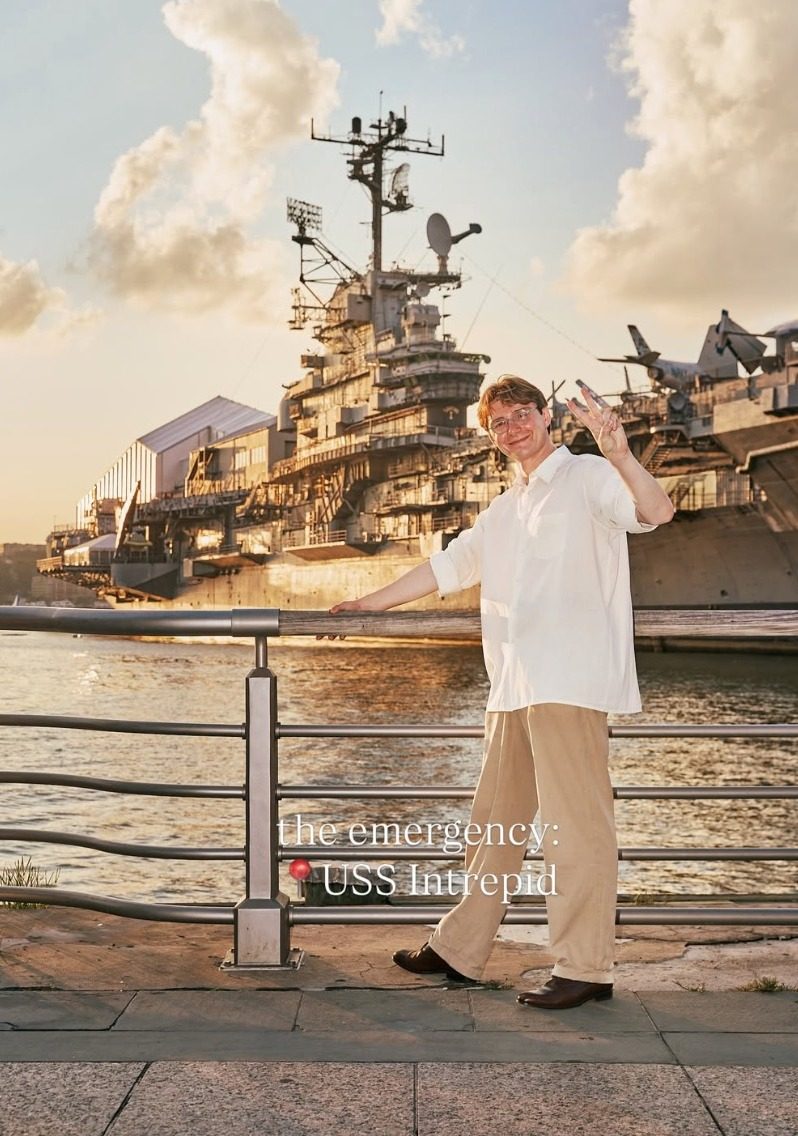
The Intrepid frame from the same carousel. Same evening, same wardrobe, no posing left in it.
What it looked like on his feed
He posted it as a carousel with his own jokes typed over the images. The Times Square frame reads "unfortunately, you have to go to NY for an emergency." The next one answers it: "the emergency: USS Intrepid."
That's the whole argument in one design decision. The photos had to leave room for his voice. A polished portrait would have been the loudest thing in the frame and there would have been nowhere for the joke to sit.
Why I think this is the direction
Production value used to be evidence. A sharp, lit, retouched photo meant somebody paid for it, and paying for it meant you were a real operation. That signal worked because the pictures were genuinely hard to make.
They are not hard to make anymore. Everyone's phone is a cinema camera it doesn't know how to use. AI will hand anyone a flawless image in eleven seconds. When perfect gets free, perfect stops carrying information, and audiences work that out faster than brands do.
What's left is much harder to fake, which is proof that a specific human being was actually there. Slightly off. Slightly in motion. Recognizably themselves.
One thing gets misread here constantly, so I'll say it plainly: shooting loose is not shooting careless. Ian still had to look good, and he does. Unflattering and authentic are not the same word, and nobody has ever hired me for the first one. The frames are still exposed, still in focus, still chosen. The craft moved from making an image look expensive to making a considered image look unconsidered, which takes more judgment, not less.
If you're about to book someone to make you look impressive
Ask where the pictures are going before you ask anything else.
Website header, pitch deck, press page, award submission: the polished version is correct and worth paying to get made properly. That viewer is deciding whether you're legitimate, and a loose shot in that slot reads as unprepared.
A feed, under a caption you wrote yourself: the polished version is working against you. That viewer is deciding whether they like you, and every degree of production distance costs a little belief.
Most people need both, and both fit in one half day if you plan the order right. Controlled setups first while the wardrobe is crisp, then loosen everything for the back half. Same person, same clothes, two libraries, two jobs. The mistake is picking one and forcing it everywhere.
Congratulations, Ian. Thanks for letting me throw out the plan and then throw out the good photos.
Need both versions out of one shoot day?
Tell us where the pictures are going and we'll plan the order so you leave with two libraries, not one.
See Corporate Content