
Photo by Vitaly Gariev via Pexels.
A founder's personal brand runs on a company's calendar — a raise, a launch, a new hire, with a business behind them absorbing everything else. A consultant or coach has none of that. There's no company softening the load and no event forcing new content into existence, so the photography has to do a different job entirely.
A consultant or coach's personal brand photography needs to solve for continuous trust, not event-driven bursts like a founder's does. The core problem is holding authority and approachability in the same frame, and the practical fix is one well-planned session shot for a year of variety, real working settings, and a repeatable format the consultant can run themselves.
Table of Contents
- Why a Founder's Content Plan Doesn't Work for a Solo Consultant
- The Real Problem: Authority Versus Approachability
- Why a Consultant Needs a Repeatable Format, Not One Great Shoot
- Shooting Enough Variety to Cover a Year Without Repeating the Same Jacket
- Photos That Work as Backgrounds for Text, Not Just Portraits
- Why the Setting Should Be a Real Working Environment, Not a Rented Office
- Capturing the Speaking or Teaching Context, When the Offer Involves a Room
- The Honest Scope Note: One Session Usually Beats a Retainer Here
Why a Founder's Content Plan Doesn't Work for a Solo Consultant
A founder's personal brand content is organized around events — a raise, a launch, a new hire — with a company behind them absorbing the rest of the work. A consultant or coach has no events and no company. The person is the product, so the content has to work continuously, carrying trust on its own, week after week, without a news cycle behind it.
This changes more than the shot list. A founder's content plan can lean on the company's momentum: a product launch supplies the topic, the announcement supplies the urgency, and the founder mostly needs to be visible next to real news. Our founder content guide covers that version of the problem in detail. A consultant doesn't get that scaffolding. There's no round of funding to post about, no product ship date to build a week of content around.
That absence is the whole reason a consultant's photography plan has to look different from a founder's, not just a smaller version of the same plan.
The Real Problem: Authority Versus Approachability
For a consultant or coach, the hardest tension in personal brand photography is looking credible without looking untouchable. Too polished reads as insincere in a field where people are buying candor and judgment, not polish. Too casual reads as unserious, like someone without the standing to charge for advice. Every usable photo has to hold both qualities at once, which is a narrower target than it sounds.
A founder can lean fully toward polish — investors and enterprise buyers often want to see command of a room, a company behind the person, evidence of scale. A consultant selling their own judgment is selling something closer to a relationship. A studio backdrop and a stiff pose can undercut that faster than an outdated photo would, because it signals distance instead of access.
This is the single design constraint the rest of a consultant's shoot should answer to. Not more polish, not more casualness, but a setting and expression that reads as a real, capable person someone could actually work with.
Why a Consultant Needs a Repeatable Format, Not One Great Shoot
A founder's content follows a launch calendar with built-in variety — a fundraise looks different from a product release, which looks different from a hire announcement. A consultant posts on a plain schedule with no external events supplying new material, so the format itself has to be repeatable: something they can shoot for once, then reuse and remix themselves for a year, not a one-time library that runs out by spring.
This is a planning problem as much as a photography one. A single day of great images, shot without a plan for how they'll get used over the following months, tends to get burned through in a few weeks of posting. A format built for repetition — the same general setups, deliberately varied enough not to look identical — holds up because the consultant knows exactly what to reach for on a slow week.
The goal isn't a bigger shoot. It's a shoot planned around how the material will actually get used, week after week, with nothing external forcing fresh content to exist.
Shooting Enough Variety to Cover a Year Without Repeating the Same Jacket
One well-planned session can cover a year of regular posts if it's shot for variety on purpose — multiple outfits, several settings within the same space, close and wide framing, seated and standing. Without that planning, a consultant ends up with a dozen strong photos that all look identical, and the sameness becomes its own tell that nothing new is happening in the practice.
The practical fix is treating wardrobe and setup changes as part of the shot list, not an afterthought squeezed in at the end. Two or three outfit changes, a couple of different spots in the same office or home workspace, and a mix of distances gives a year's worth of posts enough visual range that they don't read as one photo recycled on repeat.
This matters more for a consultant than almost any other subject, because the same face is going to show up in front of the same audience dozens of times over twelve months. Variety is what keeps that repetition from reading as staleness.
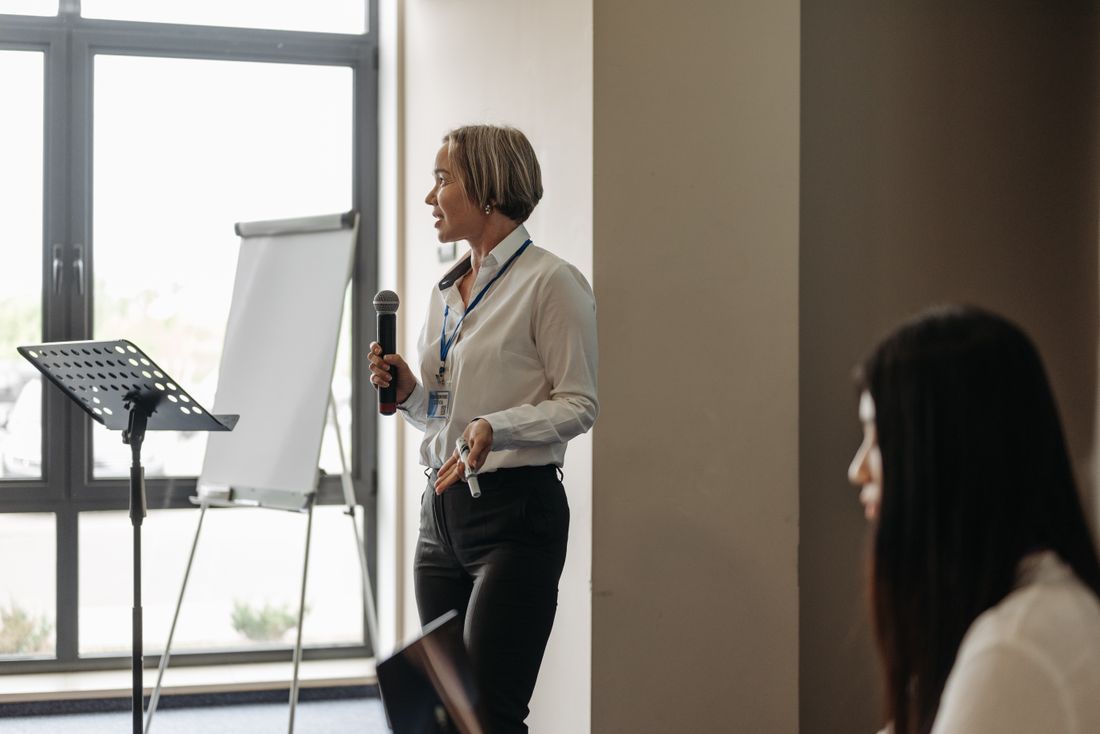
Photo by Pavel Danilyuk via Pexels.
Photos That Work as Backgrounds for Text, Not Just Portraits
Most of a consultant's content isn't a portrait post — it's a quote, a tip, or a headline with a photo behind it, so the shoot needs images with genuine negative space: a plain wall, a window, an empty side of a desk. A frame built only for a centered headshot crop has nowhere for text to sit without covering the subject's face or fighting a busy background.
This is an easy thing to miss when planning a session around portraits alone. A photographer working purely for tight, symmetrical headshots produces images that look great as a profile photo and terrible as a carousel background, because there's no room left in the frame for a sentence of copy. Wider shots with the subject off to one side solve this directly.
Asking for a mix of tight portraits and wider environmental frames with open space on one side gives a consultant material that works for both jobs — a profile photo when they need one, and a background for the text-driven posts that make up most of a working content calendar.
Why the Setting Should Be a Real Working Environment, Not a Rented Office
A rented studio or a borrowed conference room photographs fine but reads as generic the moment a client actually works with the consultant somewhere else, and repeat viewers eventually notice the mismatch between the polished backdrop and the real, ordinary space where the work happens. The setting that holds up over a year of posts is the one the person actually works in, not a space rented for a single afternoon.
A real desk, a real bookshelf, a real client-facing room carries a kind of evidence a rented set can't fake — it shows the practice actually exists somewhere, run by someone with an actual daily routine rather than a stock backdrop assembled for one shoot. That detail does real work in a field where the buying decision is built almost entirely on trust.
This doesn't rule out a clean, uncluttered space. It rules out a space that isn't genuinely the consultant's own, however good it happens to look in a single well-lit frame.
Capturing the Speaking or Teaching Context, When the Offer Involves a Room
If any part of a consultant or coach's offer happens in front of people — a workshop, a training, a small-group session — that context deserves its own images, because a desk portrait alone can't prove someone can hold a room. Photos of the person actually teaching, presenting, or working with a group carry a kind of credibility a static portrait can't produce on its own.
This is worth planning for specifically rather than hoping a phone photo from the back of a room turns out usable. A session built around an actual workshop or a staged small-group setup gives a consultant images that show the offer in motion — the whiteboard, the audience, the microphone — instead of only showing what the person looks like sitting still.
Not every consultant needs this. Someone whose entire practice is one-on-one advisory work over video calls may never need a room shot at all. But if teaching or speaking is part of the actual offer, it belongs in the shot list as its own category, not an afterthought.
The Honest Scope Note: One Session Usually Beats a Retainer Here
For a solo practice, a single well-planned session with a wide take of setups, wardrobe, and settings usually covers a year of content better than an ongoing retainer does, because the volume a solo expert posts rarely justifies recurring production costs. A retainer earns its price when there's a team, a events calendar, or a genuinely high volume of new material to shoot. Most consultants and coaches have neither.
This is worth saying plainly instead of defaulting to whatever package sounds more complete. An Executive Portrait Session — a half-day shoot producing 10-15 final edited portraits, shot for variety across outfits and settings — is usually the right scope for one person building a year of content around themselves. Deciding between a photo session and a short video, which some coaching offers also need, is worth working through separately; our photo-versus-video decision guide covers that call in more detail. A monthly retainer makes more sense for a company producing recurring team or culture content, not for a single practitioner's personal brand.
The honest recommendation isn't the more expensive option. It's the one scoped to how a solo practice actually posts.
Frequently Asked Questions
How is personal branding photography for a consultant different from a founder's headshots?
A founder's content is organized around company events — a raise, a launch, a hire — with a business behind them absorbing the rest of the visibility. A consultant or coach has no events and no company; the person is the product, so photography has to carry trust continuously rather than in bursts tied to news. That changes the shot list toward variety, real working settings, and repeatable formats instead of event-driven moments.
Why does authority versus approachability matter so much for coaches and consultants?
Because the buying decision is built on trust in one person's judgment, not a company's scale. A photo that's too polished can read as insincere in a field where people are paying for candor and honest advice. A photo that's too casual can read as unserious, undercutting the standing to charge for expertise. Every usable image has to hold both qualities in the same frame, which is a narrower target than a purely polished executive portrait.
How much variety do I actually need from one personal branding session?
Enough to cover roughly a year of regular posts without repeating the same outfit and setup in every frame: two or three wardrobe changes, a few different spots within the same real working space, and a mix of tight portraits and wider environmental shots. Planned this way, one session gives a consultant enough range that months of posts don't read as the same photo recycled on repeat.
Do I need photos of myself teaching or speaking, or are portraits enough?
It depends on whether teaching or speaking is actually part of the offer. If any part of the practice happens in front of a group — a workshop, a training, a small-group session — those images carry credibility a desk portrait can't, showing the person can actually hold a room. If the practice is entirely one-on-one work over calls, a room shot usually isn't necessary.
Should a solo consultant book a retainer or a one-time session for personal branding photos?
For most solo practices, a single well-planned session covers a year of content better than a retainer does, because a solo expert's posting volume rarely justifies recurring production costs. An Executive Portrait Session — a half-day shoot producing 10-15 final edited portraits shot for variety — is usually the right scope. Retainers make more sense for companies producing ongoing team or culture content, not one person's personal brand.
Related Reading
Have a launch or brand project where scale is actually the story?
Tell us what the aerial shot needs to show, and we'll scope it alongside the ground coverage from the start, permits included.
See Personal Branding & Launches