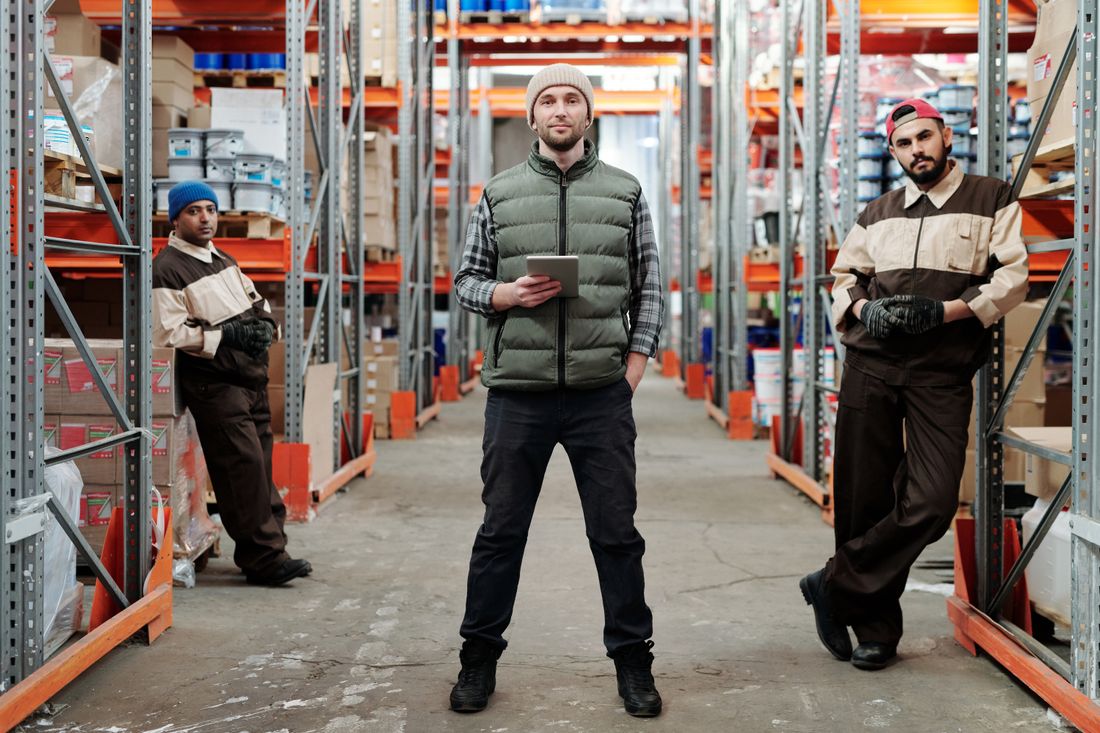
Photo by Tiger Lily via Pexels.
A freight-moving operation sells trust the same way any B2B service does, and the account manager's headshot in an RFP response does as much of that selling as the pitch itself. Logistics and supply chain teams need a headshot register of their own: operational enough to look credible under real conditions, polished enough to hold up inside a partner deck, shot inside a warehouse or distribution facility that never actually stops moving to make room for a camera.
Logistics and supply chain team headshots need to read as both operational and credible, because they show up inside RFP responses, partner decks, and customer materials where a buyer is judging whether the company can be trusted with real freight. That register gets shot inside active warehouses, scheduled around shift patterns, and refreshed as dispatch and ops roles turn over.
Table of Contents
- Why Logistics and Supply Chain Teams Need Their Own Headshot Register
- Who on a Logistics or Supply Chain Team Actually Needs a Portrait
- Why Account and Sales-Facing Roles Carry the Most Weight
- Shooting Team Photos Inside a Live Warehouse or Distribution Facility
- Matching Headshot Style Across Multiple Hubs and Warehouses
- Scheduling a Session Around Shift Patterns and Dock Schedules
- Where Logistics Team Headshots Actually Get Used
- Planning Around Turnover Instead of Reacting to It
Why Logistics and Supply Chain Teams Need Their Own Headshot Register
A logistics or supply chain operator's headshots need to read as operational and dependable at once, because the people in them show up in RFP responses, partner decks, and account materials where a buyer is quietly judging whether this company can be trusted with freight, not just admired for having a nice team photo.
That's a different job than a generic corporate headshot does. A law firm's portrait sells polish. A logistics team's portrait sells competence under real conditions: does this person look like someone who can actually run a dock schedule, manage a customs delay, or keep a customer's shipment on track when a route falls apart. The photo doesn't need to be dramatic. It needs to look like it belongs to someone who does the job.
Getting that register right starts with treating the shoot as its own brief rather than defaulting to whatever style a photographer already has on file. A background, a wardrobe note, and a tone that fit an ops-heavy business are worth deciding on purpose, not discovering after the photos are already delivered.
Who on a Logistics or Supply Chain Team Actually Needs a Portrait
A logistics or supply chain roster typically needs portraits for operations managers, account and sales representatives, dispatch or transportation leads, warehouse or facility managers, and safety or compliance leads, since each one appears in a proposal, a partner deck, or a customer-facing page where a buyer is evaluating the team behind the freight.
Account and sales representatives usually need the most polished version, since their photo often travels furthest, into an RFP response, a proposal deck, or a prospective customer's first look at who they would actually be working with. Operations and dispatch leads matter almost as much, because they're the names a customer hears on a call when something needs tracking down.
Warehouse and facility managers are worth including even though they rarely appear in sales materials, because a facility page or a safety-and-compliance section of a website leans on exactly this kind of photo to show a real person is accountable for the building. Executive leadership rounds out the set for a leadership page, but a logistics company's credibility usually rests more on the operators than on the org chart.
Why Account and Sales-Facing Roles Carry the Most Weight
An account or sales representative's headshot carries more weight than any other photo on a logistics team page because it's the one most likely to appear inside a document a prospective customer is actively deciding on: a proposal, an RFP response, or a partner one-pager, where a buyer is scanning for a person to trust with real freight.
That's a different pressure than a warehouse manager's photo carries. A sales-facing portrait works toward a decision: does this person seem credible enough to hand a contract to. It needs to look sharp without looking stiff, since an over-formal photo can read as distance in an industry that still runs on relationships and phone calls.
Because that photo does so much of the account team's persuasion work before a call even happens, it's worth budgeting real time to it in the schedule rather than treating it as one frame among many. A slightly longer slot, a second look at wardrobe, and a background that reads as professional without looking generic all pay off in a document a buyer is actually reading closely.
Shooting Team Photos Inside a Live Warehouse or Distribution Facility
A logistics headshot session usually has to work around an active warehouse or distribution facility, not a cleared-out conference room, which means finding a corner, a clean stretch of wall, or an office space where a backdrop and light stand don't sit in the path of a forklift or a loading dock still running a full shift.
Real operations don't pause for a photo shoot, so scouting the space in advance matters more here than at a typical office. A quiet stretch near an office area, a break room, or an underused corner of the floor usually works better than trying to clear a section of active racking for an hour.
What ends up in the background matters too. Legible carrier names, client logos on boxes, or anything that reads as a staged safety demonstration rather than a real moment can create problems the photo doesn't need. A clean wall, blurred racking, or a genuinely neutral stretch of the facility keeps the focus on the person. Timing a session around a slower part of the shift, rather than mid-peak movement, gives everyone room to work without turning the shoot into an obstacle on a working floor.

Photo by Imtiaz Ahmed via Pexels.
Matching Headshot Style Across Multiple Hubs and Warehouses
A logistics or supply chain company running more than one hub, warehouse, or regional office needs a headshot style that matches across every site from the first shoot, not a style that gets reconciled later once a partner deck or a website page puts two mismatched sets of team photos side by side.
That consistency problem shows up fastest on a company-wide team page or a partner-facing deck that pulls people from multiple locations into one document. A regional ops manager shot against a different background, in different light, than the account team at headquarters reads as two different companies rather than one network.
A documented reference, a background treatment, a crop, a lighting approach, gives any site something concrete to match, whether the same photographer shoots every location or a different one covers each region. That reference doesn't need to be elaborate. A short written brief and a handful of approved example photos usually cover it, and checking new photos against that reference before they go live is worth the extra step.
Scheduling a Session Around Shift Patterns and Dock Schedules
A logistics operation rarely has one quiet hour that works for everyone, since dispatch, warehouse staff, and account teams often run on different shift patterns, so a headshot session tends to work best scheduled around a short window on each shift rather than one shared block that pulls an entire team off the floor at once.
Freight doesn't wait for a photo schedule, which makes a rotating call time, each person getting a specific slot instead of a shared hour, the more realistic approach for most operations. Coordinating with whoever runs the floor day to day, rather than guessing from a calendar, usually surfaces the actual quiet windows a shift schedule doesn't show on paper.
Some roles are easier to pull aside than others. Account and office-based staff can usually step away for ten minutes without much disruption. Dispatch and warehouse leads may need a narrower window planned around a specific lull or a slower stretch between inbound and outbound loads, so building the schedule with input from the people running those shifts avoids a session that fights the operation instead of working around it.
Where Logistics Team Headshots Actually Get Used
A finished set of logistics or supply chain team headshots typically ends up in RFP responses, partner and customer decks, a company website's team or leadership page, LinkedIn profiles, trade show materials, and recruiting pages aimed at drivers or warehouse staff, so planning for that full spread avoids a second shoot when a use case shows up later.
RFP responses and partner decks tend to want the most polished, formal crop, since they're doing persuasion work in a document a buyer is reading closely before a contract gets signed. A website team page and LinkedIn can carry a slightly warmer version, since they're introducing the company to someone earlier in the relationship, before a proposal is even on the table.
Recruiting pages aimed at drivers or warehouse staff often want a different tone entirely: less formal, more approachable, since the goal there is showing a real workplace rather than closing a deal. Delivering a couple of framing options per person up front, rather than one fixed crop, lets each of these use cases pull the right version without a follow-up request months later.
Planning Around Turnover Instead of Reacting to It
Logistics and supply chain operations see real turnover in dispatch, warehouse, and regional ops roles, which makes a headshot set a moving target in a way a stable back-office team's photos aren't, so planning a standing refresh point in advance beats noticing an outdated photo in a partner deck months after someone has already left.
A refresh tied to a season or a fixed interval, rather than to noticing a problem, keeps a partner deck, a website, and an RFP template current without turning every departure into its own separate photo request. Many operators find it easier to schedule around a slower stretch in the shipping calendar and refresh whoever has changed since the last visit.
The smaller version of this problem matters too: an outdated headshot next to a current title, in a document a prospective partner is actually reading, is a small credibility gap working against the company. Keeping the roster current is an ongoing task worth owning on purpose, not a project that only gets attention once someone finally notices the mismatch.
Frequently Asked Questions
What makes logistics and supply chain team headshots different from a typical corporate team's?
They need to read as operational and dependable at once, since the people in them show up inside RFP responses, partner decks, and customer-facing materials where a buyer is evaluating whether the company can be trusted with real freight, not just admiring a polished team photo. That's a different register than a law firm's formal portrait or a startup's casual mix, and it's worth designing for on purpose rather than borrowing a generic corporate style wholesale.
Who on a logistics or supply chain team typically needs a professional headshot?
Operations managers, account and sales representatives, dispatch or transportation leads, warehouse or facility managers, and safety or compliance leads are the roles most commonly included, since each one appears in a proposal, a partner deck, or a customer-facing page where a buyer is sizing up the team behind the freight. Account and sales representatives usually need the most polished version, because their photo travels furthest into documents a prospective customer is actively reading and deciding on.
Why does an account or sales representative's headshot carry more weight than others on the team page?
It's the photo most likely to appear inside a document a prospective customer is actively deciding on: a proposal, an RFP response, or a partner one-pager, where a buyer is scanning for a person to trust with real freight. That photo needs to look sharp without looking stiff, since an over-formal portrait can read as distance in an industry that still runs heavily on relationships and phone calls between the people actually moving the shipment.
How does a headshot session work inside a warehouse or distribution facility that's actively running?
It works around the real operation rather than a cleared-out conference room, usually in a quiet stretch near an office area, a break room, or an underused corner where a backdrop and light stand don't sit in a forklift's path. Legible carrier names, client logos on boxes, and staged safety-drill setups are worth avoiding in the background. Scheduling around a slower part of the shift, rather than mid-peak movement, gives the session room to work without disrupting a working floor.
How should a multi-site logistics company keep headshot style consistent across hubs and warehouses?
A documented reference covering background treatment, crop, and lighting approach gives any location something concrete to match, whether the same photographer covers every site or a different one shoots each region. That reference can be as simple as a short written brief plus a handful of approved example photos. Checking new photos against it before they go live on a website or in a partner deck avoids a mismatch that makes one company look like two.
Related Reading
Planning headshots for a finance or wealth management team?
Tell us your team size and the tone you're going for, and we'll build a session that fits the credibility bar this industry actually needs.
See Headshots & Brand Videos