
Photo by Werner Pfennig via Pexels.
A senior executive's written bio is a list of institutions: degrees, prior titles, board seats, in careful order. It proves the résumé is real. It says nothing about whether the person can hold a room, which is the actual question a board search committee, a recruiter, or a conference programming committee is trying to answer before they commit real time to a candidate. That's the gap an executive bio video is built to close, and most of the ones I see get the format wrong in the same way: too long, too produced, too careful. The version that actually works runs about two minutes, looks almost plain, and gets one honest answer out of someone who has spent a career learning not to give one.
An executive bio video works when it answers one question a written bio can't: can this person hold a room. That means a real answer to what they actually do, one point of view they genuinely hold, and one concrete decision they made, held inside roughly two minutes and shot mostly as a plain, well-lit conversation rather than a produced brand film.
Table of Contents
- What Is an Executive Bio Video For, and Who Actually Watches It?
- Why Is Two Minutes the Honest Ceiling for a Bio Video?
- What Structure Actually Works Inside Two Minutes?
- Why Does the Talking-Head-Only Version Usually Beat the Over-Produced One?
- What Are the Right Wardrobe and Setting Choices for This Kind of Subject?
- How Do You Get a Genuine Take Out of Someone Trained to Speak in Approved Language?
- What Does Shoot Day Actually Look Like for a Senior Executive with No Rehearsal?
- How Does One Production Session Turn Into a Video, Stills, and Short Cuts?
What Is an Executive Bio Video For, and Who Actually Watches It?
An executive bio video exists to answer one question a résumé can't: can this person hold a room. The people watching it are board search committees screening finalists, recruiters vetting a slate before a client call, and conference programming committees deciding who gets a keynote instead of a panel seat.
None of those audiences are casual viewers. A search committee member watches a shortlist back to back, usually late at night, comparing candidates against each other more than against some abstract ideal. A recruiter often has to vouch for the person internally before a client sees the tape, so they're watching for whether the candidate will embarrass them. A programming committee is making a scheduling decision, not a hiring one, but the question underneath it is the same: does this person read as worth the room's time.
That's a different job than a written bio does. The bio proves the résumé is real. The video is the only artifact that shows how the person actually talks, thinks on their feet, and carries themselves when the sentence isn't scripted. Everything about the format should be built around that one job, not around making the subject look impressive in a generic sense.
Why Is Two Minutes the Honest Ceiling for a Bio Video?
Two minutes is the honest ceiling because that's roughly how long a board member, recruiter, or programming committee will give an unfamiliar name before moving to the next file in the stack. Anything longer gets skimmed, not watched, which defeats the purpose of shooting video instead of just improving the written bio.
Getting there means cutting things that feel important to the subject and their communications team: the full career arc, the acknowledgments, the mission-statement language. A two-minute video has room for one clear answer to what this person does, one point of view worth remembering, and one concrete example of a decision they made. That's it. Everything else, however true, is competing for seconds that don't exist.
The discipline required to hit two minutes is almost entirely an editing discipline, not a shooting one. I'd rather film fifteen minutes of an executive actually talking and cut hard than try to script a tight two minutes in advance, because scripted answers read as scripted on camera and cost more credibility than the extra runtime would save. The cutting is where the real work happens, and it should happen after the interview, not before it.
What Structure Actually Works Inside Two Minutes?
The structure that works has three moves and nothing else: a real, specific answer to what do you actually do, one point of view the person actually holds, and one concrete thing they changed or decided, described plainly enough that a stranger could picture it. No mission statement, no montage.
Most executives, left alone, answer 'what do you do' with a title and a division name. That's not an answer a viewer can use. The useful version names the actual decisions the role involves, in plain language a peer outside the industry could follow. The point-of-view section is where the video earns its place over a written bio: a specific, stated opinion, delivered with conviction, is often the most memorable thing in a two-minute video, and most executives have one buried under years of approved talking points.
The concrete example closes the loop. It doesn't need to be dramatic. A decision the person made, a process they changed, a call they got right or wrong, told with enough specificity that it sounds like a real memory instead of a résumé line. Cut everything that isn't one of these three things, including b-roll that exists to fill time rather than say something.
Why Does the Talking-Head-Only Version Usually Beat the Over-Produced One?
At the executive level, a plain, well-lit talking-head video usually beats a heavily produced one because the audience is evaluating a person, not a brand film, and every cutaway to stock office b-roll is a few seconds the viewer isn't spending looking at the subject's face and judging whether they buy what they're hearing.
This runs against the instinct of a lot of communications teams, who assume more production value signals more seriousness. In my experience, it usually signals the opposite to a search committee or a recruiter: an over-produced video reads as marketing, and marketing is exactly what this format has to avoid to do its job. A board isn't hiring a brand. They're hiring a person, and they want to see that person, not a sequence of shots of them walking down a hallway.
That doesn't mean the video should look cheap. Good lighting, a clean frame, and a real edit still matter, and a second short cutaway or two, a meeting, a hallway, a whiteboard, can help pace the piece. But the ratio should stay heavily weighted toward the person talking, because that's the only footage actually answering the question the viewer showed up with.
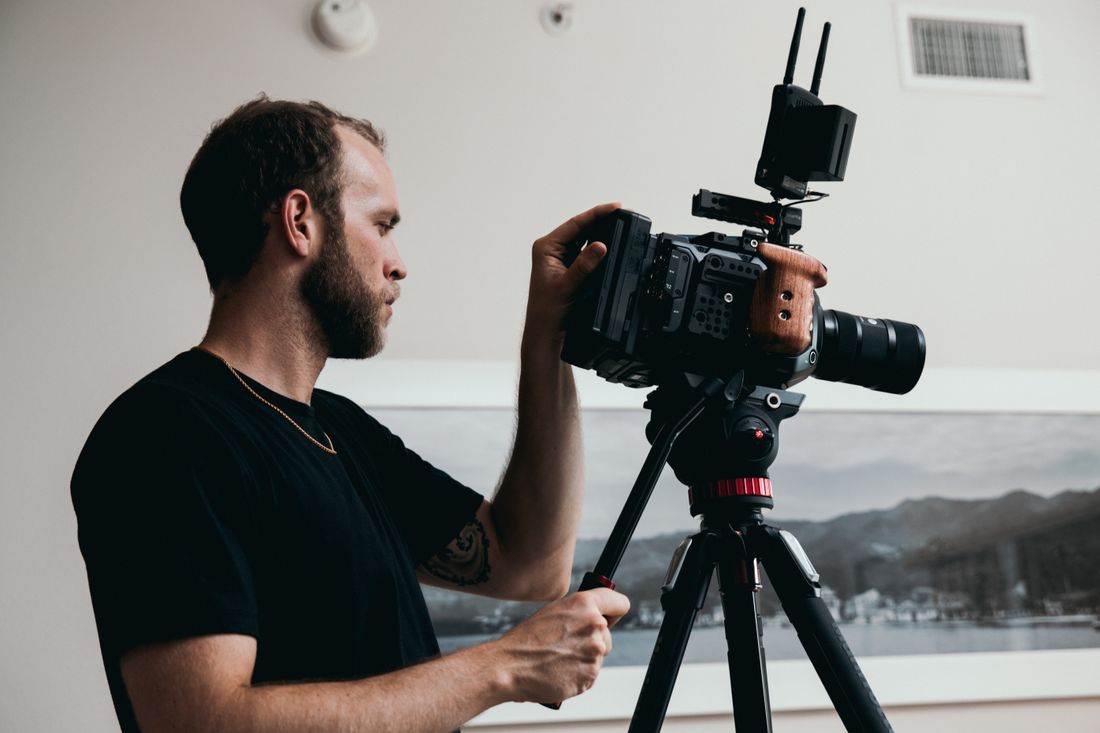
Photo by Kyle Loftus via Pexels.
What Are the Right Wardrobe and Setting Choices for This Kind of Subject?
Wardrobe and setting need to read as senior and credible, not as a startup founder in a hoodie on a couch. That usually means a suit or tailored jacket rather than casual layers, and a setting that reads as an actual place of business, an office, a conference room, a boardroom, rather than a styled lifestyle backdrop.
The instinct to soften a senior executive's look, unbutton the collar, swap the blazer for a sweater, borrowed from founder-brand video, usually works against the format here. The audience is a board or a recruiter evaluating gravitas as much as personality, and a look that undercuts that reads as miscalibration, not approachability. The subject should look already qualified for the room, not like they're auditioning for a different one.
Setting matters just as much as wardrobe. A generic conference room with no context reads as stock footage. The subject's actual office, a boardroom with real materials on the table, a hallway with signage blurred for privacy, all read as specific and true in a way a rented backdrop never does. The goal is a setting that could only belong to this person's working life, shot simply enough that it doesn't compete with the talking.
How Do You Get a Genuine Take Out of Someone Trained to Speak in Approved Language?
Getting a genuine take starts with not asking scripted questions and not letting the subject prepare a script of their own. Senior executives are trained by years of earnings calls and press interviews to answer in safe, approved language, and the fastest way to get that language on camera is to hand them a question in advance.
The better approach is a real conversation, not an interview in the formal sense: open questions asked in plain language, follow-ups that push past the first answer, and enough patience to let a pause sit instead of rescuing it. The first answer to most questions is the rehearsed one. The second or third answer, after a genuine follow-up, is usually the one worth keeping, because that's where the person stops performing and starts actually thinking out loud.
It also helps to ask about a specific decision, not a general philosophy. 'What do you believe about leadership' invites a talking point. 'Walk me through a call people pushed back on' invites a story, and stories read as genuine on camera. My job in the room is less director than interviewer, and the best two minutes usually come from questions that never made it into any brief.
What Does Shoot Day Actually Look Like for a Senior Executive with No Rehearsal?
Shoot day for a senior executive is usually ninety minutes, no rehearsal, and often squeezed between two other meetings, so the entire plan has to work within that window: a short setup conversation, then camera, then the interview itself, with almost no room for a false start or a reshoot.
That constraint shapes everything about how the session runs. Lighting and the camera setup need to be ready before the subject walks in, not built while they wait, because an executive standing around watching gear get adjusted starts the session in the wrong headspace. The first few minutes matter more than usual here: a short, unrecorded conversation about what the video is actually for, phrased honestly rather than as a pep talk, tends to produce a more relaxed subject once the camera starts rolling.
There's no do-over built into ninety minutes, which means the interview questions have to earn a real answer on the first real attempt, not build slowly toward one. In practice that means front-loading the most important question, the concrete-example one, rather than saving it for last in case time runs short. Everything else can flex. That one can't.
How Does One Production Session Turn Into a Video, Stills, and Short Cuts?
One well-planned session covers the bio video, a set of executive stills, and a handful of short cuts, because the same ninety minutes that produces usable interview footage also produces natural pauses and stills-ready moments, and the same footage that builds a two-minute video contains ten- and thirty-second segments worth cutting separately.
The stills come from breaks in the interview, not a separate posed portrait session bolted onto the end, though a short dedicated stills block at the start or end still helps. A subject who's already settled into the conversation photographs more naturally than one posing cold, and a few minutes built into the ninety covers headshots and a couple of environmental portraits without adding real time to the day.
The short cuts come out of the same edit as the full video, not a separate shoot. The concrete-example answer, on its own, often works as a short clip for a LinkedIn post announcing a board appointment or a speaking engagement. The point-of-view answer works the same way for a caption-driven post. None of this requires more camera time. It requires planning the interview and the edit with all three deliverables in mind from the start, not just the headline video.
Frequently Asked Questions
How long should an executive bio video actually be?
Two minutes is the practical ceiling for most board searches, recruiter reviews, and conference programming decisions, because that's roughly how long an unfamiliar name gets before attention moves to the next candidate in the stack. A tighter cut, closer to ninety seconds, still works if it holds one clear answer, one point of view, and one concrete example. Past two minutes, a video usually gets skimmed rather than watched, which defeats its purpose.
Does an executive bio video need scripted talking points?
No, and scripting usually hurts it. Executives trained on earnings calls and press interviews default to safe, approved language when handed questions in advance, which is the opposite of what makes this format useful. A real conversation with open questions and honest follow-ups produces answers that sound like actual thinking rather than rehearsed messaging, and that difference is usually visible to anyone evaluating the subject on camera.
Should a senior executive's bio video look like a startup founder's brand video?
No. Founder-brand video often works with a casual, approachable look, but a board search committee or recruiter is evaluating gravitas as much as personality. Wardrobe should read as a suit or tailored jacket rather than casual layers, and the setting should read as an actual place of business rather than a styled lifestyle backdrop. The subject should look already qualified for the room they're trying to get into.
How much time does a senior executive actually need to set aside?
In practice, plan for around ninety minutes with no rehearsal, often squeezed between other meetings. Lighting and camera setup should be ready before the executive arrives, and the interview should front-load the most important question in case time runs short. There's rarely room for a reshoot, so the plan has to work on the first real attempt rather than build slowly toward a usable answer.
Can one shoot produce more than just the bio video?
Yes. A well-planned ninety-minute session can also cover a set of executive stills, taken during natural breaks in the interview or a short dedicated block, plus several short cuts pulled from the same footage as the full video. A concrete-example answer often works on its own as a short clip for a LinkedIn post about a board appointment or speaking engagement, without any additional time on camera.
Related Reading
Planning headshots for a finance or wealth management team?
Tell us your team size and the tone you're going for, and we'll build a session that fits the credibility bar this industry actually needs.
See Headshots & Brand Videos