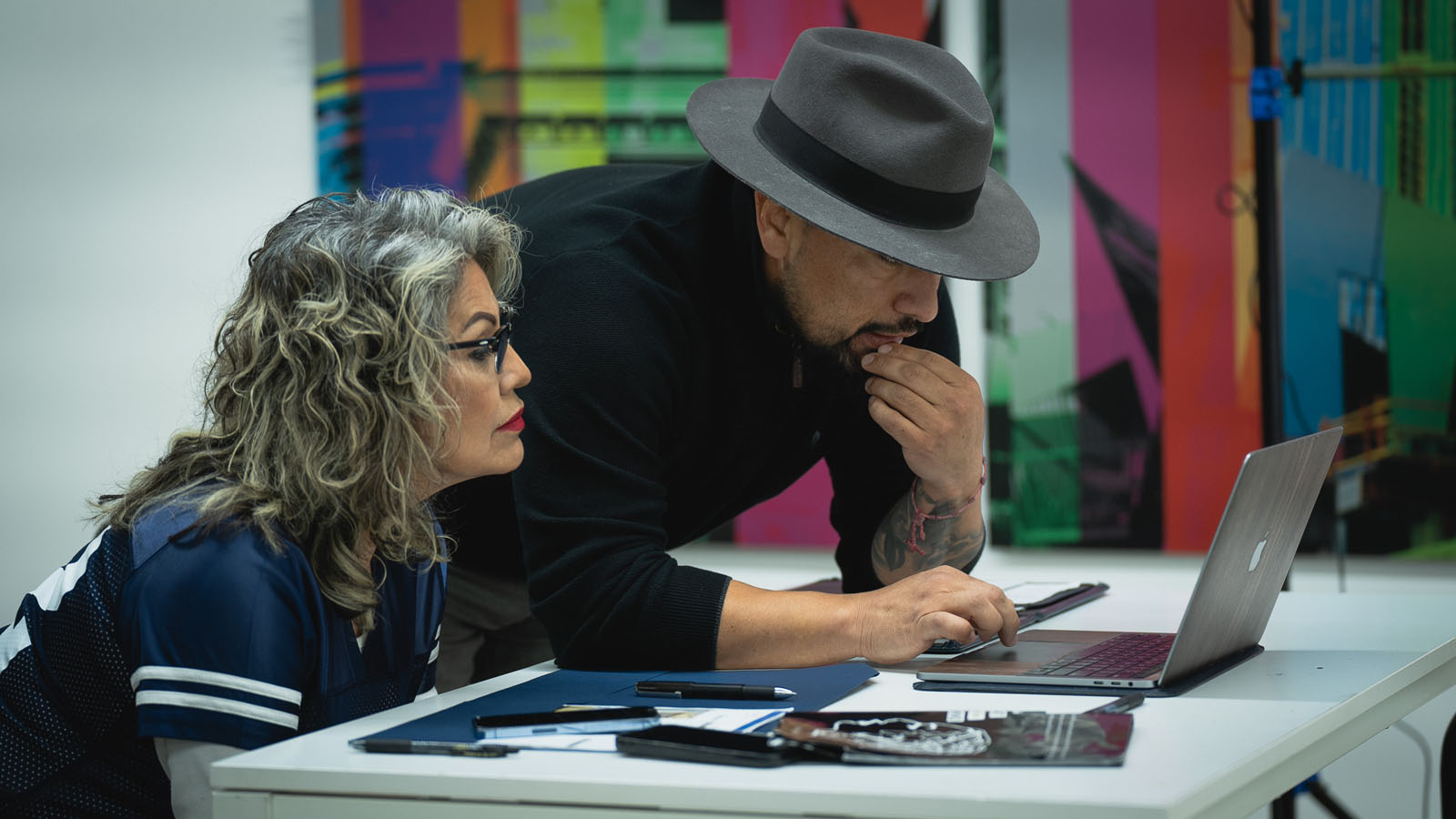
Photo: Core Visuals NYC
Two companies are launching one thing together, a product, a partnership, a collaboration, and both are still separate companies with their own comms teams tomorrow. That's a different visual problem than a single company's launch, because the camera has to answer to two approval chains instead of one. Neither brand can walk away from the shoot looking like the junior partner, and both sides need something they can actually run in their own channels. Getting that right takes a shot list built for two, not one, from the very first planning call.
A co-branded launch shoot needs a shot list both companies' approval chains sign off on before the day, staging that keeps two people or two logos visually level, and deliberate either-side variants so each company has a version leading with its own person. It also needs a clear conversation about who owns the resulting files and how each side can use them.
Table of Contents
- The Shot List Needs Two Approval Chains, Not One
- Staging That Keeps Both Sides Visually Level
- Why We Shoot Deliberate Either-Side Variants
- Asset Handoff and Usage Rights, Settled Before the Day
- The Timing Trap: One Company's Embargo, Not the Other's
- What a Co-Branded Launch Shoot Actually Covers
- When a Co-Branded Shoot Actually Runs Smoothly
- When Shared Photos Are Genuinely Plenty
The Shot List Needs Two Approval Chains, Not One
A co-branded launch shoot needs its shot list approved by both companies' comms or marketing teams before the day, not just the one team that happened to book the photographer. Skipping that step is the single most common way a joint shoot goes sideways.
A single-company launch usually has one internal reviewer who can wave a shot list through in an afternoon. A co-branded launch has two, and they don't automatically agree on what the day needs. One side might expect a product-focused set; the other might be picturing executive portraits. Sorting that out on the day, camera in hand, is the wrong time to discover the mismatch.
We ask for a shared shot list, reviewed by both sides, before we ever show up. It's an extra round of email that pays for itself the moment two comms teams are both happy with the same folder of files instead of arguing about what's missing from it.
That one round of shared review also surfaces disagreements while they're still cheap to fix, instead of on the day, when reshooting anything is no longer an option.
Staging That Keeps Both Sides Visually Level
Framing decisions in a co-branded shoot have to actively avoid making either company look secondary, since even small choices like who stands stage right or whose logo sits higher in frame get read as a signal by both sides.
That means paying attention to things a single-brand shoot never has to think about: equal eye-line height for two executives in a two-shot, logos sized and positioned so neither dominates a wide shot, seating that doesn't put one company's person in the visually dominant chair by accident. None of this is about creative preference. It's about not accidentally telling one company's audience that their side of the deal is smaller.
We build this into the actual staging plan, not just the final crop. A photo edited after the fact to "balance things out" reads as exactly that once someone compares it to the raw frame, so we'd rather get the physical staging right on the day, before a single frame gets captured.
Why We Shoot Deliberate Either-Side Variants
An either-side variant is a version of the same moment shot so each company has a frame that leads with its own person or product, and a co-branded launch needs both versions, not one shared image both sides are asked to use identically.
Company A's own channels want a photo where their executive is the visual anchor; Company B wants the same for theirs. A single frame optimized for total parity often ends up looking flat for both sides' individual use, even if it works fine for a joint press release. Shooting the moment twice, once favoring each side's framing, solves that without asking either company to run an image that quietly centers their partner instead of them.
This takes a few extra minutes on the day, not a second shoot. We plan for it explicitly in the shot list, right next to the shared "both companies together" frame that the actual joint announcement will use, so nobody's improvising it on the spot once everyone's already standing there waiting.
Asset Handoff and Usage Rights, Settled Before the Day
When two companies share one set of photos or video from a joint shoot, both sides need a clear answer to a simple question before the shoot happens: can each company use every file, or only the ones featuring their own people and product.
This isn't a legal question we're positioned to answer for a client. It's a planning question worth raising early, because the answer changes what actually needs to get shot. If both companies can use the full set freely, the either-side variants matter less. If usage is split by who appears in the frame, those variants become the whole point of the day.
We ask both companies to confirm this before the shoot, not after delivery, when someone's already trying to post a photo their partner never agreed they could use. A quick answer here avoids a much slower conversation later, one that involves lawyers instead of photographers, over a problem that a single early email would have prevented.

The Timing Trap: One Company's Embargo, Not the Other's
A joint launch runs on two companies' publishing calendars at once, and it's common for one side's internal embargo or approval timeline to run longer than the other's, which can leave one company ready to post before its partner is.
This isn't a photography problem exactly, but it becomes one fast: if the shoot's deliverables land in one company's hands before the other's sign-off catches up, there's real pressure for someone to post early and break the shared announcement moment. We've seen this timing gap catch companies off guard simply because nobody asked about it during shoot planning.
We ask both companies for their expected go-live windows as part of scheduling, not as an afterthought. It's a five-minute question during the planning call, and it's the kind of gap that's much easier to catch before delivery than to explain after one side jumps the gun on a launch date the other side wasn't ready for. Nobody wants to be the company that broke the joint moment by accident.
What a Co-Branded Launch Shoot Actually Covers
A typical co-branded launch shoot covers a small, deliberate set: the shared announcement moment itself, individual portraits of the key people from each side, product or deliverable shots if there's a physical thing being launched, and any signing or handshake moment if the partnership includes one.
That's a narrower list than it might sound. We're not trying to document an entire event; we're building the specific frames both companies' comms teams will actually need in the following weeks, for a press release, a joint blog post, LinkedIn announcements from both sides, and whatever internal recap each company circulates.
Keeping the list narrow and specific is part of what makes the two-approval-chain process manageable. A shot list with twelve categories is hard for two teams to agree on quickly. A shot list with four is something both sides can sign off on the same day, which is usually the point where planning stops feeling slow and the actual shoot date starts feeling real.
When a Co-Branded Shoot Actually Runs Smoothly
The smoothest co-branded shoots are the ones where one company clearly owns coordination, even though both sides approve the shot list. Someone still has to be the single point of contact collecting sign-off from both comms teams and relaying it back.
Without that, questions bounce between two organizations and stall, since neither side wants to make a call that affects the other company's brand unilaterally. With one coordinator, even an informal one, decisions move faster because there's a clear path for questions to travel and come back with an answer.
We ask early in the planning process which company is playing that role for this launch, partly so we know who to loop in when a staging or usage question comes up mid-shoot. It's a small logistics detail, but it's the difference between a shoot that keeps moving and one that stalls waiting on an email neither company got around to sending, on a day where every stalled minute is one both crews are paying for.
When Shared Photos Are Genuinely Plenty
Not every joint announcement needs the full either-side, dual-approval treatment. A smaller collaboration, two founders posting about a modest integration or a limited-run partnership, is often fine with one shared set of photos both sides use as-is.
The either-side variant approach earns its complexity when there's real visual parity at stake, senior executives, a formal signing, two brands genuinely equal in size or stakes in the deal. A lighter partnership between two small teams doesn't usually carry that same pressure, and asking for two approval chains and doubled shot variants on a low-stakes announcement can slow things down for no real benefit.
The honest question worth asking early is how much either company's audience is actually going to scrutinize the visual framing. If the answer is "not much," one well-planned shared set covers the launch just fine, and everyone can skip the extra planning overhead a bigger co-branded moment would actually need, and put that time back into the actual partnership instead.
Frequently Asked Questions
What makes a co-branded launch shoot different from a single company's launch shoot?
A co-branded launch answers to two approval chains instead of one, which changes the planning process more than the actual shoot day. The shot list needs sign-off from both companies' comms teams before the day, staging decisions have to keep both sides visually level, and usage rights for the resulting files need to be settled upfront since two separate companies will be using the same set of images.
What's an either-side variant in a co-branded photo shoot?
It's a version of the same moment shot twice, once framed so Company A's executive or product is the visual anchor, and again so Company B's is. Each company gets a frame that leads with its own side for their individual channels, alongside a shared frame both sides use together for the joint announcement itself. It takes a few extra minutes on the day, not a separate shoot.
Who owns the photos from a co-branded launch, and can both companies use them?
That's a usage-rights question the two companies need to answer before the shoot, not after delivery. Some joint launches agree both sides can use every file freely; others split usage by who actually appears in a given frame. We ask this early because the answer changes what needs shooting: split usage makes either-side variants the actual point of the day, not an afterthought added once someone asks whether they can post a photo their partner is standing in.
Why does an embargo timing mismatch matter for a co-branded launch shoot?
Two companies rarely run identical internal approval timelines, so one side is sometimes ready to publish before the other's sign-off has caught up. If shoot deliverables land with one company well before the other, there's real pressure for someone to post early and break the shared announcement moment. Asking both sides for their expected go-live window during scheduling, before the shoot day, catches this kind of gap while it's still easy to fix.
Does every co-branded announcement need a full two-company shoot plan?
No. A smaller collaboration between two modest-sized teams is often fine with one shared set of photos both sides use as-is, without dual approval chains or either-side variants. That extra structure earns its cost when real visual parity is at stake: senior executives, a formal signing, two evenly matched brands. For a lower-stakes partnership, one well-planned shared set usually covers the launch without the added coordination.
Related Reading
Working on founder content or a launch and not sure what to shoot?
Tell us where the content needs to live (site, LinkedIn, press, or a launch page) and we'll come back with the scope and a fixed price before anything gets booked.
See Personal Branding & Launches