
Photo: Core Visuals NYC
A data center or cloud infrastructure company sells reliability to buyers who almost never meet the people behind it. The buyer evaluating a vendor isn't asking whether the founder has a compelling vision. They're asking whether the operations team will actually be there at three in the morning when something breaks, and whether the security lead can answer for the audit. That question doesn't get answered by another photo of a server aisle or a rack of blinking lights. It gets answered, in part, by a handful of honest, steady portraits of the actual people running the operation, shot in a register that matches what the buyer is actually shopping for: calm, credible, unglamorous competence, not a vision statement with a headshot attached to it.
Data center and cloud infrastructure headshots need a steady, unglamorous register, not a startup's energy: calm poses, plain dark wardrobe, and a neutral background. Coverage should include the operations and security leads a buyer's diligence process actually asks about, not just the CEO, and facility interior shots should support those portraits rather than replace them.
Table of Contents
- Why an Industry Built on Servers Still Needs Faces
- Who Actually Needs to Be Photographed, Not Just the CEO
- The Register: Steady, Not Visionary
- Wardrobe and Background Choices That Read as Reliable
- The Facility Interior Is a Supporting Image, Not a Substitute for Faces
- Security and NDA Constraints of Shooting Near a Live Facility
- Where These Photos Actually Get Used
- Planning the Shoot Day Around Access, Not Just Availability
Why an Industry Built on Servers Still Needs Faces
A data center or cloud infrastructure company sells something a buyer can't see: uptime, security posture, and whether a team will actually answer at three in the morning when something breaks. Photography can't prove that, but it can put a real, credible person behind the promise, better than a stock photo of a server aisle and nothing else.
Enterprise IT buyers rarely tour the facility before signing a contract, and they almost never meet the engineers who'll be on call once they do. A website built entirely around equipment photography and architecture diagrams reads like it's hiding the people behind the service, intentionally or not. A handful of honest portraits of the actual operations and security leads does more to signal a real, accountable team than another server-aisle photo ever will.
This is a different job than most corporate headshot work, which usually leans toward energy or approachability. Here the photography has one quieter task: make the buyer believe there's a specific, competent person on the other end of the contract, not a logo and a phone number.
Who Actually Needs to Be Photographed, Not Just the CEO
A CEO headshot alone doesn't answer the questions an enterprise buyer's diligence process actually asks. Those questions go to the VP of operations, the head of security, the person who owns the incident response process, the names that show up in a security questionnaire or an SOC 2 conversation long before anyone reads the founder's bio.
I plan these shoots around that reality: the operations lead who can speak to uptime and maintenance windows, the security or compliance lead who owns the audit relationship, sometimes a site or facilities manager if the company positions its physical infrastructure as a differentiator. A leadership page with only a CEO and a generic sales headshot undersells a company whose actual credibility sits with people a buyer's procurement team will eventually want to see, or at least verify are real. That short list is worth confirming with whoever runs sales engineering, since they know exactly which names come up in a vendor call before anyone else on the team does.
The Register: Steady, Not Visionary
A consumer tech startup headshot often reaches for energy, a founder mid-gesture, a bright accent wall, something that signals momentum. That register works against a data center or cloud infrastructure company, where the buyer isn't looking for excitement. They're looking for evidence that nothing dramatic is going to happen on their watch.
The right tone is closer to a utility company or a bank than a consumer app: calm, direct, a little understated. Straight-on or near-straight poses read better than an animated three-quarter turn. A neutral, composed expression reads as more credible here than a wide smile, not because warmth is unwelcome but because the buyer's actual question is reliability, not likability. I brief every session around that register before a single frame gets shot, since it's easier to hold a tone from the start than to fix an overly casual set of portraits afterward. A slightly relaxed smile still works. What doesn't work is anything that reads as performed enthusiasm.
Wardrobe and Background Choices That Read as Reliable
Wardrobe for this register sits between a blazer and a hoodie: a plain dark shirt, a quarter-zip, a button-down without a loud pattern. Nothing that reads as either overdressed for an operations team or too casual for a page a security auditor might click through during a vendor review.
Solid colors photograph more predictably than a busy print, and they age better across the two or three years a headshot typically stays live on a site. Backgrounds matter just as much as wardrobe. A clean, neutral wall or a softly blurred office interior works better than a facility floor for the actual portrait, since equipment behind a face competes with it rather than supporting it. I keep the background consistent across every subject on a team page, same wall, same light, same crop, so a buyer scanning six or eight leadership photos reads them as one coherent team rather than headshots collected from six different photo sessions spread out over three or four years.
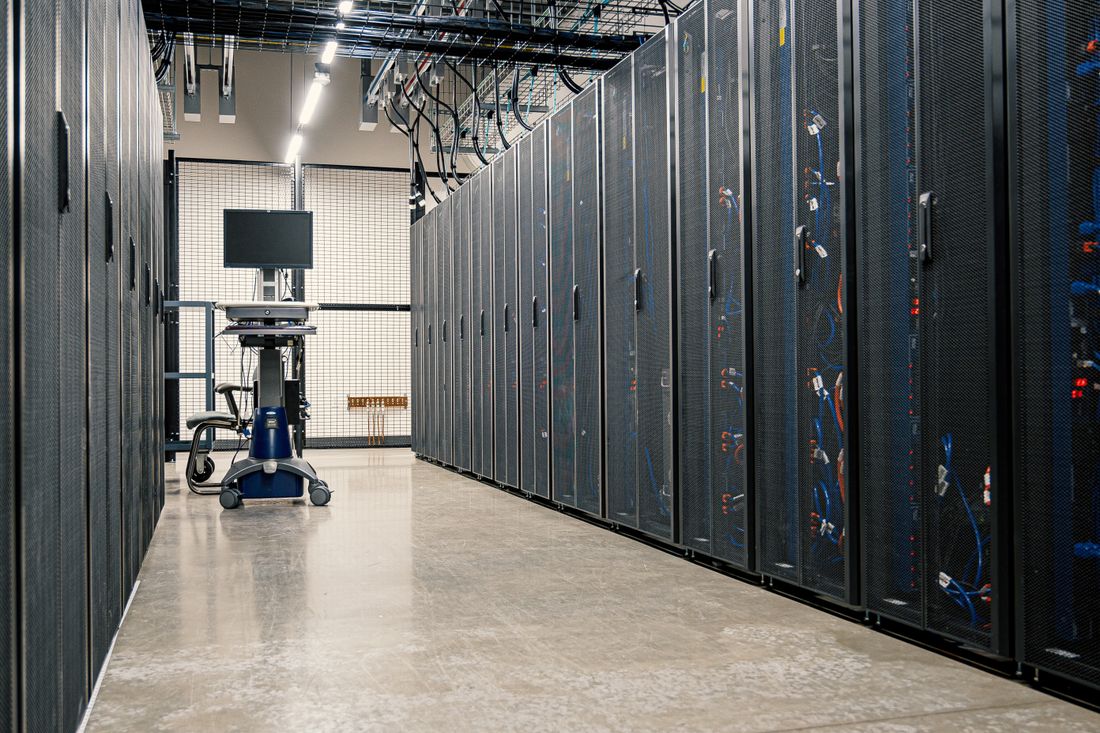
Photo by Brett Sayles via Pexels.
The Facility Interior Is a Supporting Image, Not a Substitute for Faces
A wide shot down a server aisle is a legitimate, useful image, it signals scale and a real operation behind the marketing. But it works as a supporting image next to real portraits, not a replacement for them. A site built entirely on equipment photography with no faces reads as a company that would rather not be looked at directly.
The strongest version of a trust page pairs both: a small set of facility images establishing that the physical infrastructure is real, alongside portraits of the people a buyer would actually deal with during onboarding or an incident. I treat the facility shot as the establishing image, the one that runs at the top of a page or in a hero slot, and the portraits as the substance underneath it. Neither one does the other's job. A page with ten rack photos and zero faces reads as evasive no matter how impressive the equipment actually is, and most buyers notice the absence even if they can't name what's missing.
Security and NDA Constraints of Shooting Near a Live Facility
Shooting anywhere near a live data center floor usually comes with real constraints: an NDA before anyone brings a camera past the lobby, a facilities or security escort for the entire visit, and a list of angles that are simply off-limits, rack labels, badge readers, anything that reveals a layout a security team doesn't want documented.
I ask for that list before the shoot day, not during it, since finding out mid-session that an entire wall is off-limits wastes time everyone in the room is already tight on. Portrait sessions are usually easier to place, a conference room, a lobby, an office adjacent to the floor, since none of that requires clearance to photograph. The facility interior shots are the ones that need the escort and the pre-cleared angle list, and it's worth confirming both well before the crew shows up with equipment. None of this is a legal opinion, just a practical planning step worth raising early with whoever manages site security.
Where These Photos Actually Get Used
Data center and cloud infrastructure headshots mostly serve a trust page, a leadership or team page, and the LinkedIn profiles of the operations and security leads a buyer's procurement team is likely to search for by name during diligence. They rarely anchor a splashy marketing campaign the way a consumer product launch might.
That changes what's worth prioritizing, and it's a shorter list than a typical brand photography plan. A current, professional photo attached to the name in a security questionnaire or an RFP response matters more here than a wide variety of lifestyle shots. Sales and business development leads benefit from the same register on their own LinkedIn profiles, since a prospect googling a rep before a call finds the same calm, credible tone the company presents everywhere else. Consistency across those individual profiles matters as much as any single portrait, and it's worth updating them together rather than one at a time as people happen to ask for a new photo.
Planning the Shoot Day Around Access, Not Just Availability
Scheduling a shoot for a data center or cloud infrastructure company usually means planning around facility access and security clearance first, calendars second. An operations lead who's easy to book for a Tuesday afternoon might still need two weeks to clear a photographer for the floor, and that timeline needs to drive the schedule, not the other way around.
I ask early who owns facility access approval, separately from whoever owns the marketing budget or the shoot itself, since those are often different people on different timelines with different priorities. Portraits can usually happen with minimal lead time in a conference room or office space. The facility shots are the long pole, and treating them that way from the first planning call avoids a shoot day where half the plan is ready and the other half is still waiting on a security sign-off that should have started weeks earlier, before the crew was booked and the shoot-day calendar was ever locked in place.
Frequently Asked Questions
Who should be photographed at a data center or cloud infrastructure company?
More than just the CEO. Enterprise buyers doing diligence usually want to see the operations lead who can speak to uptime and maintenance, and the security or compliance lead who owns the audit relationship. Those are the names that come up in a security questionnaire or a vendor call, not the founder's bio. A leadership page with only an executive photo and a generic sales headshot undersells the team a buyer will actually deal with day to day.
What should headshots for this industry look like compared to a tech startup?
Steadier and more understated. A startup headshot often reaches for energy and momentum, an animated pose, a bright wall. That register works against a company selling reliability, where the buyer wants evidence nothing dramatic will happen on their watch. A calm, direct, near-straight portrait with a plain dark shirt and a neutral background reads as more credible here than a wide smile or a casual, high-energy pose.
Can facility interior photos replace individual headshots on a trust page?
No. A wide shot down a server aisle signals scale and a real physical operation, and it's a legitimate supporting image, but a page built entirely on equipment photography with no faces reads as evasive. The strongest trust pages pair a small set of facility images with real portraits of the operations and security people a buyer would actually deal with, treating the facility shot as an establishing image rather than a substitute for the team.
What security constraints come with shooting near a live data center floor?
Usually an NDA before a camera goes past the lobby, a security escort for the visit, and a list of angles that are off-limits, rack labels, badge readers, anything revealing a layout the security team doesn't want documented. It's worth getting that list before the shoot day, not during it. Portrait sessions are easier to place in a conference room or lobby, since they don't need the same clearance the facility shots require.
How far in advance should a data center company book headshot photography?
Earlier than the portraits themselves usually require, because facility access approval is often the longer lead time, sometimes two weeks or more, and it's typically owned by someone different from whoever books the shoot. Portraits in a conference room or office need little lead time. The facility interior shots are the long pole, and confirming that approval early avoids a shoot day where half the plan is ready and the rest is stuck waiting on security sign-off.
Related Reading
Booking headshots or a brand video for your team?
Tell us how many people and whether you need photo, video, or both, and we'll send back a fixed price with the volume discount already applied.
See Headshots & Brand Videos